Log in
EN
FR

Guitar Amp Simulation Pedals

178 products found

Filter
Sort by
Evaluation
  • Reviewed or not
  • Editor’s award
  • Reviewed by Audiofanzine
Availability
  • Available or not
  • Sold new or used
  • Sold new
  • Sold used
Must-have products
  • All products
  • Flagship products
  • Best rated products
  • Hot products
  • Popular products
Price
  • Freeware
  • Low-cost (< $150)
  • Mid-range ($150 - $300)
  • Premium (> $300)
€
Clear
Sort by
  • Popularity
  • User ratings
  • Price - low to high
  • Price - high to low
  • Used price, increasing
  • Used price, decreasing
  • Name (from A to Z)
  • Name (from Z to A)
  • Added on
Sort results
  • Popularity
  • User ratings
  • Price - low to high
  • Price - high to low
  • Used price, increasing
  • Used price, decreasing
  • Name (from A to Z)
  • Name (from Z to A)
  • Added on
Filter results 178 results found
Evaluation
Availability
Must-have products
Price
  • Freeware
  • Low-cost (< $150)
  • Mid-range ($150 - $300)
  • Premium (> $300)
Show results

The best Guitar Amp Simulation Pedals reviews

The reviews Audiofanzine members found the most helpful.
  • « Swiss army knife for musicians »

    The Sans Amp Para Driver DI by Tech 21 is probably one of the most overlooked but intuitively usefull tools every musician should own. Built primararly to be a Direct Interface, which it does well, it goes well beyond the scope of any normal DI box. This is an analog DI that can be powered by a nine volt battery, an AC adapter, or by phantom power. It offers one quarter inch input, a quarter inch parallel uneffected output, one quarter inch effected output, and one effected XLR output. There is one true bypass footswitch on the pedal. There are six large knobs that control level, treble, mid, mid shift, bass, drive, and 1 mini knob to controll the blend of the Sans Amp simulator. In addition to this there are three switches, two that controll the output level between line and instrument level on the two effected outputs and a third to select phantom power and a ground connect switch. UTILIZATION Unlike many pedal manuals Tech 21 sends a very informative guide to the operation of the pedal and its many components. Along with that there are many examples of setups provided for use with guitar, both acoustic and electric, bass, keyboard, and more. This pedal truely is useful across the range of amplified instruments. The use of this pedal is very straight forward but does require some experimentation to gett the feel of it. The controls are extremely interactive which allow for drastic changes with minimal adjustments. It can be made to not sound the way you want if you treat it as a general tone shaping device as the knobs require a high level of familiarity, similar to the way you would dial in a Mesa Boogie Recto. It is not a deficiency of the unit but a testament of how powerful the shaping qualities can be. SOUND QUALITY This unit is a transparent or as colored as you needit to be. The reason it is so adept to working across various instruments is it versitility. If you simply need a colorless DI to the board it has it covered. If your a bass player and want to take just your instrument to a house of worship to play it can send a convincing Ampeg sound to the board. It works wonders to eliminatethe unwanted parts of piezo pickups and really anything you need it to do. It also is indespensible for use in a home studio. If you are using an amp for feel and are recording it the parallel though is indispensible for preserving a quality DI track for future reamping if needed. OVERALL OPINION This unit is a perfect solution to many problems any musician can face in any situation. There are no flaws I can see in this design. I believe this piece is worth every penny and I only wish I had owned it since the day it was built. It operated phenominaly in any situation as long as the user takes some time to know what they actualy own in this piece. I have seen and used a few other DI boxes in the past but none can compare to the toolbox nature of this unit. I would buy it again if anything happened to it but it is built very well. I do not forsee me breaking it anytime in the future. The only regret I have is the fact I never thought much of it before I actually went and tried one. I wish it had been with me since day one.

  • « The most sounds in one pedal, period. »

    The POD X3 is an amp sim/multi-effects pedal from Line 6. It uses all digital signal processing. Getting started is as easy as plugging in your guitar and headphones, then stepping on the foot-switches to jump between presets. The software application for the POD X3 has always given me problems. I think there are some 'bugs' in the way it downloads the presents to the foot pedal. Normally, I recommend using a software editor with a GUI. However, with the problems, I find it easier just to tweak the knobs on the pedal whenever I want to make changes. UTILIZATION There is a learning curve when starting out with the POD X3. There are tons and tons of options to edit the internal processing like: amp EQ, speaker models, microphones, effects pedals, parallel signal chains, etc. This requires scrolling through a lot of menus when looking at the screen on the pedal. It can take a while to figure out how to get to the right place to edit what you want. After you figure this out, this pedal is capable of a ridiculous amount of different sounds. SOUND QUALITY Amp simulation isn't perfect. The Line 6 X3 sounds convincing, especially if it is in the context of a full band. Still, it only gets the guitar player most of the way to the experience of playing through a real amp. To me, the best use of these kinds of effects pedals is in the studio to experiment with a ton of different sounds without having to completely change your setup. If you play live in a cover band, it might be useful to be able to switch between a lot of different sounds as well. OVERALL OPINION Although Line 6 has released a new line of PODs (the HD series), the POD X3 still has some useful aspects. I really the Matchless, Orange, Budda, etc. amp sims in the X3, but they are missing in the HD series. Hopefully, Line 6 updates the firmware of the HD series in the future with more amp models. Until then, the X3 has the most number of different amp simulations, well over +100. This alone should attract the true tweakheads.

  • « Cheapest POD HD model »

    The HD300 is the lowest model in the Pod HD line. Even though it is the lowest model in the line it still has the exact same models that the higher end models have. The only differents is the user interface. This lack of user interface makes it a bit harder to use than the HD500. With the 300 and 400 you pretty much need to connect it to your computer and use the patch editor to make any decent patches. It comes with all of Line 6's HD amp models which there are now 22 of. When you first get the unit there are 16 models. This is a lot less than the 80 or so amps the Pod X3 came with but these amps are modeled in much more detail than those. If you are wondering if you should get this instead of the X3 just think quality vs quantity. The X3 can sound just as good but it will require much more tweaking and skill in your patch making. UTILIZATION Utilization is the weakest part of the 300 for me. For something this complex they really do not have that many controls. There is an unlabled 3 way mode switch which switches from amp mode to looper mode to patch mode. You will have to learn what each color indicates. These modes change the fuction of the buttons on the bottom face of the amp. There are dedicated amp eq controls and dedicated effects controls. There is a large expression pedal that can be switched from a wah to a volume pedal. There are plenty of outputs on the back, anything you would need for working in the studio. There is no on or off switch like on the XT you just plug it in which is kind of unnerving. SOUND QUALITY With only a fraction of the models of the outgoing POD units the detail in the modeling of these units is much better. It is easy to get a good raw amp sound from this unit. Me being a mostly heavy music player the low number of high gain amps is kind of disappointing but the models it has are good. The amp has all the classic amps modeled in it. The models I find myself using the most are the JCM 800, Bogner Uberschall, Mesa Dual Rectifier and ENGL Fireball. It has several old Fender blues amps. I just wish it had a Roland Jazz Chorus or something with a really pure clean sound. The amp models sound good but you pretty much have to use the computer based patch editor to make up the patches. The user interface on the unit is too cluttered and the tiny LED screen doesnt help as much. The big screens on the X3 and the HD500 are much better for creating more detailed patches on the unit. OVERALL OPINION If you are looking for a cheap way to have a good sound this is a good unit. It can be used lived with a PA or power amp and it is also great for just home studio stuff. Your first few days with it will be the toughest as you learn what all the functions do and make all your favorite sounding patches. With the 400 and 300 you pretty much have to use the computer based editor to make the patches because the screen on the unit is too small and awkward to use. If you just want the HD amp models and can edit everything on the computer there is really no point in getting the more expensive models because the amp models are exactly the same throughout the line.

  • « Boss and Fender »

    This pedal is a team-up between Fender and Boss to create a pedal that closely resembles the tone of a vintage Fender 1959 Bassman. This pedal is a cool little device for trying to recreate those vintage tone that have now become infamous in rock and roll history. This pedal was unique in a few ways. Normally Boss would silk screen the pedal name and model on the front of the pedal. On this pedal you had a glued on sticker that said Fender Bassman Boss FBM-1. You also had a textured finish on the casing of the pedal where as all Boss pedal are painted. What is also different with this pedal unlike any Fender Bassman is the gain control. The original Fender Bassman never had a gain control. So this is a modern take in a compact Boss pedal of the original Fender Bassman in a amp simulation circuit. UTILIZATION Specifications Controls: Level, Gain, Treble, Middle Bass, Presence Connectors: Input, Bright In, Output, AC Adaptor Current Draw: 36 mA (DC 9V) Weight: 440 g (1 lb.) Nominal Input Level: -20dBu Input Impedance: 1MOhm Nominal Output Level: -20dBu Output Impedance: 2.2kOhm Recommended Load Impedance: 10kOhm or greater Recommended AC Adaptor: PSA Series SOUND QUALITY This pedal uses COSM technology which is a modeling based circuitry. That is all I know about ti. The pedal does have a Fender bassman quality but to the Fender bassman get most of its charm and character from the power tube interacting with the preamp tube section. The tone of the Bassman is a clean tone that has a good punch and drive and so it is understanding that Marshall would get their first design concept from this circuitry and amp. The pedal has some good tonal qualities and a good overall smooth distortion and drive. it cannot be capable of the real tube amp tough but it is a cool pedal nonetheless. OVERALL OPINION At new these pedals come in right around $119, which isn't bad for this pedal. It is an inexpensive way t get that famous tone as a close as you can without spending the money on a real amp. I have seen real Fender bassman's go for well under $800 so I would save up and buy one of those instead of this pedal. If you need something now then this is a good way to try it out.

  • iamqman's review

    I have never been a fan of distortion pedals. They come of unnatural and never really nailing the tone to which most of them claim on their box. They have a natural tinty sound that comes off as bright and thin and not very pleasing to the ears. This pedal was a bit of a surprise to me. These character series pedals from Tech 21 has been a bit of a hit or miss. Some have been decent sounding and very usable and others have not sounded very good at all. This pedal is going for the 70's Marshall tones from plexi's to bluesbreakers to the all out high gain stacks . I have to say that did a pretty good job for a pedal. UTILIZATION Tech 21 SansAmp Character Series British V2 Overdrive/Distortion Pedal Features: Authentic-sounding, tough tones, from Bluesbreaker to Plexi to '70s stack Six level-, tone-, and drive-shaping controls (Level, Mid, Character, Drive, Low, and High knobs) Switchable speaker emulation Use as a stompbox, preamp, or standalone recording tool Proven SansAmp quality and reliability SOUND QUALITY I was a little apprehensive before hearing this pedal because I am just not a fan of the the distortion boxes. When I heard this pedal kick it I was pleasantly surprise at how good this pedal was. Sure it was going to have the feel or the real tone of a bluesbreaker or a plexi but the voicing was right on and the drive of the pedal worked well with a clean amp. This pedal does a decent job at recreating the Marshall tones from those old 70's records. You can hear the character knob changing the voicing structure of those amps from the plexi's to the stack Marshal's and such. That character control is a cool little feature that allows more options to be had in this little pedal. OVERALL OPINION At new these pedals come in at around $169. Not a bad price for this pedal. Is does have a very usable tone and the option you get if you are a Marshall fan are fantastic. I would recommend this pedal to anyone with a clean amp and wants to get a decent Marshall tone and doesn't want to spend a whole lot of money to get there. You get a good pedal for well under $200 and the pedal works great going directly into your computer using the speaker simulator.

  • Audiofanzine FR's review

    Originally written by Lenoir on Audiofanzine FR. You get everything you need in a compact footboard housing. Everything is very basic and plug and play. Guitar, X V-amp, phones/amp/hifi system and that's it. UTILIZATION Very easy to use if you read the manual. Editing sounds is not as easy and fast as with several dedicated stompboxes, but you can get a good result if you take the time. And unlike a pedalboard, you don't lose your settings unintentionally! SOUND QUALITY Good effects, considering the price. Especially the reverb, modulation and pitch effects. Of course, the simulations are not very faithful but they do sound similar... From clean to high gain over crunch, you get everything. There is a one second latency (no signal) when you recall another simulation. The problem can be easily solved by creating two presets using the same amp but different gain settings. And who changes the amp during a song? OVERALL OPINION I've been using it for one year. I'm very satisfied. The things I like most: + Value for money More than unbeatable: incredible... + Endless possibilities Spend enough time with the device and you'll be able to do anything. + The gain/volume/expression pedal. The things I like least: - Construction quality. Don't get too wild with it! - One-second signal drop-off when you change simulations (can be easily solved). If it gets broken tomorrow, I would buy it again. You can certainly find better products (from Line6, for example) but they are much more expensive.

  • « Pure Fender Sounds in a Pedal - Authentic! »

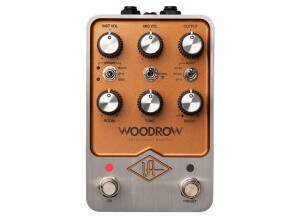
    I supposed I could joke about how this is a guitarist’s ‘Wet Dream,’ but the name Dream ’65 will suffice. Emulated from select 1965 Fender Super Reverb amps, as well as select speaker emulations, UA got as close as possible to a real amp that I have heard. And that goes for their Woodrow (Tweed) and Ruby (AC30) counterparts. I will address a few details, although they are demonstrated in the accompanying video, but first the basics. Think of Dream ’65 as a Fender Super Reverb amp, with stereo ins and outs. You have access to six select Speakers (imagine six cabinets), each providing a different tone/sound, and three Amp Modifications (Boosts), and with built-in Vibrato & Spring Reverb. On that note, both the Vibrato and Reverb sound spectacular. Some may argue the reverb is not quite as good as a real tank, but this is very close. The Vibrato has a very natural and organic flow to it. This amp has the basic functions, including Volume, Output, Reverb, Bass & Treble (the Treble and Boost double as Vibrato rate and intensity respectively) and an on/off switch. It also has a Pre-set switch, so that you can save a favorite sound and switch back-and-forth with a different knob setting, viz., a two-channel amp. Of course, add a distortion, fuzz or OD to the front end and you have three unique sounds… clean… crunch… lead. You certainly can get away with just the Dream ‘65 and its internal mods when playing lead, but for those who want a more modern and higher-gain sound, then a front-end pedal may be required. Here is the tricky or ‘adjustment’ part of the amp. One of the mods or Boosts is based on the Stevie Ray Vaughan sound, and it is great! However, you cannot apply Vibrato IF you use that mod. I thought it would be ideal if this could be achieved, since SRV is known for combining a Super Verb with Vibroverb. Regardless, there is a toggle switch that allows you to switch between Amp and Alt (Vibrato function), and that switch also serves to save the Preset. If you select the SRV mod, then Vibrato automatically shuts off. If you select the other two mods, then you will hear the Vibrato IF you set it (you can switch back to the Bass & Treble controls, but Vibrato remains UNTIL you flip the toggle to ALT and reduce both Vibrato rate & intensity to zero). And if using those other two mods, and you do not hear any vibrato, then you must flip to Alt and set the Vibrato (and while setting it, Bass/Treble do not work). The video will clarify this and it is not as complicated as it may sound. While in the ALT mode, the Bass knob also doubles as a Room function, which adds studio atmosphere or room ambience to the sound, making it more realistic to the ears. This is a great tool for clean or slightly dirty tones. The other two modifications or Boosts are Lead (‘80s OD) and Stock (clean preamp boost). The latter says it all, and you do not hear much compression or saturation with this one. The Lead mod sings best with its level past noon, and provides a less beefy OD than the SRV mod – however, the Lead mod is smoother and ideal for a lead that sings rather than screams. As mentioned, there are six speaker types, all of which are very useful (completely different results and tones). These match up so well with different guitars in my studio that I do not see the need for different speakers. But just like the Woodrow and Ruby, Dream ’65 allows you to bypass the internal speakers and go direct to a preferred IR. Overall, if you are into amp modeling or emulation, all three UA pedals have surpassed the competition – although I am basing this on my ears, and this also is the reason why I now have all three in my studio as my primary amps. I do have other amps, including tube and solid state, and I enjoy them, but the sound, size and simplicity of these pedals have caused me to leave the digital modeling world, insofar as amps are concerned. What I find modeling lacks is in producing authentic feel or sound quality (although very decent over the past 3-4 years), but also the simplicity of an amp, with dozens of things that could be tweaked, to the point that you get ear fatigue and it is difficult to dial into a great tone as easily. Now, before lambasts me about not liking digital modeling, I do realize that a quality IR makes all the difference, but I have not delved too deep into that realm. Any time I do use modeling for some high-gain tones, it is with a third-party IR, and yes, they make a significant difference. Dream ’65 does require a 400mA power supply (most bricks can handle this), and it does not have MIDI or an FX Loop. That may turn off some people, but this is emulated from 1965 amps, and that is what you are getting. On the plus side, it is an excellent pedal platform, since it is so clean (or can be set slightly breaking up to play well with high-gain gear), and it can become a secondary amp via a 4-cable method. If you have a regular AC30 or Marshall, for example, you now can have Fender Super Reverb sounds. What would I change about the Dream ’65? First, I would like to have the Vibrato function work with the SRV modification, which I think is most obvious to me. Second, I like the two-tone look of the Woodrow and Ruby (brushed aluminum framing with a color in the center). I think the Dream would look as spiffy if it were not all black and had that aluminum framing. Regardless, I am not that finicky about a pedal’s looks, as compared to a guitar, and the Dream ’65 is addictive to play through.

  • « Complete Amp-in-a-Pedal that Emulates Incredibly Well »

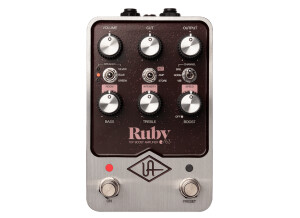
    After having UA’s Woodrow ’55 (Fender Tweed amp emulation) for only a few hours, I knew I had to review the Ruby ‘63 (Vox AC30) and Dream ’65 (Fender Reverb Twin), the latter of which I will be done soon. These are a true joy to use because they sound so authentic, which makes it fun to review. Now, the Ruby ’63 includes three amps, which is a lot of quality tones, and without considering the six speaker emulations included. The amp types are an AC30 Normal, which was a standard with Rory Gallagher, and then later Brian May. There also is the higher-gain Brilliant AC30, as well as a Vibrato amp selection (which is more of a Tremolo and not vibrato, as with the Dream ‘65). Both the Normal and Vibrato amps’ EQ are controlled by a single Cut knob, which allows you to ‘cut’ the degree of bass in the signal (Brian May has this set all the way left for maximum treble, since the tone of the Normal AC30 is dark with plenty of thick mid-range). The Brilliant amp’s EQ includes the Cut knob, but also the Bass and Treble functions –Treble knob becomes Tremolo Rate and the Boost knob becomes Tremolo Intensity when using the Vibrato amp. This may seem confusing, but the video included demonstrates how various knobs are shared and have different functions among amp types. The six speaker emulations range considerably, from a brighter, thinner sound to a robust and heavier sound. I think there is something for nearly every taste out there, but you can bypass the built-in speakers and go direct to a preferred IR. What I like about the speaker variety is that some do not sound that good with a few of my guitars, yet they sound very usable or quite good with other guitars, much of which has to do with single-coil vs. humbucker, bright pickups vs. dark pickups, or style of playing/tone you are trying to achieve. UA knew this going in, that we all have different tastes, even if liking the same amp… and they sound great! The video demo goes through several settings and functions, but I will address some of the other aspects. The EQ sections, including the Cut knob, all are sufficient, in that they range the bass, mids and treble very effectively without exaggeration – no heavy bottom end or boom, and no shrill top end (the Brilliant amp is brighter, but not harsh or brittle). There is a Room knob (which doubles as the Bass EQ knob) that provides studio or room ambience, and it is a nice feature for clean to slightly dirty sounds, particularly for that old Rock ‘n Roll or Rockabilly type comping; and it adds a slightly different dimension when coupled with a reverb or a slap-back echo. The Boost is very effective (which doubles as the Vibrato amp’s Tremolo Intensity) and it produces a very natural sounding gain as the amp responds accordingly. This sounds more like how an amp behaves, with that great break-up tone when cranked and digging in, as opposed to a saturated OD effect. There are so many advantages to UA’s Ruby ’63, and this holds true of their other amp emulations. It is small and compact, which means bringing it to a gig and going direct to a mixer or powered amp. It can be integrated into an amp via the 4-cable method so that you can turn your Marshall, Fender, etc., into an AC30 at the click of a switch. You have access to three different AC30 models, along with various speakers/cabs, which would cost thousands of dollars to replicate with the real thing (particularly if you were to hunt down the vintage models, which these emulations were created upon). In that regard, the price of the Ruby ’63 may be considered a pricey boutique ‘pedal,’ but it is more than just a pedal – it is your amp and primary tone source that fits on a pedalboard. It is well constructed with a good heft and there this is obvious quality when you hold it or work the controls. And it certainly is eye-catching (sound should be the only thing that matters, but musicians still want attractive or cool-looking gear). There are a few drawbacks, and price may restrict some buyers, particularly if they already have an amp (or amps) and may be content in that regard… others may bite at it due to curiosity or hopes of replacing a heavy, bulky amp combo. Still, other concerns from musicians tend to be “lack of MIDI,” or “lack of FX Loop,” etc. However, these were created to emulate classic amps and what functions they had available in their original format. Woodrow ’55 was an exception, as a ‘Mic Level’ knob was added, to give some heat/gain from that perspective. Regardless, some may be put off that only one preset can be saved, which you can toggle back-and-forth from the ’on’ settings you have dialed in, and this is how a two-channel amp would work anyway. The Preset could be clean (for example), whereas you set up the pedal for a crunch or something dirty. And if you wanted higher gain for lead or a heavier crunch, you step on an external boost/OD/fuzz/distortion. As well, you cannot add in the Tremolo to the Brilliant channel, nor can you add Boost to the Vibrato (since the Boost knob becomes Tremolo Intensity) – it is meant to be played clean. The only other drawback, which really is not as such, is that you require 400mA to power it. Most power supplies can handle this, but it depends what other power-hungry pedals are on your board. Regular combo amps have to be plugged in, and so, a wall-wart is a solution. Overall, if you consider the Ruby ’63 to be a classic amp, and that you get three of them (plus the speakers) under one chassis, then it is easier to appreciate what the product is and what it is supposed to offer. You lose out on a few modern additions (tech that came about long after these amps), but are giving up those features for mind-blowing sound and likely the best AC30 emulation to date.

  • « Crystal Clear Tones with Plenty of Amp Choices »

    SOUND: Of the eight high-gain amps my favorite is number three, which simulates the Marshall JCM 900 4x12 – the grain and clarity is very cutting and edgy. I found the Peavey 5150 a touch fizzy for my liking, but I may not have had it dialed in well. Nonetheless, there are six other high-gains from which to choose, all giving a different flavor of nastiness, including amp sims by ‘Flagman,’ Orange, Diezel, Mesa/Boogie, Soldano and ENGL. One thing for certain, those amps all sound rich and full, but I was even more impressed with the clean amps. My particular favorite is the Roland Jazz Chorus sim, which is best described as full-bodied and defined. Whenever I demo pedals on a clean amp channel I typically use The Countess V4 preamp (which has four tubes), due to its quality and note detail. However, the Roland Jazz Chorus sim competes very well for top spot in my studio. The other clean/crunch sims sound convincingly authentic as well, with tastes from Marshall, Mesa/Boogie, Matchless, Vox and Fender. The accompanying demo goes through some sound samples of all the amps and with some of my favorite settings. I even added an OD pedal for some leads (the Greg Howe Lick Box) and the Coral Amp accepted it willingly. Also, this tiny pedal and sounds so clear due to its built-in buffer – no mud here. OVERALL IMPRESSION: At only $79.99 USD I’m uncertain if there’s anything on the market that competes in quality and price. Do the amp sims sound better with an Axe-Fx or Kemper? Perhaps, but for someone looking for a pedal that sounds darn good for home recording, practice and even to keep gear light while transporting to gigs, then the Coral Amp is a serious contender. With sixteen amps (and matching cabinets) in two categories (clean/crunch and high-gain) that can be switched back and forth at the press of a footswitch, the Coral Amp has a lot to offer. One downfall may be that the Amp Type selection, gain or EQ may not be the same for both A and B selections. For instance, you may like clean amp 3 (and have the Amp Type dial in that position), but prefer high-gain amp 8 (and would need to turn the dial for that selection). And if you want different gain, volume and EQ settings for each, then you would need to tweak accordingly. A clearer way to think of this is having an amp head with two channels (crunch and lead), but with only one set of EQ, gain and volume knobs shared between the two. Regardless, for the price I am impressed. GENERAL USE: The pedal works like any amp would, with a control for Volume, Gain and EQ (bass, midrange and treble). The amount of volume and gain depends on the model and how much overdrive you want in the signal. Some of the ‘cleaner’ amps require a high level of gain to produce distortion and a breaking up quality, whereas most of the high-gain amps sound best with the gain around 11-o’clock and 2-o’clock (a bit higher for leads and if not using an additional overdrive pedal). You chose among eight clean/crunch amps or eight high-gain amps by stepping down on the footswitch (the Cab Sim LED flashes green for the clean/crunch amps and red for the high-gain amps). For best sound the Cab Sim should be engaged, unless directing the Coral Amp to a different cabinet source (software or other IR pedal). When the Cab Sim is engaged its LED flashes, whereas the LED remains solid when disengaged. The Coral Amp is bypassed by holding down on the footswitch for a few seconds. OTHER DETAILS: Measuring 93.5mm(D) × 42mm (W) × 52mm (H) or 3.74 (L) x 1.65 (W) x 2.0 (H) inches and weighing 160 g or 5.6 ounces, the Coral Amp is both light-weight and built well, with an aluminum alloy die-cast casing. The soft (no ‘click’) footswitch feels solid with no audible noise in the signal when in use. The mini plastic knobs light up when engaged, for clear indication when the pedal is on and for superior visibility in dark areas. The pots feel smooth and solid when turned. The Cab Sim on/off button is recessed and produces a click to the touch when pressed. The footswitch also is set higher than any of the controls, thereby avoiding damage when stomping. The Coral Amp requires a 9VDC standard power supply (negative tip) while drawing 200mA of current.

  • « Flagship Amp Sim »

    The Pod HD 500 is the flagship effects pedal from Line 6. Getting started is as easy as plugging in a guitar and headphones to start picking away at a preset amp model. Tweaking the internal processing of the pedal has a learning curve if you haven't used a Line 6 pedal before. I suggest using the downloadable software application to really go deep in the editing, but some people will always prefer twisting knobs. UTILIZATION This pedal has many improvements over the previous generation of POD X3s. The hardware has been upgraded to metal rather than plastic. This gives the pedal more of a rugged feel compared to the old plastic pedal which seemed like it wasn't made to last for very many years. The internal DSP chips are capable of significantly more processing, which means that the amp sim models sound more realistic. There is also more storage, so there is tons of room for user presets. SOUND QUALITY I use a Variax 700 guitar with the HD 500. This allows for even more control because I can assign a specific guitar effects model to a particular user preset. Then with only click of a button, the entire signal chain can be changed. I can change between a Gibson Les Paul through a Marshall JCM800 to a Fender Telecaster through a Fender Bassman, to a Gibson J-200 acoustic guitar all by stepping on a footswitch. This can make for a huge range of possible sounds with only two pieces of gear at a gig. OVERALL OPINION The Pod HD 500 is another step forward in amp simulation. There are a wide range of amps included from clean to overdrive to extreme distortion. To me, there are still a few amps 'missing' from the X3 that I hope Line 6 includes as a firmware update to the HD line (Matchless, Orange, Budda). All in all, this effects pedal is capable of some very realistic amp sounds. Unless you are willing to pay for an Axe-Fx, this pedal is the best bang-for-your-buck.

  • « Boss BC-2 British Combo Driver »

    Boss is known for making pedals that can withstand a nuclear bombing or a similar yet equal test of endurance; live gigging. I first heard about the BC-2 Combo Drive a few weeks ago. To me what set it apart from most pedals is the Sound Knob which turns this pedal into a clean boost, light and crunchy overdrive to a mean and loud roaring lion of a distortion tone. Because this is a full accessible knob and not just a rotary knob you can blend all of these sounds. Brand new the pedal costs $119 The sound knob allows me to use this pedal for many applications. I can use it as a clean boost for my acoustic guitar solo work, to even out a single coil sound to equal a humbucker if I'm switching guitars live or I can just use this as I would any old overdrive pedal. It would be cool to see if there are any mods available that can tame the high end as I never need to go past 12 o'clock with this pedal, but that said I generally like a bassier tone anyway. Rock solid quality like all Boss pedals. The rubber coated switch, the metal pots and aluminum case all the around this pedal is ready for anything! Stnadard Boss 9 volt power supply is what powers this if you aren't using batteries. I personally like my Godlyke power supply which works just as well. A great all around pedal to have. Really sounds great in front of the right tube amp. The sound knob is what sets it apart from the rest of the pedals out there in pedal land. This review was originally published on http://www.musicgearreview.com

  • « Vox Tonelab SE Floor Board Multi Effects »

    Been playing guitar most of my life (i'm 41 now). Tastes range form Rock, blues, Christian worhsip. Purchased from Sound Control in Birmingham around the same time I was upgrading all my gear - it was used with my Mesa Boogie F50 and Gibson Les Paul or Fender Stratocaster. I think it cost £399 - they had only just come out at the time - you can get them much cheaper now. I was attracted by having all effects in one unit, it looked great with two expression pedals and the valve showing and the flexibility and number of effects was just out of this world. I've sold it on ebay now. I'm a bit of a techno-junkie (and computer programmer), but never really had the time to work out how programme it properly - it was just a little too complex for what i wanted for a live gig - even though I had pre-programmed the channels beforehand (although for recording when I had more time to dial in the efects and play with it a bit more it was great). I never seemed to be able to get the best sounds on the unit and had problems in getting 'equal' volumes / levels when switching between pre-sets, especially when changing between clean and crunched sounds. When it was used in bi-pass mode it seemed to loose gain / brightness (even with the gain switch at the back set on max) and again, problems getting even levels between bi-pass and effects. Fantastic - at a gig I accidentally dropped my Gibson on it - took a chunk out of the headstock of the guitar, only made a minor dink on the case - rock solid construction. If you have the time, patience and ability, then this unit is well worth having - I take full responsibility for not generating the time to get the best out of the unit, but hey, i just decided I wanted something simpler. This review was originally published on http://www.musicgearreview.com

Categories that may interest you