Log in
EN
FR

Hollow Body/Semi Hollow Body Electric Guitars

2082 products found

Filter
Sort by
Brand
Evaluation
  • Reviewed or not
  • Editor’s award
  • Reviewed by Audiofanzine
Availability
  • Available or not
  • Sold new or used
  • Sold new
  • Sold used
Must-have products
  • All products
  • Flagship products
  • Best rated products
  • Hot products
  • Popular products
Price
  • Freeware
  • Low-cost (< $700)
  • Mid-range ($700 - $2,000)
  • Premium (> $2,000)
€
Clear
Sort by
  • Popularity
  • User ratings
  • Price - low to high
  • Price - high to low
  • Used price, increasing
  • Used price, decreasing
  • Name (from A to Z)
  • Name (from Z to A)
  • Added on
Sort results
  • Popularity
  • User ratings
  • Price - low to high
  • Price - high to low
  • Used price, increasing
  • Used price, decreasing
  • Name (from A to Z)
  • Name (from Z to A)
  • Added on
Filter results 2,082 results found
Brands
Evaluation
Availability
Must-have products
Price
  • Freeware
  • Low-cost (< $700)
  • Mid-range ($700 - $2,000)
  • Premium (> $2,000)
Show results

The best Hollow Body/Semi Hollow Body Electric Guitars reviews

The reviews Audiofanzine members found the most helpful.
  • « Ideal for those who wants to tune it up themselves. »

    From USA, built in China. Hardtail, Floating bridge, one volume, one tone, 20 frets. The feeling is great, the string height is as good on a electric guitar (Godin, fender, etc...) The instrument seems build solid but not with a great second pass on finish. I mean the esthetic is good but there are MANY rough cut. It still look pretty awesome, the finish is overall good. But visually there are mistakes ... There are some very nice details, inlay in the fret board, nice C shaped neck, very thight neck too, easy to play ... You want to try with a brand new string set, I tried only a Jazz String Set 12-52 and it unveil a deepness that was missing before with the former string UTILIZATION The access to the entire fretboard is nice, I raise the bass strings only few millimeters to eliminate buzz effect and there you go. The fretboard is missing a bit of polish, if you like to bend strings a lot you gonna notice it right away. Its rough and gave a scratching effect. Maybe a little polish on the fret too. I wanna try flat wound strings before I could tell more. Its also very easy to get a nice rich sound. The response is good. Don't be afraid the acoustic is still pretty good. SOUNDS The Tone control is almost ineffective, though the sound is warm and deep. I would change it for a linear pot, i believe it's a very bad logarithmic one. (the area between the level 0 through about 2 is the most range of the pot, the rest of the graduation changes only 10% in comparison to the 90% between 0-2). The acoustic sound is very good, though I would enjoy a little warmer sound. But again a string set would make A HUGE difference there. Bass strings are very responsive through the pickup, some of the depth of the two last string are lost through the pickup, but for a rythmic and folk sound it's pretty nice. Some of you high pitch finess might be lost through the bass notes (but there I don't get the best amplifier to tell) Its warm, a lot of natural harmonics, the wood will sings along. I'll blend here sound with A LOT of effect to know really the pickup is responsive... I bought it to get more pounding and deep to my sound, the acoustic of this instrument will help me a lot. I expect a Jack Whiteish sound, tom morello, Led Zeppelin, Yes, Yardbirds, etc... out of this. I would believe i'll get nearer from what I could obtain with my Godin LGT. OVERALL OPINION There are still many adjustement I wanna make on this beauty (she's still pretty good looking you know). But in general I think you got a nice piece of instrument that needs a bit (or a lot, depends on your skills) of tuning. The fretboard, the keys, string replacements, bridge positioning, even the saddles could use a bit of sanding. I would say for a first Jazz Electro-Acoustic it's pretty awesome what you got here ! But for a professionnal High End gear, I might say it's not suitable. I guess this instrument is good for recording, praticing (and it's good looking on stage). But don't expect to build a career around it. For 700-800$ its a deal, but honestly I would hope for that kind of finish on a 500$ instrument more than what I paid. Find it used or in rebate. It still worth a try. Maybe I should try few others before to get this one. But I was charmed by its good looking ... try it with new strings ... ask the retailer, for a 800$ guitar they can make some effort for your bucks :)

  • « A terrific instrument! »

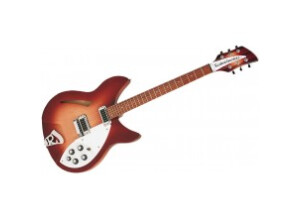
    I use this Rickenbaker 620 with an ibanez TSA30H tube amp (a very good small amp that I can only recommend), and I mainly play rock. Excellently built: solid maple, neck-through construction. Quality can be felt. After a time to adapt to its thinness and short length, the neck appears comfortable and pleasant. I still had to have the string height set as it was a bit high to my taste. It features TWO truss rods, allowing for a very precise setting (my repairman particularly appreciates this feature). The guitar stays in tune very well thanks to excellent closed tuners. The sound is incredibly homogeneous when you get from one string to another, with the whole greatly balanced. As for its cons, I noticed the second string sounded approximately 1/10th of a tone out à tune (especially noticeable when you get from a G to an A), something my repairman an I more or less solved by slightly trimming the slots in the nut. I believe however this problem to be a side effect of the guitar’s extreme sensibility to position change (sitting, up, neck positioning…). No vibrato needed, merely distorting the neck pressing the body works very well for that. Compared with the other guitars I’ve tried (I own a Gibson SG, a strat, a cheap Gretch), you even get more of a tremolo effect when shaking the neck. In the end, it’s not a real problem provided you manage to keep a stable position while playing, it’s even a quality in that it makes the guitar an extension of your own body, sensible to all nuances and ready to react to all intentions. On another note, setting the saddles is a real nightmare with a standard key (which comes with the guitar) due to how close the bridge is (yeah, it’s a beautiful R and still…). Perhaps there’s a way around this, but if so I haven’t found it yet (neither did my repairman). Now, let’s get to the SOUND! I’m really pleased with it. It can sound aggressive, bite with the bridge pickup but also round and soft with its neck counterpart. The important distance between them certainly accounts for such a contrast. Both hi-gain single coil pickups are a real pleasure – how punchy! The aforementioned homogeneity really reveals when the guitar is plugged in, with a full sound, crystal-clear (yet not aggressive-sounding) trebles (the clean neck pickup with a good reverb on a split chord on the fourth trebly strings around the 12th fret just sounds… wow!). As for the sustain, it’s just huge! The attack’s “soundgrain” is not bad, either. The setting knobs (two for volume, two for tones and an extra knob that acts like a sort of EQ allowing extra control over the sound) are very efficient and allow for a wide array of sound. It’s been the first time I’ve actually used tone knobs… Is you also consider the contrast between both pickups, the intermediate pickup selector position becomes most interesting. Please note: it’s also possible to plug a stereo jack on a second, specific jack out. I haven’t used it but if I’m not mistaken, I understood it was meant to get the separate outgoing sounds of each pickup for two different amps. Finally, its look is quite original, and I love its curves! Of course, that’s quite subjective. Caution though: the guitar is really small. The neck has one less fret and seems buried into the guitar’s body, unlike, say, an SG. I first found it quite disturbing. Considering this, I wonder if it would be fit for a large sized guitarist (which ain’t my case). In a nutshell, Pros: - perfect manufacture with quality components - homogeneous sound - crazy sustain - awesome playability (only for experienced guitarists – not a guitar to be put in anyone’s hands…) - very good pickups, precise-sounding and powerful - it has a real personality - its look Cons : the original string height was a bit high to my taste, an important sensitivity to position change, and even an almost out-of-tune sound in the very first frets (but believe me, this guitar takes -and deserves- being tamed), plus the saddles which aren’t easy to access. Also, it’s a rather rare models and it takes some time to manage to get one. Clean sound : just like heaven. Overdrive: you’d love yo eat it whole! Distortion (with an original Sans Amp and a Proco Rat): raving! OK, this review is quite ecstatic, but I still claim a certain level of objectivity: I had a very good and experienced guitarist friend of mine play this guitar, and not only does he share my advice but he now also wants a Rickenbacker (but he’s after a hollow body model). As to my favourite guitar repairman who usually never says a thing, he went “hey, nice guitar, and the sustain… wow!”. So, i’m a happy guitarist. Pdate a few months after: still happy with it, I finally got used to the neck and I can no longer live without this guitar! Totally satisfied for live use too: I bought a Vox Nightrain head and they work wonder with each other. A real love story between a Rick and a Vox...

  • Audiofanzine FR's review

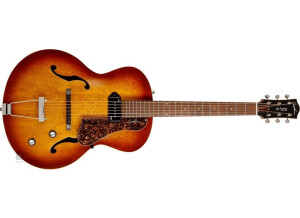
    (Originally written by Makos/translated from Audiofanzine FR) Peerless... Korean luthier who works for the best brands (Fender, Gibson, Epiphone, etc.) now has his own brand. He doesn't need to prove his craftsmanship credentials regarding industrial guitar manufacturing. He made many expensive archtop guitars for our favorite brands... I own one since 15 days ago: • 17" Hollowbody guitar • Plated spruce top, plated maple back and sides, maple neck • Mother-of-pearl and abalone inlays on the fingerboard, tune-o-matic, tailpiece, rosewood pickguard • Bone nut • One Korean mini humbucker • Grover machine heads • One volume control • Original strings: half roundwound D'Addario 13-56 UTILIZATION The following statement is subjective but many guitarists will share my opinion: this guitar looks wonderful! Its simplicity is beautiful. The wood color, the glossy finish, the slim bindings, the simple pickguard. Everything is sober. It's a typical jazz guitar, it could had been made in the 50's or 60's... • The guitar is well-balanced and too heavy (normal for a hollowbody), excellent playing comfort. • Rather wide neck with a curve that allows to play comfortably • Jumbo frets • Easy access to the upper frets (normal for an archtop) • Smooth and accurate machine heads • Plug and play with only one volume control. • Standard strap pin. A strap lock would have been better. SOUNDS The sound... The configuration is very simple: one floating mini humbucker and one volume control... That's it! The pickup quality is good and the output power is similar to a full-size humbucker. The pickup doesn't color the sound of the instrument. What about the sound? It's the sound of the guitar, the amp and your fingers. The jazz sound depends on the amp settings and on your playing technique (thumb, pick, finger picking). From mellow (thumb and soft amp settings) to percussive (more highs, compressor and pick playing). The unplugged sound is very good and that's always a very good sign. The amplified sound is also excellent. It's clear that this guitar was conceived for jazz. I've played it with many amps and I always found a good sound. The amp doesn't have a big influence on the sound, it's the guitar and your playing that give it character. It's true that a JC-120 or a Fender Jazz King will enhance the sound of the instrument, but it's easy to get a jazz sound with this guitar and a cheap amp. OVERALL OPINION This wonderful guitar is sold with a good-quality case. I've spent a lot of time with it the last two weeks. I took it with me to the stores to find the perfect amp (I had to sell my all-tube head and Celestion speaker cabinet :-(. I play it with a Vox AD50 (modeling amp)... The sound is one hundred percent jazz. I owned an Epiphone Joe Pass several years ago but I sold it. The New-York is better. The finish is better (machine heads, varnish, wood quality). And I like simple things. So the New-York is the right guitar for me. It's difficult to find this guitar now. Don't hesitate to call your local distributor to know where you can buy it. Summary: it was love at first sight as I saw it on the website. It's the guitar I was looking for. No colored varnish, only one pickup, no tone control... but a strong personality and a good sound. I ordered it without testing it. Bingo! I won't part from it and we will grow old together. Six months later... I'm still very happy with this guitar and it gets better with aging. The sounds gets better and better. I have no regrets, except for my cats that piss on its case :-)))) More than one year later... We are still in love ;-). Perhaps I will change the pickup.

  • « Beautiful and unique »

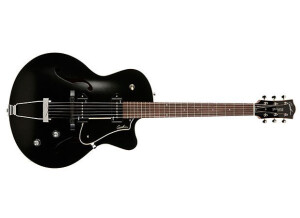
    It's magnificent with the green reflections on its black dress. The satin gives it a slight rebel look. No BIGSBY, no pickguard... But the gilding is classy, especially since I complemented it with a golden plate for the Harpe tailpiece. In terms of sound, it's not jazzy, already unplugged it sounds definitely '70s, really warm. I play it mainly with a VOX AC30C2, what a treat. It's a Korean guitar, but the wood work is stable, with a good finish, it's nice. To me, it's not obvious that I'd get a better quality paying 3 times as much for a Japanese-made one. The string action can be super low and the guitar isn't heavy. Features: Electromatic Hollow Body Laminated maple body Maple neck Rosewood fingerboard 22 jumbo frets White inlays Scale: 24.33" Nut width: 1.6" Adjusto-Matic bridge with rosewood base Harpe tailpiece 2 FilterTron Black Top pickups Three-way toggle switch One volume control. Gold-plated hardware Color: Black

  • « Solid, sounds good, easy to handle »

    Japanese-made, hollowbody without the neck-through body that was characteristic of all Aria Pro II guitars. Bolt-on neck, no vibrato. It's hard to consider one without messing everything up, IMHO. Two humbuckers, volume and tone knobs. 3-way toggle switch: 1, 2 and 1+2 22-fret neck, some frets aren't flush and mus be filed on the bottom part of the neck. Sometimes the high E string gets stuck after a bend downwards. Some other times they grates my fingers. I should've done it already but I can't be bothered to do it and I have other guitars that also sound fine. Mine is brown, with a more natural color, even if I'm not really sure that it's the real color of the wood itself. UTILIZATION The form of the neck is very pleasant, except for the tiny finish details, but don't forget it's an entry-level guitar. The weight is balanced, no problems in this regard. On the other hand, you have to fix the strap to the headstock or you'll have to mount a strap lock yourself. Easy access to the upper frets, up to the 19th fret, thanks to the neck and the thin hollowbody design, too. After the guitar got wet in my cellar, the neck isn't perfectly straight anymore, even after three attempts to fix it at the guitar shop. So I tune it for it to be right up to the 5th fret, a compromise that makes everything unpredictable. But anyway, blues isn't Beethoven. SOUNDS I must admit that I thought it would die after the flood in my cellar. I cleaned it up well, applied a bit of silicone lub and the pots recovered their health, the electronics survived, and the sound is the same as before. Namely: Blues, blues and blues. Fat, crunch, sweet with the neck pickup and powerful, sharper and more aggressive with the other. No annoying sounds, you can get harmonics if you look for them and you have new strings. It sounds well with open strings, too. It has a good sustain despite the bolt-on neck. Amp: It sounds better with the Fender Rumble 100, which has more lows and no overdrive, than with the VOX AD30VT modeling amp. It's great for jazz, as well. OVERALL OPINION I've had it for a long time and I take it up from time to time when I get bored of my other guitars. I didn't try many others before buying it, it flirted with me in the store. It's robust (do you know many electric guitars that can be 10 days underwater and can still be played afterwards?), with a nice sound, it's easy to play and to get nice sounds out of it (anything you play sounds good). The only flaw: The finish and the frets that had to be filed. Another drawback is that I want to change the pickups, but a good pickup would cost me today more than the guitar itself!!

  • « Hohner as good as 1960's ES 335 or Epiphone »

    I have'Gibson-ised' it as I love the '58 era dot inlay 335's, but could NEVER afford genuine one! What astonished me, apart from build quality is there is even the oval orange paper copy of model type and number, just as per Gibbo, visible through f hole. I fitted a 'roller' type bridge, action is just so good, no fret buzz, really well finished. I removed bridge PUP cover and intend to remove other. It was made by Hohner in the '90's I believe and was told by guy I bought this from that it has 'Kent Armstrong' humbuckers, no idea if true or were std on original? Whatever they are they sound great (I suspect they are originals). I fitted the Gibson type 'tulip' machine heads and truss rod cover (original was different shape with SE35 on it. I would NEVER try to pass on as a Gibson, and anyone who knew their 'onions' would know it is NOT a Gibbo in an instant, but it plays great through my Hi-Watt 100 watt combo, looks great, and you can get all the sounds you would expect from a 335. I have gigged with it many times. So if you ever see one up for sale, grab yourself a great late 50's era 335 type for a fraction of the price!! They seem quite rare as there is only 1 or 2 (favourable) reviews on Youtube, and I have only seen 1 for sale on e-bay, but don't look that often.

  • « Very good secondhand guitar! »

    Copy of the celebrated Gibson ES335, made in Korea (there's a sticker on the rear of the neck!) by Samuel music, a US company. It features a tunomatic bridge and a Gibson-type stop bar. Mine is from the late '70s, it has golden hardware and you can certainly tell the passing of time on the screws, etc. When you clean everything the veneer comes off very easily...in short, it has a vintage look! 21 frets, two splittable humbuckers (with the switch next to the pickup selector), one pickup selector, two volume and two tone controls. Note: Vintage Gibson wiring for the volume controls. USE Very nice 5-ply neck with a superb headstock and original inlays. Very comfortable access to the upper frets, I usually play a Les Paul and a Telecaster. SOUND It has a very smooth sound, ideal for blues, jazz, pop, rock ... In single-coil mode the sound is more twangy and with less volume (which is normal). I'll take it to my luthier for a full checkup in a month, so I'll tell you more when I get it back! OVERALL OPINION I bought it three weeks ago, three weeks during which I took it apart, cleaned it and polished it...everything except play it. Excellent value for money, although I think I got a (very) good deal. Edit from 06/23/11: I rehearsed with it yesterday... It has a very round and smooth sound, more so in the highs and mids, in split mode, the neck profile is very comfortable.

  • « For Jazz – but not only »

    Thomann had it made in China under the brand name Harley Benton, but this model has no longer been produced since September 2015 as far as I know. I bought the last model, a b-stock guitar, and I don’t believe that many were produced. I’ve used it with tube amps to play Jazz exclusively. I have other guitars for other genres. I have been playing for over 50 years now. Workmanship is perfect, the (very straight) mahogany neck is lightning-fast once the truss rod and bridge (for intonation) are set correctly. Its fretboard is made of rosewood and features thin, well-polished frets. Arched top, very basic rosewood bridge that requires either replacement by a tune-o-matic or adapting the saddle to the neck’s curve. The tuners do their job in the softest manner. The body is purely hollow, without a central block. Of course, it features flatwound 12/56 strings, very close to the neck except for the outer strings due to the non-rounded nut. The guitar was originally equipped with a floating humbucker pickup and two basic potentiometers, almost a make or break. It will require being upgraded to a Classic 57-type pickup and good pots. This is a quality pickup provided you upgrade it for approximately 250 euros – including your repairman’s work! You can find a Youtube video of Jean-Luc LACHENAUD playing AUTUMN LEAVES on this guitar equipped with a Classic 57: what a sound! https://www.youtube.com/watch?v=Cd7wCKSvzEA If you manage to fin dit used for 120 to 150 euros, go for it provided you can afford a total upgrade. For a total 400 euros (much less provided you can service it yourself and gat a cheaper, used pickup), you couldn’t dream better. Or perhaps after spending twice as much? Mine is still as i twas when shipped, except for the usual settings. I take my time to upgrade it, as I have other works in progress. EDIT1: I've changed the pickup for a Wilkinson humbucker that I found on a Harley Benton Les Paul-type guitar – of course, the body had to be drilled. They come together fine, but the next step would be upgrading to a Gibson Classic 57. I’ve also changed the bridge for a Goldo Tune O’Matic, with a result close to what you can hear on Jean-Luc LACHENAUD’s video. I did it all myself for under the 300€ mark. The good news is, Thomann now offers this model again. EDIT2 : I got a used Classic 57 from AudioFanzine’s classified ads section and put it on the guitar straight away. I now have the exact sound I was after!

  • « I play my E-200 twice as much as my 3k$ 335’s »

    Don’t listen to the guy saying you can’t compare it to a 335. A guitar is only as good as it feels and sounds and is a personal preference. I own three 335’s and one E-200. Sure, it’s a copy, has a bolt on neck, zero fret and weak tuners but in my opinion has the best Bigsby copy ever made and plays better than most. This guitar stays in tune better than any Gibson I own and have several. The best thing I can say is one night I was stepping off of a stage about a ft tall. My foot got caught on a cable. I landed on concrete on top of the E-200. I landed so hard It bent the toggle switch and put a gouge in the lower part of the body. Never mind that on that same stage a month earlier, my J45 fell over from the wind (and the headstock broke off) this E-200 was STILL in tune!! Don’t get me wrong, I love Gibson but they are delicate and some are duds. Bottom line... if you’re lucky enough to find one of these E-200’s, buy it and replace the tuners and possibly the electronics. I will NEVER again underestimate any musical instrument built in Japan. They are master builders. A legacy of creating greatness with a small price tag.

  • « Excellent, inexpensive jazz-blues guitar »

    Technically, the other reviewer said it all, yet I will add: I play guitar (lately mainly blues-jazz) since 1959. and have some 30+ guitars ... my favourites are Gibson CS-335s for studio and the smaller CS-339s for live gigs or custom shop Les Pauls, and generally (American designs) made in Japan (or some custom guitars from Germany). This inexpensive AG-95 jazz-blues-classicrock guitar is somewhat like (more expensive with small, floating humbuckers) signature Ibanez George Benson jazz model, and is more suited for blues-rock, hence I bought her. Actually, initially I had a more recent model, boubinga AG-95, yet I hastility sold her (mainly as she sounded insufficiently bluesy to me), yet it was a mistake, so I bought her again: this time the older (the initial? model), a transparent red finish, again used, and she was well played in, yet impeccable. I rarely play 'pure' jazz, so this guitar suits my blues-jazz approach even with rather light gauge strings. She can play nicely any jazz standard, or a blues classic as well as some singing Santana ... although for any of these styles you can get a better result with dedicated guitar (L5 for jazz, Strat or Tele for blues, LP or PRS for classic rock). Well, I recommendAG95 as a versatile blues-jazz guitar to all, except to shred metal or extreme rock guitarists.

  • « THE jazz guitar par excellence? »

    I bought this guitar secondhand from a German collector for 1700 euros. It was crafted in the Memphis factory in 1994. I previously tested a 175 '59 Re,wich was a real sh.... For 3500 euros you would expect better, but Gibson isn't any longer what it used to be. That's why I went looking for a secondhand one. Even then, the finish wasn't the best, but it was clearly better than on current models. I got it with a Benedetto B6 pickup, but I replaced it with a 57 Classic, which I prefer to the original 490R. The latter is too twangy for my taste. I wanted a smoother sound. The bridge is made of rosewood. This model has both controls integrated on the top. I prefer that to having one single knob on the pickguard. USE The neck is perfect for me, neither too slim nor too thick. It's easy to get familiar with it and you can lower the action without it sounding bad. I play with D'Addario Chrome strings, flatwound, 12- 52. SOUND It's a guitar made for jazz, so don't try to do anything else with it. I love warm sounds. So I set the tone control to 2 or 3. The clean sounds are very nice, without a doubt, but that's not what I was looking for. I use it mainly with a 1984 Roland Cube 60 MIJ and a 1983 Roland Bolt 60. I used it some time with an all-tube Fender Blues Deluxe, but I love the neutral sound of the Roland Cube 60, which, incidentally, is lighter and easier to transport. But, once again, it's always a matter of taste. OVERALL OPINION I've played it every day for a couple of hours since October 2012 and I think I waited too long to get it. It's certainly worth its price (especially secondhand) and I wouldn't change it for a 175 because I think one of the pickups is useless and only puts more weight on the top. The perfect guitar does not exist, but I think this guitar is a must-have for jazz. At least in my opinion!

  • « Flawless. »

    The AM 93 guitar is a semi hollow guitar in Ibanez's Artcore series. It has an arched maple top, back, and sides, and all are bound and made of quilted maple. Neck is 3 piece with mahogany and maple, and fretboard is bound rosewood, block inlays, and 22 frets. It uses the Custom 58 pickups, and has a tuneamatic style bridge and tailpiece setup. There is a floating pickguard, and 2 volume, 2 tone control setup with a 3 way switch. UTILIZATION This guitar is fantastic. It is gorgeous, and breath-takingly so - this guitar looks like it should cost 4 times what it does. The playability is extremely nice, with a very positive string action. It balances quite well, and the ergonomics are comfortable. Many hollow and semi-hollow guitars have balance and ergonomic problems, yet the AM 93 is a joy to play. One detail I love is the knobs - they are classy looking, yet have a nice rubber ring around the top to greatly enhance finger grip. SOUNDS Here we go! These pickups are incredible! Their tone has this nice, buttery warmth, and the crisp note definition is unparalleled. This is a great guitar for blues, jazz, rockabilly, country, classic rock, reggae, ska, and jazz-fusion. Really, about the only genre I can think of this guitar not meshing well with is any of the extremely heavy metal styles, although it could sound neat on metal recordings, being used on clean passages or solos. OVERALL OPINION This guitar can be had for $550 new. That is just a steal and a half. I don't understand how they can make so much guitar for so little money! There is something about an Ibanez semi-hollow guitar that just works! They've been making incredible semis since at least the 70s, with giants like Scofield, Metheny, and Benson playing their guitars exclusively. This guitar is no departure from that great tradition. Flawlessly done, Ibanez. Highly recommended.