Log in
EN
FR

Octavers/Harmonizers/Whammies

212 products found

Filter
Sort by
Evaluation
  • Reviewed or not
  • Editor’s award
  • Reviewed by Audiofanzine
Availability
  • Available or not
  • Sold new or used
  • Sold new
  • Sold used
Must-have products
  • All products
  • Flagship products
  • Best rated products
  • Hot products
  • Popular products
Price
  • Freeware
  • Low-cost (< $100)
  • Mid-range ($100 - $250)
  • Premium (> $250)
€
Clear
Sort by
  • Popularity
  • User ratings
  • Price - low to high
  • Price - high to low
  • Used price, increasing
  • Used price, decreasing
  • Name (from A to Z)
  • Name (from Z to A)
  • Added on
Sort results
  • Popularity
  • User ratings
  • Price - low to high
  • Price - high to low
  • Used price, increasing
  • Used price, decreasing
  • Name (from A to Z)
  • Name (from Z to A)
  • Added on

The best Octavers/Harmonizers/Whammies reviews

The reviews Audiofanzine members found the most helpful.
  • moosers's review

    The Foxrox Octron is a very simple, but highly effective octave pedal. The pedal has a pretty standard make up in terms of it's general characteristics, consisting of 1/4" connections for your input and output, and requiring power from a nine volt battery or power supply. The pedal has true bypass, so you won't get any signal loss when the pedal is disengaged. The Octron isn't rackable as it's a stomp box. UTILIZATION The make up of the Foxrox Octron really couldn't be any simpler. The three parameters that the pedal has are for controlling the direct level, octave up level, and octave down level. You can blend the three of these any which way you like, which can give you a variety of results. I've never seen the manual for the Foxrox Octron, nor do I think I ever will. SOUND QUALITY The overall sound of the Foxrox Octron makes it one of the cleanest sounding octave pedals that I've used to date. Most of this has to do with the tracking, as it's got awesome tracking that doesn't break up unless you try to play too many notes at once. I like both the octave down and octave up sounds equally, but I do think that the tracking is slightly better on the octave down. It's great that you can also blend the two of them, with or without the original signal in there. OVERALL OPINION If you're looking for an awesome octave pedal for guitar, the Foxrox Octron is probably the pedal I'd recommend you check out first. There is a newer version of the Octron, the Octron 2, which is a bit more in depth, but I like this simpler one just fine. It's not going to be the cheapest pedal on the market, but I do think it's reasonably priced considering the high quality the pedal is made at. This is one of my favorite octave pedals that is currently available new for sure...

  • « Great Harminizing proccesor! »

    Got this because Vai and Satriani used them for years! This is the first pitch shift (harminizer) I have ever had that sounded even close to a real guitar but I think the hi note needs played and the lower ones programmed into the harminizer to sound as realistic as possible! THIS IS IMPORTANT= Routing needs to be routed as mono input so it gets a direct sound from the guitar so it can read the note correctly!! Doing so allows you to use the noise gate in front of the unit and will clamp off ANY hi gain noise!! 16 bit signal path is the achilles heel of this unit and will degrade the amps tone some but worth it to many. This unit was $1600 in 93' !!! Has Chorus, Delay, Flange, 3 different Graphic EQ's, 6 Tap Delay @ 6 sec!, ect. Great unit for people looking for great FX and pitch tracking faster than a EVENTIDE!

  • « For keyboardists who sing only »

    The TC Helicon Harmony-M is an interesting product if you happen to sing and play keyboards. It allows you to add vocal harmonies to your voice, depending on what chords you play with the keyboard, and what mode/preset you currently have selected. It features a midi input, mic input, footswitch port, and a stereo output. It has a mic input gain control with clip indicator, which is essential for setting the gain correct, in order for the harmonies to properly process. It has 20 total preset slots (10 banks, 2 a/b presets per bank), and master tone, humanize, fx, and harmony controls. UTILIZATION One of my biggest problems with this unit, is simply the cable format of the output. The input is an unbalanced, low-z microphone input via xlr, but the output is stereo trs, higher z, line level. This makes it nearly inpossible to simply intercept a xlr microphone cable with the device. Instead, I had to also use this pedal with a direct box, in order to convert the signal properly back to microphone level; even though the output of the device is technically balanced, the volume is way too loud to be used as a mic signal. I don't think the other TC Helicon products have this problem. Notably, the Harmony G has xlr inputs and outputs. Perhaps they simply ran out of room. SOUND QUALITY The harmonies sound amazingly realistic, but they aren't fine-controllable like they are on the Voicelive 2. I tend to sing in a brighter, higher voice, and the harmonies that are high, higher, and octave up, tend to sound pretty good for me. The harmonies that are low, lower, and octave down, sound too bassy, too male, for my genre, but they woulds sound good in more classic rock genres. In the Voicelive 2, the timbre of the voice is more customizable, and I was able to produce low harmonies on that device that sounded better for my purposes. OVERALL OPINION Overall, the TC Helicon Harmony-M is a useful product for a very specific audience. I personally can't imagine how many keyboardists/vocalists are out there that could use this, compared to their more popular products that work with guitar inputs. But it is a great product nonetheless, especially if you are in a band full of non-singers. Enjoy!

  • « A bit overpriced but still nice »

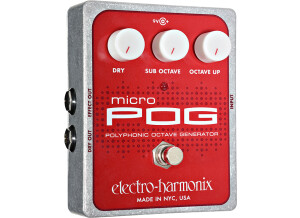
    Advertised as a 12 string emulator and polyphonic generator but it's more of an octaver and all around crazy sound generator. Let it be known right now, if you want and Octaver go buy an Octaver. This is a different beast altogether. While the general layout is very much like an octave pedal, the effect itself is a lot more broad sonically speaking. It's a digital pedal as far as I can tell. Has dry and wet outputs which I suppose is a good feature to have. Has a wet dry knob and separate switches for up and down octaves. All in all not that complicated of a pedal. UTILIZATION To be honest I did not plan on buying this. I received it in a trade for a pedal of near the same value. I am a bit of a pedal collector and having never previously tried the micro pog I decided to give it a shot. Like most of the Electro Harmonic stuff it feels very solid and seems reliable. Battery installation is kind of a pain but if you don't leave it on for hours that shouldn't be a problem. I really don't have any complaints about the configuration. Knobs are simple. No issues. SOUND QUALITY This is where words become limited in how I can describe what you hear from this pedal. First of all, I think a lot of players use this pedal for the more traditional 12 string emulation feature, and while I'm not really into that sort of thing, I can attest that the 12 string sounds are pretty darn good. I'm impressed with the accuracy coming out of this small pedal. Usually 12 string emulations sound fake at best, but this one is decent at least. Even believable. The octave sounds are also pretty good. Nothing I haven't heard before. Be aware that you won't get any bass sounds because the low octave only goes down once. So no bass sounds. The really interesting sounds come out when you mess with the blend knob. You can get some triple octave stuff going on which is great. OVERALL OPINION Honestly I was expecting more. At the end of the day this is a really fancy octave pedal with blend options. I'm not knocking it for that. It's actually one of the better octave pedals I've used and definitely the most flexible octave pedal of this footprint I've found. But for $200 I think I should get more. I suppose the sound quality is what I'm paying for here.

  • « very clean »

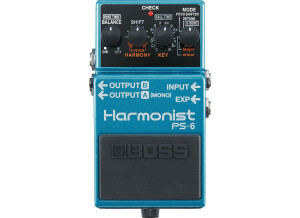
    The Boss PS-6 Harmonist is a very simple, but highly effective octave pedal. The pedal has a pretty standard make up in terms of it's general characteristics, consisting of 1/4" connections for your input and output, and requiring power from a nine volt battery or power supply. The pedal has true bypass, so you won't get any signal loss when the pedal is disengaged. The PS-6 Harmonist isn't rackable as it's a stomp box. UTILIZATION The make up of the PS-6 Harmonist really couldn't be any simpler. The three parameters that the pedal has are for controlling the direct level, octave up level, and octave down level. You can blend the three of these any which way you like, which can give you a variety of results. I've never seen the manual for PS-6 Harmonist , nor do I think I ever will. SOUND QUALITY The overall sound of the PS-6 Harmonist makes it one of the cleanest sounding octave pedals that I've used to date. Most of this has to do with the tracking, as it's got awesome tracking that doesn't break up unless you try to play too many notes at once. I like both the octave down and octave up sounds equally, but I do think that the tracking is slightly better on the octave down. It's great that you can also blend the two of them, with or without the original signal in there. OVERALL OPINION If you're looking for an awesome octave pedal for guitar, the PS-6 Harmonist is probably the pedal I'd recommend you check out first. There is a newer version of the Octron, the Octron 2, which is a bit more in depth, but I like this simpler one just fine. It's not going to be the cheapest pedal on the market, but I do think it's reasonably priced considering the high quality the pedal is made at. This is one of my favorite octave pedals that is currently available new for sure...

  • « Worth the buy. »

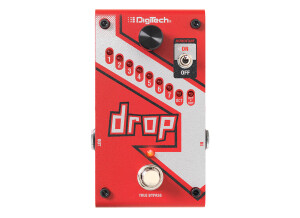
    DROPTUNE FEATURES Proprietary polyphonic pitch drop Drop tune up to 3½ steps in ½-step decrements Full Octave Drop and Octaver Latching EFFECT ON/OFF switch Momentary DOWN and TOGGLE/UP switches Bright backlit DROP PITCH, OCTAVE, OCTAVER, TOGGLE and EFFECT indicators Rear panel TRIM LEVEL control with front panel LED level display IN, OUT and power supply jacks (power supply included) Rear panel USB port for software updates Patent Pending Rugged cast-metal chassis Two-year limited warranty UTILIZATION The DropTune pedal from Morpheus is very easy and intuitive to use. It is a life-saver on gigs in which multiple tunings are used, because one needed physically retune the guitar strings to a different pitch. One stomp on this and the whole tuning sounds lower! The display is easy to read and understand, and the effect "toggle" on off is a great feature! SOUND QUALITY This sounds good enough. It does not sound absolutely crystal-clear perfect, as in how the guitar would sound if physically in a different tuning. But it sounds close enough - no weird tracking errors like other pedals have, due to the polyphonic tracking. The tone just drops a bit of high end presence off when the pedal is engaged. Still would sound great, even in the studio, but when A/Bing with no other instruments playing, the tonal difference, though slight, is noticeable. I feel like my Strat still sounded Strat-like, and the Les Paul was still distinguishable as a Les Paul. OVERALL OPINION The fact that this pedal makes gigs so much easier is the best thing about it. Hauling a boatload of different guitars can be a hassle (and a liability), and retuning manually can get old for the audience. Also, the fact that guitars with a locking tremolo system can be "retuned" by this pedal instantly makes locking tremolo systems worth it again! This pedal is a great idea, and designed very well.

  • « Whammy in a box »

    The IPS-33B is famous for having the original Whammy chip built inside it. However, this unit is actually a multi effects processor. It can do more than just your average whammy sound, and Edge + Vai showcased that. It features everything you'd need to connect it to your rig -- MIDI implementation, a nice footswitch and so on. UTILIZATION Digitech did a good job with this unit in terms of overall implementation. The unit is easy enough to program that you don't really need the manual. The stock presets are also pretty cool. One of the biggest complains I have is that there is some tone suckage with this unit. It's not that transparent, and if you have a serial loop, it'll show. The unit is dated, so it's kinda understandable, but if Rocktron were able to make transparent effects in the 80s, why couldn't Digitech? One feature I really liked was the ability to run an expression pedal straight from the back of this unit. You don't need a MIDI footswitch with an expression pedal output. It just makes life easier when programming certain whammy effects. SOUND QUALITY The sound of this is pretty good, but like I said above, there's some tone suckage. Once you get past that, the whammy features really shine. Don't forget that this unit can also do that famous "shimmer" sound. Be sure not to get this confused with the IPS33. They're not the same unit, and the IPS33 goes for considerably less on the used market. This unit is actually almost identical to the DHP55 that the Edge used for a bit. OVERALL OPINION If you're looking for an intelligent pitch shifter and are on a budget, I recommend checking this out. Despite its flaws regarding the bypass, it's one of the best pitch shifters out there in terms of quality per dollar ratio. It's easy to program to boot. If you're going to get this, I recommend running some sort of mixer with it so you're not destroying your original tone.

  • « One Octave down and/or Two Octaves Down with Dry Blend - Sounds Great! »

    An octaver goes back to the 1960s, originally designed by Roger Mayer for Jimi Hendrix. As applicable for the bass player or keyboardist, an octaver adds breadth, depth, fullness and a hint of eerie edginess to a tone. Certainly, an octaver plays a role in make a smaller band sound much larger, as extra tones meld into the mix. The Sonicake Octaver provides three levels of control/mix – how much dry, how much of one-octave down desired, and the same with two-octaves down. An octave-up would have been a good addition, ideal for bass and down-tuned rhythm players, but for the price and the quality of sound, that is my only complaint (and the reason for four stars). The included demo has the dry mix all the way up, except for one instance; and for my use, I prefer keeping the dry up full, then adding a touch of octave, in order to enhance and swell the original tone. The dry knob does come in handy if increasing the octaves a lot, since volume is affected somewhat and it may be necessary to reach parity with a few of pedal tweaks. https://www.youtube.com/watch?v=6yl9ksJ2aU4&t=1s Although not demoed in the video, the Sonicake Octaver does sound excellent with a cleaner signal, including acoustic guitar. Again, it adds a fullness to the original sound, and compliments other effects, like a modulation or chorus, for an even bigger sound and detail. The cleaner the signal, the smoother and more realistic the effect achieved from this true-bypass, analog pedal, although distorted tones (as per the video) still present themselves well. I did compare this octaver to those available on the Fractal Audio FM3 – the latter has a smoother effect, albeit more digital sounding. The Sonicake Octaver’s sound is fuller and more natural sounding to the ears. For the price, this is a very good deal. 30% off code: SONICAKE2022 (until June 5, 2022) https://www.amazon.com/dp/B09XXF31K8

  • « Excellent Octave Pedal for Bass Guitar »

    I am a bass player so I am only using this pedal with bass guitar. First I have to say it tracks really well. The octave sounds are very clean and it doesn't glitch as much as with other pedals. You can create a range of different sounds from clean synth sounds to heavy distorted sounds. The second octave is only useable in the last frets of the neck on a four strings bass as it's probably too low to track properly. You can use it as a distortion pedal if you select the drive mode and turn the octace generator to zero. I couldn't really find a use for the polyphonic mode, maybe it is more suitable for guitar players. See the video below for a demo I made of this pedal. https://www.youtube.com/watch?v=XJqxo9pORuY

  • « Creative Sounds »

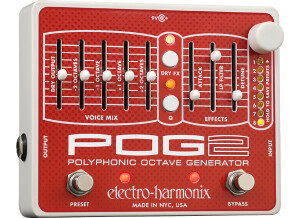
    The Electro Harmonix POG 2 is a Polyphonic Octave Generator, you can translate the word Polyphonic to "producing many sounds simultaneously" In the voice section the knobs are ,1. "dry output" to control the volume of the sounds 2. "-2 Octaves" 3. -1 Octaves 4. +1 Octave 5. +2 Octaves , so you have a lot of space to control with the octaves. In the Effects section you have 1."Attack" that can add swells, fade in speed of the Octaves. 2. "LP Filter" adds resonance to your sound. 3. "Detune" you can enhance your sound. In the middle theres two buttons called "Dry FX" and "Q" with LED lights over them, the "Dry FX" adjusts the effects on the right side you can also select to bypass the effects. The "Q" button effects the resonance of sound of the Low-pass filter knob. You also have the biggest knob on the pedal, all the way to there right is a Preset control knob, this was the reason I bough this pedal. It gives you 8 bank saves that you can adjust on the fly. Its a true bypass Digital pedal, the power is standard 9v. UTILIZATION The POG2 layout is very basic and easy to control and understand. The deeper you dig in the more you will find out. Basic hold down the preset button for quick bank saves. I think for the amount of sounds and knobs it has its a perfect size pedal for me to adjust on the fly and doesn't get in the way of all the other pedals around it. If theres any questions that i would have the manual explains it very detailed. SOUND QUALITY I like to use the Organ sounds + lower octaves sound with my clean sound on my Tele, its very smooth and fits many genres. I also love mixing in other sounds/pedals with it for example like delay or chorus sound also some distortion makes it sound very interesting, its all about experimenting and finding that unique sound that meets your needs. On live shows the pedal stands out a lot especially if I'm using stereo sound with my amps, it catches peoples attention right away. At my studio i like to use the core Shure 57 mic, it reproduces the sound that i hear nicely. I tend to use the Clean channel more on my amp to capture the organic sound of the pedal, but its always fun to mess with that and add little spice to it. OVERALL OPINION The thing i love the best about it is the programmable 8 preset memory, that made my life easier compare to the older version of POG, now all the cool sounds i create i can save and pull it up on the fly without me bending over and switching knobs around. I have nothing bad to say about the pedal it does what its supposed to do. I bought it used so for me the price was fair. The pedal is built like a tank and i haven't had any problems with it at all. I had the first POG which i sold later on since the POG 2 came out, and like i said the Presets memory was the thing i needed the most and got, if i lost the pedal I would buy a new one.

  • « Amazing »

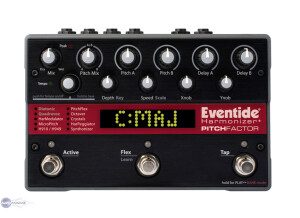
    The Eventide Pitchfactor is a digital harmonizer, and also dabbles in delay, echo, chorus, flange and a bunch of other things including a synth and fuzz patch there are a bunch of hook ups including midi, usb and multiple in's and outs for wet dry setup or whatever you please! UTILIZATION The manual is a little hard to understand, but it gets you where you need to go, it definitely takes time and effort to learn how to use it effectively. There is so much to do and learn that it take months to really understand it in my opinion. It's simple enough to get used to, but after that it just gets deeper, its crazy how much is in it! SOUND QUALITY I use it with my guitar obviously, and also plugged it into piano and bass before. I LOVE this pedal, it is something that is always on my board and I utilize pretty much during every gig I play, its harmonies are second to none on the market other than literally playing them with another guitar player or some EXTREMELY expensive rack gear. It flubs a little on higher notes and fast passages, but not noticeably to be honest, I use it mostly for harmonies, but it has some great, delays chorus's in it also, I highly recommend this pedal to anyone looking for any of that stuff. It's honestly my favorite pedal on my board, its great. I'm not a huge fan of the synth patch or the fuzz sound though, its like they just decided to cram it in because they could. other than that though, amazing pedal OVERALL OPINION I've said pretty much everything I wanted to, it sounds amazing, its a little expensive, and the learning curve is a little sharp at times, but once you get it, its unbeatable as a harmonizer! I highly recommend it!

  • « Guyatone MOm5 Micro Octaver »

    The MOm5 is part of the Mighty Micro line of effects from Guyatone. These effects measure just 2.6' (W) x 3.9' (D) x 2.3' (H). I'm a professional guitarist/instructor with 31 years experience. I produce instructional videos for Elmore Music and perform with the band, 3 Hour Tour. I play many styles of music and delay is a pretty big part of my sound. I acquired this pedal from Godlyke Distributing to review and also to upgrade my rig. The MOm5 can be purchased for $142.50 USD. <a href="http://www.godlyke.com">http://www.godlyke.com</a> This unit has a grungy, unpredictable sound that will leave analog enthusiasts salivating. This is truly an exciting effect you'll want to try on your next riff or solo. When I first plugged my guitar in I set the pedal to trigger one octave down and I was approached by a distorted tone and an effect that behaved in an unpredictable manner. This is part of the analog charm when working with harmonizing pedals. Each note I played was embedded in a cloud of fuzz and the octave down effect was triggered pretty accurately in the mid-high register of the fingerboard. The unit features 3 main knobs on the top: Oct-1, Dry, and Oct-2. It's possible to create synth-like textures with the MOm5 by turning up the Oct-1 and Oct-2 controls and leaving the dry signal of the guitar down. I like to use this effect to thicken my single note lines, especially in the mid - upper register of the fingerboard. I just simply dial in the dry signal until it matches the uneffected signal and bring in the Oct-1 (1 octave down) knob until it's just audible. Another feature that works great is the addition of a filter switch that either distorts the tone, decreases the hi-end, or further decreases the high-end for an organ-like tone. More often than not I found myself switching the filter to the organ-like tone. This may sound really picky, but if I want a clean octave effect that triggers perfectly 1 octave down I'd like to explore that as well as all the features that the MOm5 has to offer. Keeping with it's analog architecture, the unit is warm (especially selecting 'organ tone') and notes trigger in an unpredictable nature at times, which can be very pleasing. The MOm5 is part of the Mighty Micro line of pedals from Guyatone and these are sturdy little stomp boxes packed with useful features. It's constructed of cast-alumimum and includes the input and output jack on the top back leaving the sides free. This is great if your pedalboard is smaller or if you're running out of real-estate. The unit feels as though it'll last a lifetime. Every switch and knob is solid to the touch and assures the player that it's always ready to deliver. If you're looking for something different and even wacky to add to your sound - test drive an MOm5 Micro Octaver. In addition to the cool sound this unit provides its well thought out and clever design will appeal to many players. <img src="http://www.musicgearreview.com/dbpix/Guyatone MOm5.jpg" /> This review was originally published on http://www.musicgearreview.com