Log in
EN
FR

EQs/Enhancers/Boosters for Guitar

142 products found

Categories
Filter
Sort by
Evaluation
  • Reviewed or not
  • Editor’s award
  • Reviewed by Audiofanzine
Availability
  • Available or not
  • Sold new or used
  • Sold new
  • Sold used
Must-have products
  • All products
  • Flagship products
  • Best rated products
  • Hot products
  • Popular products
Price
  • Freeware
  • Low-cost (< $90)
  • Mid-range ($90 - $150)
  • Premium (> $150)
€
Clear
Sort by
  • Popularity
  • User ratings
  • Price - low to high
  • Price - high to low
  • Used price, increasing
  • Used price, decreasing
  • Name (from A to Z)
  • Name (from Z to A)
  • Added on
Choose a category
Selected category: EQs/Enhancers/Boosters for Guitar
Sort results
  • Popularity
  • User ratings
  • Price - low to high
  • Price - high to low
  • Used price, increasing
  • Used price, decreasing
  • Name (from A to Z)
  • Name (from Z to A)
  • Added on

The best EQs/Enhancers/Boosters for Guitar reviews

The reviews Audiofanzine members found the most helpful.
  • moosers's review

    The Electro-Harmonix Attack Equalizer is a unique guitar pedal, suitable for use with electronic instruments of all kinds. This is a vintage pedal that is no longer being manufactured. They do have a reissue of the pedal called Knockout, which sounds pretty close to this one. The Attack Equalizer has 1/4" TRS connections for input and output, and has an on/off switch. This isn't a rack mountable piece of gear as it is a stomp box. UTILIZATION Using the Electro-Harmonix Attack Equalizer is very simple, as there are only three separate parameters to work with. The pedal has knobs for fundamental, which is the volume of your original tone, one for blend, and one for attack. Even if you're unsure off the bat what these parameters will do, after playing with it for a minute or two you should be able to catch on. A manual for the Electro-Harmonix Attack Equalizer would probably be pretty hard to find. SOUND QUALITY Let me start off by saying that the Electro-Harmonix Attack Equalizer isn't the type of pedal that is necessary a player of any type. It is a cool pedal to have if you're looking to have some subtle toning available at your feet. I've used the pedal with a '76 Fender Twin Reverb and a Fender Jazzmaster, so I'm getting a pretty good idea of what this pedal sounds like. I also use both a Big Muff and an Ibanez Tube Screamer, and this helps me to control the attack of my sound in great detail. I don't use it all of the time, but only in situations where I feel a tone I am already working on could use it. As always with EH, you've got a clean sounding pedal here without too much noise. OVERALL OPINION If one of the studios I've worked at didn't have the Electro-Harmonix Attack Equalizer, I'm sure that it isn't a pedal that I would have sought out myself, as these are pretty rare. Like I said earlier, they do have a reissue known as the Knockout, which works quite well and is a lot more readily available. If you're looking for ultimate control over your attack levels this is the perfect thing to help you level it all out, but isn't a necessity.

  • nickname009's review

    This is a 10 band eq pedal by MXR that allows 12db of cut or boost, with a level and a gain slider. Pretty simple! Each EQ is also illuminated with red LEDs so you can see on stage where it's set. True bypass also. UTILIZATION EQ is probably the most important tool for every guitar player in terms of tone shaping. In order to make anything sound good you have to know the EQ spectrum of the guitar, what parts of it sound good and bad and work in what way etc. And so no beginning player would be able to use this properly without knowing that stuff first. So even though the manual provides some extra samples and descriptions, I'd say to use the pedal effectively, you'd need some previous experience with EQs. After that, using it is very easy. Set it up on the loop for the biggest dramatic tonal change or out in front to color it, or BOTH, one EQ pedal for each. SOUND QUALITY It is an EQ pedal there is technically no sound that the pedal offers. It's also true bypass, assuring that there is no color added to the original signal. What you do with it when you tweak the EQs will change the sound. Sort of like extra EQ knobs on your amp but now more specific, related to the frequencies. So in terms of sound It's not very fair to comment and doesn't make much sense to add a rating of any sort I feel. But in terms of the quality of the pedal itself and I will rate it here. It doesn't add any color as far as I'm concerned but the thing the lacks with this pedal is most likely the footswitch. I've owned two of these, one where the switch just stopped working and the other was noisy as hell. By that I mean, when you click the EQ in you hear the loudest click/pop noise EVER. Even in a live band situation if there's everything going on the click/pop noise is as loud as my guitar signal, it's very VERY annoying and I'm not sure if this pedal was made that way or if it's a defect. Others have said the same thing so maybe I'm not alone on this. Maybe this pedal was designed to be on all the time? Well it sure seems like I'll have to use it that way.. OVERALL OPINION Overall it's a good pedal. Most EQ pedals generally are no fuss pedals and simple to use. Again the only problem is the switch with this one and it's super loud pop. If you're looking for a good EQ with 10 bands and plan on keeping it on at all times this is usable. But if you're looking for an EQ you'd wanna kick in and off quite often, then look elsewhere, this is way too noisy in my opinion.

  • « EQ with a memory »

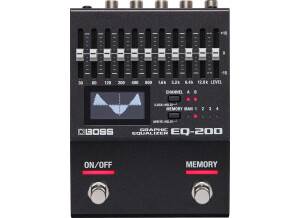
    What Roland Boss tells you that you get, is what you get. In this case, it's a graphic equalizer for guitar with 10 bands and nine memory slots along with a single setting you can change as you like. The bands on the pedal are predetermined, as with all other graphic equalizers. The technology utilized in this one, is a mix between analog and digital, as you set the bands with physical faders, but store the presets on a chip. If the presets then run out through an analog fader or use a digital circuit to recreate the EQ settings. Although it is part digital, you can't program it through a computer. UTILIZATION The general setup and editing of the parameters on the equalizer is simple. So simple in fact, that you should not need to have a look at the manual and a young kid would be able to do it (granted, the new generation is schooled with computers in general!) The problems arise, when you want to use a preset. You need to change preset with your fingers, as there are no footswitch for this function. This is a huge problem, if you want/need to change the preset during a performance. It's a big drawback, and you can have as many memory options as you want, but if you're not able to access them, when you need them - what does it help then? SOUND QUALITY The quality of the equalized signal is good. As with other pedals changing the level of your signal (i.e overdrive and distortion effects), remember to balance out the input and output! From the factory, they give you six presets for guitar, and three for bass. These are a good staring point, if you are not sure how to use the pedal in the right way. OVERALL OPINION It's a fine pedal, but not one that I will recommend to much, as you have the huge issue of not being able to access the presets in an easy way, during a performance. Look at the baby brother like the GE-7 or the MXR products. They cost a bit more compared to what you get, but the quality and simplicity is much better. If you don't have any issues changing presets with your hands, go for it.

  • « Basically the same as the normal one »

    Kerry King is fairly well known for boosting his amps with an EQ. He generally uses a "frown" pattern to really help push the front end of the JCM800s he plays. Because he used one of these for years, MXR decided to finally give him his own signature pedal, right around when he got his signature Marshall. However, it's pretty much the same as the normal 10 band EQ that MXR has offered for years. The main difference is that this can be run into two amps since Kerry King likes to run multiple Marshalls. UTILIZATION The housing is a sturdy metal housing that has this crinkle/wrinkle black finish. Each individual band has its own LED, so you can tell where everything is just by looking at it. One pain is that you really need an adaptor with this thing, and it's one of those 18v adapters, so you can't easily power it with conventional power supplies. The sliders move nicely, and it's fairly low noise. The manual gives you some nice example settings that you can mess with, but I generally just go with some sort of midrange boost, unless I'm using this in the loop. SOUND QUALITY The pedal is fairly noise free, which is a huge plus. The Boss pedals generally are somewhat noisy, and it can be a real tone sucker. This doesn't seem to suck any tone, and it's super easy to use. There are two main places you can use this pedal: in front or in the loop. If you use it in front, you'll be using it like a gain pedal. You can boost your input to help give you more "power" from your pickups. It's very much like a tubescreamer this way. When you put it in the loop, you can shape how the actual amp sounds. It's like having a separate EQ to help dial in the exact sound you hear in your head. This is super helpful, but you need to have a serial loop or 100% mix going on for this to work properly. OVERALL OPINION The pedal is solid, but I don't think it's worth spending the extra money on unless you absolutely need the extra outputs to drive more than one amp with this thing. That's the main reason to buy this pedal. If you only run a single amp, just look into getting the normal one, or maybe even look into the Build Your Own Clone 10 band EQ. That's actually my favorite EQ on the market.

  • « Great Small EQ »

    The M-109 is a 6 band graphic EQ pedal from MXR. The pedal has 6 sliders that can cut or boost that frequency by 18dB. The bands available are 100, 200, 400, 800 1.6k, and 3.2k.The pedal can be powered by 9 volt batter or external AC adapter. Dimensions of the pedal are 2.5" x 5.5" x 4.5" and it weighs about a pound. A mono input and a mono output are available. UTILIZATION This pedal is built extremely well like most MXR pedals. The housing is made of all metal and the bypass switch is very rugged. It has “positive feel” sliders that hold the settings very well, even if bumped, and are illuminated so the settings can be read on a dark stage during a gig. I wish they had included an overall volume slider like the Boss GE-7, but I don’t really miss the added high end frequency slider. SOUND QUALITY The M109 is what I use to get a muffled low fi tone in my rig, but it can do just about anything you need it to. It will remove quack from a mid heavy guitar, unmuffle the distortion in an amp, or boost a solo just to name a few. It lets you craft your sound to the exact frequencies you hear in your head. It works very well in the loop of amps to help shape the overall tone or as an overall signal boost if you run through a lot of pedals. The pedal makes a great solo boost because you can boost the frequencies that really let your guitar cut through a dense mix and stand out like a solo should. There is no change in my tone when using this pedal and there isn’t an annoying hiss like there is when using a Boss GE-7. OVERALL OPINION I like this EQ pedal a lot. I really thought that extra frequency slider would be missed, but I really just miss the volume slider I had on my previous 7 band EQs (Dano and Boss). This pedal is built for touring, so I don’t worry about reliability. The lighted sliders are great at gigs and the switch feels really solid with a nice click when you engage the pedal. It’s nice and small so it doesn’t take up much space on my board. Whether I need a solo boost, an EQ adjustment, match input signals on different guitars, or a Lo Fi tone like I usually use it for, it’s always there for me. Steer clear of the Boss and go for the MXR

  • « Cheap, quiet, reliable. »

    The Danelectro Fish and Chips pedal is a 7 band EQ pedal with an overall volume slider. The pedal has 7 sliders that can cut or boost that frequency by 15dB. The bands available are 100, 200, 400, 800 1.6k, 3.2k, and 6.4k. The pedal can be powered by 9 volt batter or external AC adapter. The pedal is very small when compared to a Boss sized pedal. A mono input and a mono output are available. UTILIZATION This pedal is another pedal from the Dano Food series. Like all the other pedals from this series, it is a pedal that is made of plastic. This worried me at first glance but after owning a few pedals from this series I haven’t thought about it since. It is a very reliable pedal and I’ve never heard of any one crushing the shell of the pedal or footswitches breaking. People have lost the tips off the sliders, but that’s no big deal and can be remedied with a little glue. For a plastic pedal these little guys can take a beating. It’s a very straightforward layout and the sliders seem sturdy and hold your settings well. SOUND QUALITY The Fish and Chips really lets you shape the tone of your gear. It lets you craft your sound to the exact frequencies you hear in your head. I love low powered tube amps, but once you get down to 10 to 15 watters, they really start cutting back on features. A lot of micro amps cut back on the EQ sections, and that’s where an EQ pedal really comes in handy to make these amps useful. It is also good in the loop of larger amps to help shape the overall tone. The pedal makes a great solo boost because you can not only adjust the overall volume of the solo using the volume slider, you can also boost the frequencies that really let your guitar cut through a dense mix and stand out like a solo should. This pedal does have a buffered output and there may be a little bit of high end loss, but it’s very slight. This pedal is no where near as noisy as the GE-7 from Boss. I much prefer the Danelectro version. OVERALL OPINION Overall this is a pretty good EQ pedal, and a great one at this price. It does do a great job of shaping your tone and allowing you to boost your volume or certain frequencies. The MXR offerings are very nice EQ pedals, and I use one now, but my Danelectro has lasted for years and I had no real complaints with it other than opting for something different. The Boss GE-7 that I had previously been using was bumped for the Fish and Chips because the Danelectro is a much quieter operating pedal, at least in my different rigs. For 30 US dollars, there isn’t much else in it’s marketplace, and it’s probably because a company would need to do a lot of research to figure out a way to make a better EQ pedal for the price. Great tweakability on the cheap.

  • moosers's review

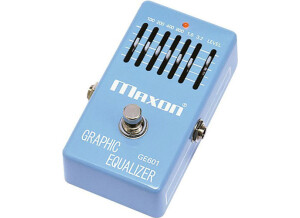
    The Maxon GE601 is a graphic equalizer pedal, intended for use with guitar. It's a six band EQ and can also serve as a booster. It's an analog pedal that has the standard configuration of a 1/4" input and 1/4" output and is powered by a nine volt power supply. It's not going to be rack mountable as it's a stomp box. UTILIZATION Using the Maxon GE601 is very simple. It has six sliders for six different fixed frequencies, starting at 100 Hz and going up to 3.2 Hz, with each band being double the amount as the previous. There is also an overall level output slider. That's more or less what you need to know here, so I don't think a manual is crucial. SOUND QUALITY The Maxon GE601 has a great sound that is extremely precise. It doesn't take much to alter the tone with each of the frequency bands, so don't feel like you have to crank or pull the bands by too much. It's great for getting rid of unwanted low end guitar rumble or for adding some brightness and using it as a booster. I like it better than the Boss and MXR graphic EQs that I've used before as it just seems to sound cleaner and only add to the harmonic worth of your sound. OVERALL OPINION While I'm not of the school of thought that you need to have a graphic equalizer in your chain, I can definitely see the worth of the Maxon GE601. It's great to have some extra control for your sound, but for me I'm usually okay the EQ on my amplifier and the tone knobs on my guitar. Still, this can be very helpful if you use it right. I don't know that it's as useful inside the studio as it can be for live shows, unless it's really part of your sound. It's not the cheapest EQ guitar pedal out there, but it's definitely up there with the best.

  • « One of the First »

    Boss made these pedals back in the late 70's. These were great pedals for adding the right or missing frequencies to your guitar tone. Unlike the MXR Eq pedals this one has the middle position at the 800 hz where as the Mxr would have their middle position at 1 K. The GE-6 has 6 bands with frequencies 100, 200, 400, 800, 1600 and 3200 Hz. The 800 is better for being in the middle because that is where the major changes of a guitar's tone will take place in this range. This pedal can either cut 15db of volume or it can add 15 db of volume to your tone. It will add some distortion if you run it in the front of an overdriven amp. UTILIZATION Specifications Controls: 6 Band Graphic Equalizer Connectors: Input, Output, AC Adaptor Current Draw: 7 mA (DC 9V) Equalizer: 100 Hz, 200 Hz, 400 Hz, 800 Hz, 1.6 kHz, 3.2 kHz Recommended AC Adaptor: ACA Series SOUND QUALITY These pedals are great for getting your guitar tone to exactly what you want to ehar. SO many amps will favor or be missing certain frequencies but you like the voicing. This is where this pedal will get you the right highs, midrange, or low end and be able to run into with your favorite voiced amplifier. The pedals were great in the 80's for guys who wanted to boost the midrange of their amps. Most metal or rock guitarist during this era would boost their amps mostly in the 800 hz level so they could get that tone they were looking for back in those day. Many guitarist used the Furman PQ3 which was a great pedal for this type of setting and it was an interesting circuit that makes a lot of noise as well. This peal is a floor unit and will be able to boost basically in the same way that the Furman would have been able to do. This is a muc smaller and not as versatile but he 800 hz is there and the most important frequency gauge anyway. OVERALL OPINION These were manufactured up until 1981. You can still find them on the used market pretty easily. I have seen the for right around $100, which isn't a bad pickup for that price. this is a great pedal to boost the best frequencies and take out the ones you don't like. a great pedal and must for many guitarists out there.

  • « Sweeping EQ Abilities in a Wah Style Pedal »

    SOUND: EQ can do a lot for your tone, but when you consider applying EQ in a dynamic sense you then enter a different realm. With Q you can set the Treble and Bass (two knobs), but then fluctuate the Midrange mix (via the pedal’s treadle). The pedal’s three bands are centered on the note C in 3 different registers (to match the musical note and equivalent frequencies) for the following combinations: 65.41 Hz (C2 bass knob), 523.25 Hz (C5 midrange treadle) and 2.093 kHz (C7 treble knob). You can achieve a wide array of tone changes so that as you work the pedal it can mimic a phaser or wah (although not sounding like a traditional wah), or can be used as a volume pedal (but not in the traditional sense either, since you’re not cutting volume completely). With the treadle parked toe down Q also works very well as a boost. Overall, the EQ transitions are smooth and the engagement (clicking on the toe switch) is 99% quiet (you hear a change in signal output or tone while playing, but no loud clicking or popping). The demo included with this review demonstrates the various uses and sounds with both clean and dirty amp channels. Clean channels can sound very modest and smooth (depending on how clean it is), whereas there’s definitely aggressiveness with a dirty channel –similar to a wah, phaser, etc., in that the character of the pedal becomes more apparent between clean versus dirty. OVERALL IMPRESSION: Handmade in Greenwood Lake, NY, Q retails for $225 USD. Its price is fairly standard for a quality pedal, but what it offers is a completely unique perspective on modulation and tone through its dynamic EQ possibilities. Not only can you add dimension by altering the midrange of your tone on the fly, but each band (Treble, Mid and Bass) has a 20dB cut/boost, thus allowing volume swells when desired, but also boosting of the signal while being able to sculpt the tone. The huge headroom of Q is the result of the same internal voltage tripler found in the Edison Preamp (also by Night Owl Industries), which gives you a lot of boost without overloading the signal (at least if placed last in the signal chain). Since the sound from Q isn’t cutting or narrow like a wah, you get a more organic scooped sound when jacking the bass and treble, or you can cut the bass and treble for some great lo-fi tones. Q also is fantastic as a basic boost pedal for lead playing and for adding swells and character while working the midrange via the treadle. Unlike a wah pedal, you can keep Q turned on and it sounds natural, since it’s an EQ pedal and the three bands can be matched ideally to your desired tone. GENERAL USE: Q allows you to sculpt your tone in real time (although the pedal can be parked without EQ sweeping) while playing guitar, bass or keyboards. The demo outlines some possibilities, but I bet there are several more. With toe down and the Treble and Bass dialed back (or turned off completely) you can achieve a very authentic lo-fi sound. Again with toe down, you can adjust the Treble or Bass to sculpt your tone, but also act as a boost (since there is a 20dB cut or boost with either the Treble or Bass). The real fun begins when you manipulate the treadle, which either cuts or boosts the Midrange by 20dB. This is where you get some interesting tone variations that seem to mimic a volume pedal and/or a phaser and/or a wah – depending how you use it. Get enough Treble and Bass in the mix and hear some very intense growls (without that shrill typically heard in wahs). When working the treadle in the front half of the range the mid scooping is not as intense, and doing so makes for a very good subtle wah-type effect. And whether working in broad or narrow sweeps, I find Q to work exceptionally well as a tremolo or Univibe – but what makes Q special is that you can control how fast or slow you want the tremolo/vibe without having to bend down and adjust any knobs like you would with a typical tremolo… you control the rate or speed with your foot so that you can have slow mixed with fast, etc. Placement is important, as often a volume or wah is at the beginning of the chain; but with this being an EQ pedal with 3-times the headroom of typical 9V pedals, your signal can be overdriven too hard if placed at the front end. Rather, place Q at the end of the signal chain (unless you want to overdrive earlier effects), viz., after distortions, delays, reverbs, etc.

  • « No discernable improvement in tonal output »

    Chose this EQ unit to enhance tonal quality of my Berhinger Amp... not much improvement. One is own their so to speak own when trying to crate that perfect tonal sound for Blues. No manual is provided with unit.... no recommended factory settings regarding use. Trial and error is the game... disappointed is my name. Other EQ pedals I have used gibe as good or better outputs.. thus the 10-Band implementation of the Caline CP-24 seems a bit of an overkill... the common 5-6 band approach of competing products seems just as worthy for consideration... IE more practical... easier to arrive at tones desired. Looks like a better prodcut, but not as functional as intended in my experience.

  • « Good buy for beginners »

    I bought it used in Hungary for about 40 bucks. I use it with a homemade JCM800, a 2x12 cabinet with Peavey Blue Marvel speakers, TD passive guitars. This is definiteley a beginner stage pedal, but I think, this one is worth it's low price. First of all, this little stompbox generates more less noise, than I had excpected, which is a really good, litlle EQ-s can be very noisy sometimes. It has got a sturdy metal casing, very far from easily destructable. The pots are just regular ones, they do their job, but nothing special. IMO it is best used in frontfter a ditortion or overdrive pedal. Pros: Cheap, easy to use, low noise, acceptable quality for a low price Cons: Not the best in its leage, average sound qality

  • « Odd tone filter »

    This is indeed one the odder effects in my bag. It is considered to be an equalizer filter pedal. It uses analog high and low filters to combine the newly tailored sound with the original one. While it is called an attack equalizer it certainly effects the entire sound. It utilizes three control knobs, low, dry, and high to set the two filters and mix the wet and dry signals. There is a quarter inch input jack and a quarter inch output jack and can be powered from a nine volt battery or an AC adapter. UTILIZATION In my opinion the manual included is useful and deceptive at the same time. Since EH bills this as an attack equalizer that will fatten a strat like a paul or thin a paul like a strat it leaves a lot to be desired. The unit is very easy to use and can either be placed in your effects chain the same as an equalizer or in the effects loop of the amp. The unit seems to do very little in front of an amp however in the effects loop it has an insane amout of shaping power. Simply set the low and high filters and blend with your original signal. SOUND QUALITY I prefer to use this in the effects loop with a guitar. It can be used with a bass however but I rarely find myself using it with bass. As I stated it seems to have little effect on the signal when used in front of the amp. It is a true bypass pedal so it will not color your sound when it is disengaged. When it is in the effects loop however this becomes a beast. It can be used to add a high end edge, add low end punch, or my favorite add both high and low and blend out a good amount of the dry signal. By nature it seems to have a scooped mid and can act like a contour control on roids. It can add a metal edge to an amp that usually does not generate tones in that vibe. Although it does sound there is something inorganic about it and it seems to become apparant after time. OVERALL OPINION There really are not many pedals to compair this to and it is a neat novelty to own. It is fun but it always finds its way out of service. Maybe if I had less gear options in the amp and guitar departments it would see more service but I always seem to have fun with it untill i decide my tone is better without it in general. It is not a costly pedal but it also sees limited action so value is a wash and I belive it sticks around more as a novelty then anything else. I think it would have been a better unit if maybe the filters were frequency assignable but meh it was inexpensive so what did I expect. It is well built but if something would happen to it I do not believe I would be desiring a replacement.