Log in
EN
FR

URS

25 products found

Categories
Filter
Sort by
Evaluation
  • Reviewed or not
  • Editor’s award
  • Reviewed by Audiofanzine
Availability
  • Available or not
  • Sold new or used
  • Sold new
  • Sold used
Must-have products
  • All products
  • Flagship products
  • Best rated products
  • Hot products
  • Popular products
Price
  • Freeware
€
Clear
Sort by
  • Popularity
  • User ratings
  • Price - low to high
  • Price - high to low
  • Used price, increasing
  • Used price, decreasing
  • Name (from A to Z)
  • Name (from Z to A)
  • Added on
Choose a category
Sort results
  • Popularity
  • User ratings
  • Price - low to high
  • Price - high to low
  • Used price, increasing
  • Used price, decreasing
  • Name (from A to Z)
  • Name (from Z to A)
  • Added on
Filter results 25 results found
Evaluation
Availability
Must-have products
Price
  • Freeware
Show results

The best URS reviews

The reviews Audiofanzine members found the most helpful.
  • « Get a Fat sound »

    The URS Phat C is a analog sounding compressor that you can use on individual channels and multiple times and not have to worry about any crashing or freezing. The URS Phat C seems to be very stable and it comes in at a great price 99.99. You can run it on Macs and Windows 7, Windows Vista and Windows XP. It gives you 6 different analog saturation modes, VSA, FET, Tube, Tape, Transformer, and Opto. Along with 2 different kind of attacks (fast,normal). I use URS Phat C as a plug in with Sonar and Cubase. I have even used it as a plug in for my video editing program to compress audio in Final Cut pro. The interface is very simple and easy to understand you get a total of 6 knobs and 2 sliders. Everything is labeled and it is right on the main interface. There are no sub menus or small unreadable text. I have not seen a manual for URS Phat C, but you will not need one because it is self explanatory and easy to understand. SUITABILITY/PERFORMANCE I have a Windows 7 OS on my dual channel 8GB desktop and it loaded correctly and worked fine. I have been using this plug in since mid 2011 after stumbling across it on KVR audio. All of the functions of URS Phat C work great. OVERALL OPINION The URS Phat C will give you a great recreation of vintage harmonics. When using those effects along with the compression you will be able to get a really heavy and rich sound to have in your mixes. You can play around with this plug in on voices and instruments and watch all of the cool stuff you will get out of it. As I said, you can run it multiple times and not have to worry about it crashing. I have had it running on 10 plus channels before at the same exact time and never experienced any issues. The program is very light on your CPU and can work in probably any DAW. I highly recommend it.

  • moosers's review

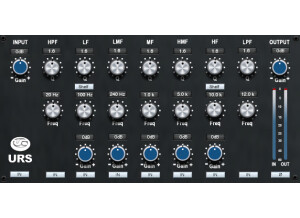
    The URS A Series Mix EQ is an equalizer plug-in that comes as part of the URS A Series EQ plug-ins. It's a more in depth version of the A Series EQ, offering more bands and therefore more control. Installing the A Series EQ plug-ins is a quick and easy process as you just follow the simple step by step instructions that your installation wizard will make you go through for installing any software. Learning the interface of the plug-in is quite easy as well if you understand how to use parametric EQ's in the first place. There are 7 bands in total, with the middle 5 giving you control over gain, frequency, and Q, while the two on the outside serve as high and low pass filters, giving you just control over frequency and band width (Q). The plug-in gives you the ability to pick and choose which bands you'd like to engage, as well as overall input and output gain knobs. It's an easy plug-in to use, so I don't think you'll need a manual. I'd recommend doing some research on equalization in general if you feel lost with this one... SUITABILITY/PERFORMANCE I've got the URS A Series Mix EQ plug-in currently running on my system at home. This rig consists of Pro Tools 9 and a Mac Book Pro lap top. The computer has 4 GB of RAM and a 2.2 Ghz Intel Core 2 Duo processor, which has definitely be powerful enough for me to run this plug-in comfortably. Generally, I'll run the regular A Series EQ plug-in if I'm just using one or two bands, but if I'm looking to get more in depth I'll pull this one up. Everyone who has the A Series Mix plug-in will have the simpler one as well, so no matter what system you're running it on it's a good idea to be mindful of this. OVERALL OPINION The URS A Series Mix EQ is overall, a great EQ plug-in to have around in my opinion. I use it pretty often when I'm looking to get some in depth equalization done for mixing if I'm working in the box. The EQ has a really clean and realistic sound, although of course as always it's what you do with it. However, you really couldn't ask for more control with the A Series MIX EQ, as it definitely covers the full spectrum of frequencies and has enough control where this can be useful for any application. URS has a nice array of different EQ plug-ins that are modeled after different consoles, so I'd encourage you to check them all out before settling on the A Series EQs, which certainly isn't a bad way to go at all. This series of plugs is cheap enough where it's attainable for almost any DAW owner, so definitely do yourself a favor and at least try out the demo!

  • moosers's review

    The URS S Series Mix EQ is one of two plug-ins in the S Series bundle of EQ plug-ins. It's basically a more in depth version of the original S Series plug-in. The plug-in is made up of five bands as well as a high and low pass filter. Each of the five main bands have parameters for frequency, gain, and Q (band width). It also gives you control over both the input and output levels. Between the five bands and the high and low pass filters, there's a ton that you can do right in the box here with this one plug-in. It's labeled as a mix EQ for a reason, as it's definitely best suited for mixing and getting in depth with sculpting your sounds. It's easy to use if you know how to use a parametric EQ, so a manual isn't really necessary. SUITABILITY/PERFORMANCE I'm currently running the URS S Series Mix EQ in Pro Tools LE 8 on my home system. This has been an adequate system for running multiple instances of this plug-in at a time without issues. My system specifically includes a Mac Book Pro computer with a 2.2 Ghz Intel Core 2 Duo processor and 4 GB of RAM and a Digi 002R audio interface to run Pro Tools. It's always hard to say how well a plug-in will run on a given system, so definitely give the trial version a whirl before buying just to be sure. OVERALL OPINION I love the in depth control available with the URS S Series Mix EQ, as between all the bands on here you can pretty much do everything you want to in terms of using EQ during mixing (or otherwise if wanted). If you're doing more simple EQ moves it's probably best to use the S Series EQ that is also included with this plug-in, but for more in depth sculpting this one is the way to go. It's really got a clean sound as it doesn't really bring it's own color to the table, and I mean that in a good way. URS has been seemingly dropping the prices of their plug-ins, so the URS S Series Mix EQ is available at an incredible price! Definitely an awesome EQ plug-in to have as an in the box mixing option...

  • moosers's review

    The URS 1970 Classic Console Compressor is compressor/limiter plug-in for virtually all software platforms. It's available for both PC and Mac in TDM/RTAS (Pro Tools), VST, and AU (for Mac) plug-in formats. It's probably my favorite plug-in from URS and is in general one of my favorite compression plug-ins. I've owned the plug-in for a few years, but from what I recall it wasn't too difficult to install or get it on my iLok or anything like that. The design of the plug-in is basically modeling itself after a Neve 2254 console compressor that was built into a number of the old Neve's. Of course they aren't licensed to say that this is modeled after it, but it most surely is. Included with this plug-in is both a compressor/limiter/sidechain version and a compressor only version. The compressor only has parameters for input level, compression ratio, threshold, gain make up, attack, and release. The full version has all of those parameters plus high and low pass filters and a limiter section with separate parameters for limiting threshold, attack, and release. A manual shouldn't really be necessary unless you're not too familiar with using compressor/limiters in general. SUITABILITY/PERFORMANCE I'm running the URS 1970 Classic Console Compressor plug-in on my home system where I'm running Pro Tools LE 8. I've got a Mac Book Pro lap top that has a 2.2 Ghz Intel Core 2 Duo processor and 4 GB of RAM. I'm running Pro Tools LE with a Digi 002R audio interface. In most of my sessions I've got at least a few of these running at a time, and it's safe for me to say that I can pretty much use this as a please on my given system... OVERALL OPINION I'm a huge fan of the URS 1970 Classic Console Compressor, as it's definitely one of my go to compression plug-ins. I always try to use analog compressors when I can, but if I'm working in the box at home I find this plug-in to be perfect for applications of all sorts. It's very warm sounding as far as plug-ins go, and I find myself using it mostly on vocals, guitars, and I also love using it on a drum bus channels. It's definitely useful across the board however, as I won't hesitate to use it on anything. I like many of the plug-ins that URS has to offer, but the 1970 Classic Console Compressor is probably my favorite, which I think is saying a whole lot...

  • moosers's review

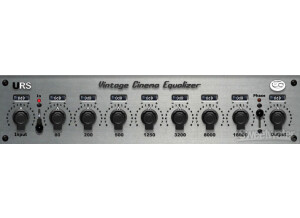
    The URS Vintage Cinema EQ is an equalizer plug-in that is part of the M Series bundle from URS. This bundle is made up of just two plug-ins, this and the MotorCity EQ, which is a similar type of equalizer with a different set of fixed frequencies. In fact, the two plug-ins compliment each other quite well in terms of the frequencies chosen, so it's definitely no coincidence that they're putting them out as a package together. As far as installation goes, there shouldn't be anything out of the ordinary here as from what I can remember it was a straight forward process much like installing any other plug-in or other software. It's compatible across the board, so there should be no problems here. Using the plug-in is really simple - it's got seven bands each at a fixed frequency ranging from 80 Hz to 16 kHz. As mentioned before, it compliments the MotorCity EQ well, so if there's a frequency you want that isn't here, chances are it will be on the MotorCity EQ. In addition to the seven bands, it has input and output level knobs and a slider for phase. I haven't seen the manual for this plug-in, nor do I think one would be necessary. SUITABILITY/PERFORMANCE I'm running the URS Vintage Cinema EQ plug-in on my home system, which is Pro Tools LE 8 based. I run it on a Mac Book Pro that has a 2.2 Ghz Intel Core 2 Duo processor and 4 GB of RAM. Pro Tools LE 8 is running with a Digi 002R audio interface, and I'm monitoring with a set of Adam A7's. I haven't had much problems with performance with this plug-in within this system, as it seems to have been quite stable. I haven't tried to run one of these on every track, but so far it's been running smoothly for what I need it to do. OVERALL OPINION When paired with the MotorCity EQ, the URS Vintage Cinema EQ and the M Series bundle of EQ plug-ins is a nice set at an even nicer price. You've got yourself a solid EQ with the Vintage Cinema EQ. It will do the job more times than not, although it's somewhat limited at times since it doesn't allow you to choose your own frequencies. Stacking the two plug-ins in this bundle will do the job almost always, as you'll get more frequencies and more control. I like the way this EQ sounds, and they definitely have their own sound, which can be considered a helpful or hurtful thing depending on how you're using it. At this price, the Vintage Cinema EQ and the URS M Series bundle are definitely worth your time in checking out.

  • moosers's review

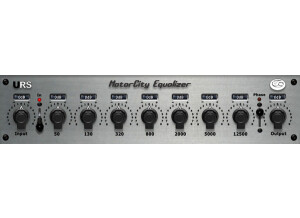
    The URS MotorCity EQ is a software equalizer in the form of a plug-in for Pro Tools and other DAW's. This plug-in is included in the M Series bundle that also has the Vintage Cinema EQ plug-in in, both of which are pretty similarly laid out. I didn't encounter any problems with installation of the plug-in as it was straight forward and easy from the first step. Using the plug-in in general is also pretty simple, as it's a seven band, with each having it's own fixed frequency. The EQ is designed after an equalizer that was used on Motown records according to URS, although I'm not sure exactly what hardware EQ they're referring to. I generally prefer to use parametric EQ's since you get control over the frequencies, but even while I like to have as much control as possible, it's worth noting that the other plug-in in the bundle, the Vintage Cinema EQ has different frequencies to choose from. So between the two different plug-ins in the bundle, you have a more complete set of frequencies than what you see just on this one alone. Even so, you've got a pretty complete plug-in in itself here, as a lot of tone shaping can be done between the frequencies given here. I haven't looked at the manual for this plug-in, so I can't speak to it's make up. SUITABILITY/PERFORMANCE I've got the URS MotorCity EQ and the M Series bundle of plug-ins running on my home recording rig. It consists of a Mac Book Pro with a 2.2 Ghz Intel Core 2 Duo processor and 4 GB of RAM. I'm running the plug-in in Pro Tools LE 8 that runs with a Digidesign Digi 002 rack version audio interface. My system is pretty consistently powerful, so it's rare that I'll have trouble with plug-ins unless I've got a really big session going, so this one doesn't cause me any trouble. OVERALL OPINION Between the URS MotorCity EQ and the Vintage Cinema EQ that also comes in the M Series bundle, you've got a very nice sounding set of equalizers. On it's own, the MotorCity EQ works great on a variety of instruments, although I find it especially useful for fattening up a bass sound by boosting some of the low frequencies given here. It's certainly more versatile than just a bass EQ, but is what I usually use it for. The M Series bundle is cheap enough that it's definitely worth considering to have as an extra add on equalizer, but I don't think I'd recommend this as your first and/or go to equalization plug-in.

  • moosers's review

    The URS A10 Series equalizer is a graphic EQ plug-in that is basically a software version of the API 560B 10-band equalizer. The plug-in is available as an individual plug or within a few different URS bundles if you're looking to get more bang for your buck, although it's a pretty good deal anyway. I don't own this myself, so I wasn't involved in the installation of the plug-in. The configuration of the actual plug-in itself is really simple, as it's just as you'd expect a 10-band equalizer to look. It has 10 bands that range in frequencies from 31 Hz to 16 kHz. In addition to the ten bands, it also contains sliders for input and output, and buttons for in/out and phase. The decibel range on each of the sliders can go to 12 db either way. I haven't had a look at the manual for this plug-in... SUITABILITY/PERFORMANCE I've used the URS A10 Series EQ on a few different systems at the studio where I'm currently working. We have a number of different rooms with different studio configurations, but all of them are Pro Tools HD rigs and run with Mac Pro computers. We very rarely have performance issues within plug-ins or otherwise, so this set up isn't a great judge for how well this plug-in will run. Having said this, I'd be surprised if there were many users out there having trouble running it since it's a basic EQ plug. OVERALL OPINION Overall, the URS A10 Series is a more than adequate graphic equalizer. It's straight and to the point and there should definitely be no debate on how to use the features in here. The frequency range and the chosen frequencies are adequate for equalization for a number of applications. In my time using the plug-in I've found it most useful for use on snare drum and other drums where I'm looking to bring out a certain color. It definitely works well across the board however, as it's a general EQ with a clean sound - it's really just what you do with it. If you're looking to expand your plug-in palette with a graphic EQ, the URS A10 Series is a nice choice that can be had for a pretty reasonable price...

  • moosers's review

    The URS 1980 Classic Console Compressor is a dynamic processor plug-in, coming with two versions of the plug-in - one with a sidechain and one without. I don't know exactly what console compressor this is modeled after, but there is also a 1970 and 1975 model, all of which I've used and love. This one in particular was very easy to install as I didn't encounter any issues doing so as it was as straight forward as a process as you'll find when it comes to installing plug-ins. The plug-in's interface isn't unlike the 1970 and 1975 Classic Console Compressors, as they all look pretty similar and share the same sorts of parameters. This includes compressor, limiter, and filter section, with plenty of control for uses of all types. I definitely don't hesitate to use this in all situations, as the vast array of parameter make it quite versatile. SUITABILITY/PERFORMANCE The system that I'm running the URS 1980 Classic Console Compressor is Pro Tools LE based. I'm running it on a Mac Book Pro that has 4 GB of RAM and a 2.2 Ghz Intel Core 2 Duo processor, while I'm running version 8 of Pro Tools LE with a Digi 002R audio interface or a Digidesign Micro Box if I'm on the go. I've been able to run multiple instances of the plug-in without issues within this configuration, as it doesn't take up too much processing power from what I can tell within the bounds of my home system. OVERALL OPINION I'm a really big fan of the URS 1980 Classic Console Compressor and of URS in general as I think they make some great plug-ins. This one is awesome as there is so much control over your sound and it can really be used across the board. I don't like the 1980 version as much as I do the 1975, but they are definitely pretty similar in sound and are extremely similar in make up, so if you've got one of them that's probably all you really need unless you're looking to expand on this idea. I can't say enough about the fine work done by URS, and the 1980 Classic Console Compressor is just one example of it.

  • moosers's review

    The URS BLT Program Equalizer is a really simple, two band equalizer plug-in. I don't own the plug-in myself, but have used it extensively enough in the professional recording studio where I work. For this reason I wasn't involved at all with installing the plug-in. However, learning how to use the plug-in could not be any easier. Literally, this is the simplest plug-in you'll find out there and is only intended for really simple equalization because of this. It's only got two bands for bass and treble, along with an overall leveling knob as well. The bass band is fixed at 100 Hz, while the treble band is at 5 kHz. Even though there isn't much flexibility, it isn't supposed to be used for fine equalization. Rather, it's best suited for adding or removing some brightness or darkness simply and quickly. A manual is not needed in the least! SUITABILITY/PERFORMANCE The system that I've used the URS BLT Program Equalizer on is Pro Tools HD based, so it's not exactly a good judge for how much processing power the plug-in takes up. Having said this, being that it's a really really simple plug-in, it shouldn't take up much of your processing power at all. I would think you'd be all set as long as you have a system that you're currently comfortable running plug-ins on. OVERALL OPINION For really simple EQ coloring, the URS BLT Program Equalizer is a fine little plug-in. It sounds quite good for what it can do, but of course it's pretty limited in what it's able to achieve since it's only two bands and they are both at fixed frequencies. Even so, it's still useful for times when you're looking to get a real quick EQ job done. The best part about the plug-in is how cheap it is! The price is about as cheap as you'll find a plug-in that isn't free. I wouldn't recommend this as a primary EQ at all, but if you're looking for a simple extra color, this is a super cheap way to expand your plug-in collection.

  • moosers's review

    The URS N Series equalizer is a plug-in that is modeled after a Neve 1084 channel strip EQ. The picture above is the older version of the plug-in, which looks like a real Neve, but the newer one that I have doesn't share the same interface look. Either way, the plug-in has the same parameter make up - perhaps they lost the right to use the Neve look. I didn't encounter any issues at all while installing the plug-in, which will also include the N Series Mix plug-in which is the same but with more bands. The configuration of the N Series EQ is the same as a Neve EQ, consisting of three bands and a high and low pass filter. The only difference is that the real Neve 1084 just has the high filter and no high pass. Each of the three middle main bands has parameters for gain and for frequency, where it gives you a few different frequencies to choose from on each band, sharing the same frequency selection as the Neve. I haven't had a need to check out the manual for this plug-in so I can't say how it's configured. SUITABILITY/PERFORMANCE Running the URS N Series plug-in hasn't been difficult for me to do at all on my home system. I've also ran the plug-in on a Pro Tools HD system, but at home I've got it in Pro Tools LE 8 running on a Mac Book Pro with a 2.2 Ghz Intel Core 2 Duo processor and 4 GB of RAM. I run Pro Tools LE with a Digi 002R audio interface or a Digidesign Micro Box if I'm on the move. No matter what the system, I've never had any performance problem with this plug-in and it's definitely worth noting that I've had many instances of the plug-in going at a time. OVERALL OPINION The URS N Series is one of my favorite equalizer plug-ins out there, although I do miss the days when it looked just like a Neve. I guess I like the plug-in a lot since I'm used to using Neve equalizers, as it's very familiar to me especially considering the frequency selection. Of course it doesn't sound too much like a real Neve 1084 EQ, but it sounds pretty good nonetheless. As far as Neve based software EQ's go, these are the best I've seen...

  • moosers's review

    The URS Classic Console Strip Pro is a channel strip plug-in consisting of compressor and a variety of equalization filters. The process of installing it was just as easy as installing any out there as I just followed the step by step instructions that it took me through. I didn't encounter any compatibility issues or other problems at all as the whole process was virtually pain free. The interface of the software does have a good amount going on, but everything is clearly labeled and easy to follow, so I didn't have too much trouble adapting to the plug-in. The compressor has parameters for ratio, attack, release, knee, threshold, and gain make up, while the EQ has four bands as well as a high pass and low pass filter. The main EQ bands have the standard parameters of frequency, gain, and Q. There are also input and output levelers, and a slew of routing options in the section of the left side of the plug-in. I've never seen a manual, but the typical functions are advanced ones are easily located, so I don't believe that one is necessary unless you are having problems with installation or something of that nature. SUITABILITY/PERFORMANCE I currently have the URS Classic Console Strip Pro plug-in running on a Mac Book Pro that has a 2.2 Ghz Intel Core 2 Duo processor and 4 GB of RAM. I run the plug-in in Pro Tools LE 7.4 with a Digi 002R audio interface or Digidesign Micro Box, depending on where I'm working from. Within this rig, I've found no real issues running the plug-in as much as I'd like. Having said this, I've probably only had a need to run two or three of these within a single session, and although I do think that I'd be able to run considerably more than this, I can't say so for sure because I haven't tried. You should also keep in mind that the plug-in does have a lot going on and will take up slightly more processing power than your average plug-in would... OVERALL OPINION The URS Classic Console Strip Pro is a really powerful piece of software. It give you access to both a great sounding compressor and EQ within a single plug-in, both of which are quite in depth. I love the plug-ins that URS has to offer because they have a killer tone and also are very reasonably priced, making them more accessible to home studio owners like myself. I've used the Strip Pro on a variety of recording sessions during mixing, and have found that it works great in all sorts of applications. The best part about the plug-in is that it has incredible versatility and the capability to be used for all sorts of things. Adding channel strip plug-ins to your Pro Tools or other DAW is a great way to save money as they offer a lot of bang for your buck, which is defintiely the case with this one. All in all, the URS Classic Console Strip Pro is definitely a plug-in worth checking out, even if you only try out the demo!

  • moosers's review

    The URS M Series EQ Bundle is a two plug-in bundle modeled after the EQs used during the recording of classic Motown tracks. Both of the plug-ins are similar in make up, but each offers up different set frequencies to work with. I didn't have any troubles installing the bundle as it only took a few minutes in total and was able to use the plug-ins within a matter of minutes. I can't think of a time where I've ever had any compatibility issues or other problems while using these plug-ins as it has been a pain free process overall. The interface of the software is virtually the same on both of the plug-ins, as each has seven bands of EQ and an input and output knob as well. There is also a phase slider and a bypass slider. These are pretty easy to use and understand so I don't think that the manual is necessary, although I haven't seen it so I can't say for sure. SUITABILITY/PERFORMANCE I am currently running the plug-ins on a Mac Book Pro that has a 2.2 Ghz Intel Core 2 Duo processor and 4 GB of RAM. I run the plug-ins in Pro Tools LE 7.4 that runs with a Digi 002R audio interface and within this set up I've yet to experience any problems pertaining to this plug-in. These are plug-ins that don't take up much processing power at all since they are pretty straight forward, so for this reason I don't think that too many people will have issues running these plug-ins. This being said, it really all depends on what type of system you are running the plug-ins on. OVERALL OPINION I've been running the URS M Series EQ Bundle for about a year or so and they are definitely some of my favorite plug-ins to use. They have a stellar sound quality and while I don't know how close they sound to the actual EQs used during the recording of Motown songs, they do sound great even when considered on their own. URS has an incredible line of plug-ins and I would definitely recommend checking them out as they are cheap and sound great. The URS M Series EQ Bundle definitely fit in within this and for this reason I would absolutely recommend trying these plug-ins, no matter if you are a home studio owner or a professional.