Log in
EN
FR

V/XPL/FB Shaped Guitars

1023 products found

Sort results
  • Popularity
  • User ratings
  • Price - low to high
  • Price - high to low
  • Used price, increasing
  • Used price, decreasing
  • Name (from A to Z)
  • Name (from Z to A)
  • Added on

The best V/XPL/FB Shaped Guitars reviews

The reviews Audiofanzine members found the most helpful.
  • « Hufschmid Tantalum 6 string guitar w/quilted maple top »

    I decided to custom order a Hufschmid guitar because I am a fan of independent builders and their work. Patrick Hufschmid is an independent builder for the past 23 years, who lives and works in Aigle, Switzerland. I opted for his super strat body, which is a double cut shape with pointed horns. I wanted a quilted maple top, which is joined to a highly ribbon figured one piece sapele body... a staple of the Hufschmid builds. The neck is a one piece sapele neck with a west african ebony fingerboard and has a 3 per side tuner configuration on the Hufschmid designed headstock. I love the way the strings do not break in either direction as they leave the nut, they are in a straight line with the tuner which enhances tuning stability. There is also no need for string trees with this type of design. The neck is hand carved by Patrick based on a picture of my hand, and I must say it is a truly comfortable profile, it feels perfect for me. I am impressed with the craftsmanship and the design of this guitar. The neck heel is exceptional, and is completely unobtrusive when you are playing on the higher frets. I love the playability of this guitar and the look is beautiful. Now on to the sound... I opted for the Hufschmid "flame maple textured" pickups, with the script "H" logo. The pickups look like they are made from blocks of black stained flame maple, there is actually a visible wood grain look to them!! Impressive and unique. Based on my musical taste I chose the OTT set of humbuckers, which are NOT active pickups, although they do not have visible polepieces. I love heavy rock and metal music and this guitar KILLS IT! The tone is incredible, with a defined heavy bottom end, and clear articulate highs. It has amazing sustain and is one of the most resonant guitars I've played. When I am feeling so inclined I play on clean and I am very impressed with the clarity and definition of the pickups. This guitar is capable of beautiful melodic sounds AND bone crushing shred... all in one super comfortable, very easy to play instrument. The action is low and fast, without any fret buzz. The intonation is spot on perfect. I would absolutely recommend a Hufschmid guitar to anyone who is looking to break away from the "big box brands" and wants to play something unique, which is entirely made by hand. Patrick sent me progress reports and photos daily and his communication was great. I never had to repeatedly contact him in hopes of a reply. The entire process was great. I received my guitar after roughly 6 weeks and was surprised because Patrick didn't inform me it had shipped... he surprised me by telling me it was being delivered to me that very day!!! I love the guitar and the entire experience was a pleasure. Here are my specifications: Super Strat, one piece ribbon figured Sapele body w/highly quilted maple top One piece Sapele neck w/heel adjust truss rod, 3 x 3 Hufschmid tension optimized headstock Exclusive Hufschmid " blue nut " West African Ebony fretboard, 24 frets Exclusive Hufglow Block inlays Hipshot locking tuners, w/knurled barrel knobs, black 2 Hufschmid OTT Humbucking pickups, flame textured, H logo Dunlop super pots, hipshot knobs, black 1 volume, 1 tone, 3 position pickup selector switch Hipshot hard tail bridge, black Hufschmid logo coin, inlaid on the rear of the body Clear electronics cavity cover Schaller strap locks It is a GREAT guitar, that sounds awesome and plays incredibly! Thank you Patrick!

  • « Great neck, and versatile sounds »

    I'm always using TH2 program via computer. (and for monitoring, I use an old East German amplifier, called 'Regent') this is how it sounds https://www.youtube.com/watch?v=wMzim3Iqy_4 I got it with hard case! Not bad, for the price :-) + the shape is very comfortable!! Mainly in sitting position, better than any guitar! Neck is perfect for me, with scarf joint, of course Very good tuners! (jackson) High output jackson PU-s Made in Indonesia, not in China as nowdays so workmanship is reliable - all the volume and tone pots were noisy when I turned them, so it must be changed

  • kinder_guano's review

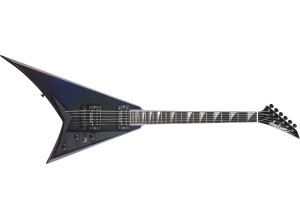
    Jackson Randy Rhoads made in the USA (Ontario, California) The RR2 was a standard series produced in 1996 and 1997, like the SL2 and the DR2 (that I also reviewed). These three series were the cheaper USA versions of the RR1, SL2H and DK1. Only a few colors were available (mostly gloss black, red metallic, gun metal grey and black metallic). Specs: - Bolt-on quartersawn maple neck with scarf joint. Gunstock oil finish. - A thick ebony fingerboard with no inlays (but there are side markers of course!). - Scale 25'' 1/2 with 22 jumbo frets. - 2-piece poplar body, in gun metal grey finish, standard headstock, "Jackson made in USA" decal. - All chrome hardware with  Jackson JT500LP locking tremolo. - One master volume knob and a 3 way toggle switch. - Stock pickups were Kent Armstrong JJB two double-0 in bridge and neck in JP-11 (specially made for Jackson) - Cool details, all the backplates are made of brushed alloy, no cheapo plastics like the MIJ. No frills at all here, to keep the price rather low: no MOP inlays, no bindings, no MOP logo. But the essence of any good USA Jackson is present: excellent woods, good finish, no flaws and a great player! Only regret, since it was among the cheapest US models, the tremolo is a good JT580LP, not an excellent Original Floyd Rose. I actually replaced the JT580LP with a good OFR without problem, just removed the japanese trem, slapped the OFR in, restrung and tuned the harmonics, nothing more. So easy! And much crispier with an OFR! Still, the perceived quality is far from the Japanese models, it's a real US guitar. UTILIZATION The neck is fairly wide and flat, the same as the DK-1's. Not an awful Ibanez ruler. The feel of the oiled neck is just great! It is immediately comfortable. The absence of fingerboard inlays is definitely not a problem, you get used to it very quickly. And it gives the guitar a killer look! The action is definitely no fret buzz though, the Floyd is recessed in a very deep route, and stays in tune. Access to the upper frets is good too, thanks to the heel contour, the neck plate is slanted to help reaching the upper frets. Better than what Jackson do with their Japanese models. The weight is ok, much heavier than any basswood stuff, still it can be compared to the weight of an alder guitar. It won't break your back! Unplugged, the sound is wide and rich. Great news! The V-shape really surprised me. This is my first scratched RR, I've always had superstrats and Les Pauls. I've tried a few RR in shops, but I could not make a real opinion. Now it's done! It is a rather well balanced guitar played standing up, though it seems the guitar has a tendency to flip... weird, you gotta get used to it. Sitting is just as easy, by placing the V on your thigh. Well, the big downside is the top pointy wing which can bang against a wall, furniture or your band mates while rehearsing ... I'm definitely not used to a guitar with these long wings!!! On top of that, it's so big the flight case is just über huge... (be careful if you ship it, it will cost more since it is 'oversized'). SOUNDS At first sight, when you see a RR, you immediately guess it was not built to play cheesy easy listening or bluesgrass. Do not expect extreme versatility. Or you need to go to the shrink!!! my current rig is simple right now: axe - lotsa pedals - Engl Powerball + V30 loaded cab axe - lotsa pedals - Engl Powerball + Palmer PGA04 - Mix - computer - headphones axe - Pod XT Live - Mix -computer - headphones I was amazed by the Kent Armstrong pickups I knew absolutely not how they'd sound. I read a review on Harmony-Central. The guy said they sounded like the DiMarzio PAF Pro ... we should not have the same ears, at least with the bridge pickup(JB-0). This pickup has a copious output level (at least 400 mV). Not as pleasant in clean where I always have to redo my settings, otherwise it crunches immediately. Yet it is the setting I use with axes in EMG 81, DiMarzio Super Distortion and Duncan Distortion ... Awww. It is not as extreme a DM X2N and / or Bill Lawrence 5800XL, but it sends a damn high output. In clean, the JB-0 is too powerful for me, but it does not have too much horrible trebles. You really have to play with the volume knob and have a very respectful picking in clean :o) The neck pickup is less extreme. It has something of an EMG 60/DM DP160 'Norton': fairly clean (not an avalanche of almost uncontrollable lows), not too warm (not like a Gibson Burstbucker or a EMG 85. No, not all EMG are ' cold '!). In crunch, it begins to be tasty, especially the JP-11 neck, provided, again, you don't want to sound too fat / too round. Really impressive, this compromise nice little warmth/ accuracy of a passive pickup. The JB-0 is very honest, a bit of a rage, it's not narrow sounding. Like a Gibson 500T that would have learned to be precise and to temper its enthusiasm in the lows, a DM Super Distortion which would have more character. In high gain , as guessed, miss RR2 is at ease! Sharp palm mutes, singing leads whatever the pickup selected. She has quite a good potential for a 'cheapo US guitar' ! Again, after reading the review from HC, I thought I would immediately pull the pickups out for my basic EMG setup...(yes, I bought it without trying it, since RR2s are definitely not easy to find in the area). The Kent Armstrong do the job! OVERALL OPINION I bought her one month ago, so this review will certainly change later on. So far, I play her a lot. The overall quality, the quality of woods (at least for the quarter sawn maple neck and the fantastic ebony fingerboard), poplar body (which does not screw the sound at all and seems to age well , as my RR2 was built 9 years ago!), everything is at the same level of qualityas the standard USA Jacksons. It's definitely not a MIJ RR3. Hardware remains a little cheap for my taste, which will be replaced by black Schaller parts and an Original Floyd Rose very soon. I don't like the chrome hardware on this guitar, plain black will give this RR2 a way better look. I am far from being unhappy with my purchase, in the end. It is still an excellent base, really worth the buck, that you can modify later on with better hardware if you're an eternal greedy and unsatisfied chap. Like me :o). It is not a refined RR1 or KV2 (let alone a fantastic XTRR or Y2KV) , no neckthrough no mother of pearl inlays, no bindings, basic hardware like the Japanese models, but the price is far from being the same. I forgot: due to its shape, you'll have to have a special guitar stand like the cool Ultimate Genesis, not too expensive and very useful. Jackson Power!!!!! Added 23/12/2005: I eventually sold her, but not before she got full black hardware and an OFR.

  • « Overall a great & cool guitar! »

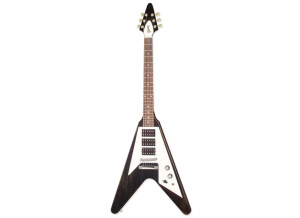
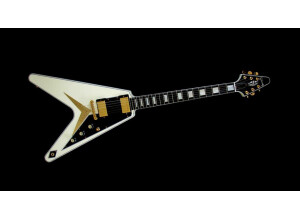
    Early 2000's USA made Gibson Flying V '67 reissue. Mahogany body and set neck, '60's thin neck carve, 24-3/4" scale & 1-11/16" width rosewood fretboard with 22 frets, Tune-O-Matic/Stop Bar bridge and tailpiece, a 496R Ceramic Humbucker neck pup, and a 500T Ceramic Humbucker bridge pup and 2 Volume, 1 Tone and 3-way Pickup Toggle for controls. UTILIZATION Being a V shape this guitar has unlimited access to higher frets - the easiest I've ever played! With 2 Volume, 1 Tone and 3-way Pickup Toggle for controls you can get a wide variety of sounds and I found it very easy to get good sounds with the guitar. Being a V shape, the guitar can be tricky to play while seated but all you have to do is have the V straddle a leg and I found it to be comfortable. This is my favorite shape of guitar to play live - it's light weight, sounds good and looks killer. You do have to be a bit careful that you don't bump the tips of the V wings since they hang so far out, so I'll take a point away for that. SOUNDS I used this guitar with custom built Peters amplifiers, which are kind of a cross between a Peavey 5150 and high gain Marshall/VHT with a little Boogie thrown in. It was also used with these amps:an Egnater IE4 pre, Marshall TSL, Mesa DC-5 and Peavey 5150II. The amp was paired with an Avatar 4x12 that had Celestion G12h -30's and a Splawn 4x12 with Governor/ManOWar speaker combo,a VHT FB cab and a stock Marshall 1960B. I usually go for a nice thick Jerry Cantrell AIC tone, to use with my modern rock/metal band. The guitar had a very open sound to it and all frequencies were represented fairly evenly with a bit more emphasis on mids and quite a bit of highs. It was tight and crunchy under high gain playing. Overall a very nice sound. The cleans were just ok because the ceramic humbuckers didn't clean up that well. My favorite sounds with this guitar were the high gain tones - both lead and rhythm playing. Least favorite tones were the limited cleans. Overall, it suited my style of music very well! OVERALL OPINION I loved just about everything concerning this guitar - so much so I bought 2 Gothic V's! I bought this as a scratch and dent from an online retailer and got a great price on it. I would buy this again if under the same circumstances. My least favorite things are the sitting and playing issue and the so-so cleans, but I still loved it. I have owned many guitars and had a number of years where I would buy, try and flip, which enabled me to have many guitars around to try out. This V has ranked pretty high on the list in overall satisfaction. I ultimately sold it when the Gothic V's came because I prefered the sound they had. For some reason, they sounded quite a bit thicker but until they arrived this was my #1.

  • « If you play metal, it's a King. If not, well.... »

    This particular model of Jackson King V is the highest end model you're going to find from Jackson's production line. Mine was built in March 2009 and is the Snow White model. This line of Jackson is built in the USA and seems very well crafted. It features an alder body, maple neck with ebony fretboard, 24 frets, MOP (mother of pearl) inlays, an Original Floyd Rose tremolo, and two Seymour Duncan humbuckers (A Jazz model in the neck and a JB model in the bridge.) It has two separate volume controls (one per pickup), a single tone control, and a 3 way selector switch. It's a pretty basic setup, but it works well enough. A major caveat I have with this control layout is that it's very cluttered and difficult to reach. Pickup switch flicks ala Yngwie are all but impossible because the bridge volume control is in the way, and you can't get to the neck pickup volume easily and quickly because again, the bridge pickup volume is blocking it. It's a leftover from the Dave Mustaine era of Jackson King V's and you would think that they'd change it... but it hasn't happened yet. Oh well, it's not a major thing, but it's definitely something you have to get used to if you like to switch pickups or adjust your volume/tone controls often. UTILIZATION Being that this guitar is an extremely pointy and large Flying V, I cannot say that it's ergonomic in any sense. It's a fairly reasonable weight (lighter than my Les Paul, heavier than most of the superstrats I've had), and it seems to balance fairly well when you're using a strap, but it's large and cumbersome to move around with because of the large and unwieldy points. The upper fret access is not nearly as good as I would expect from a neck through body Flying V (no cutaways to get around). The neck joins the body at about the 19th fret, so the last 5 frets can be a bit of a chore to get around. Also, the heel itself seems to be a bit clunky for a neck through design... so I was less than impressed there. As far as the the tones go... the biggest downfall that this guitar has is its lack of versatility tone wise. I was able to get a killer thrash metal or modern shred tone right away. However, when I tried to dial back the gain and play some more classic seventies and eighties riff rock, it was just not happening. I found this odd, because I previously had an alder bodied Charvel with a Duncan JB and a Floyd that I loved the tone off... this guitar just didn't have what I expected. I enjoyed playing Megadeth and such for a week, but once that wore off, I went back to my Les Paul and this went back into the case. Basically, it's easy to dial in metal tones, but if you want to play cleans/mid gain/rock type stuff, it's not the best guitar for that. Though, quite honestly, with a shape like this, I wasn't expecting anything super versatile. However, I hoped it would at least be able to do riff rock (Van Halen, Dokken, Loudness, early Yngwie, etc) but it just wasn't happening. SOUNDS When I got the guitar, I was using an Orange Rockerverb 50 Mark I head. I've since exchanged that out for a Mesa Boogie Mark Five. I was not overly impressed with the tones from either amp unless I was playing thrash metal type stuff (which isn't all that often.) The cleans were generally very flat and uninspiring, and since the pickups weren't wired for split coils or coil tapping, you basically had the sound of either humbucker or both together. Personally I don't much care for the sound of humbuckers played clean unless I'm playing jazzy stuff, so I really can't say the clean tones were or are currently impressive. (Ironically, this guitar has a Seymour Duncan "Jazz" in the neck position.) The mid gain tones were pretty much the same as the cleans... just very flat and neutral. A coil split might have made those tones a little livelier, but without having one in the guitar I can't judge how that would sound. Quite honestly, given the market of this guitar I'm not shocked at any of this, but it's still depressing that a $2,200 guitar really only does one or two sounds well, especially when the specs look so good on paper. The higher gain tones were great, classic Jackson thrash metal fare, but really, that was to be expected. The JB was very tight and articulate, perfect for those staccato metal riffs. The Jazz was very smooth and great for those Marty Friedman esque lead tones. But in retrospect, I should have assumed that a guitar like this was really designed for one set of tones (look at the shape for crying out loud!) OVERALL OPINION All in all, I definitely felt that this guitar was a very narrow focused instrument, really only looking and sounding good for one style of music (thrash metal). I will say that the guitar is very well crafted and displays no obvious construction flaws, but I just can't get into the vibe of the guitar. It was cool initially, but after the honeymoon was over I realized that it just wasn't my type of guitar. I'm not a very big guy so the guitar came pretty close to dwarfing me most of the time. I found it difficult to sit down with as well because the ends were so pointed. The tones as well were cool for metal stuff, but since I don't play that type of music on a regular basis anymore, it just acted as a lesser competitor to my Les Paul, and because I don't care for its rock tones, it just doesn't get played. As a result, I do plan to sell it and move on. USA Jacksons are a lot like Orange amps in my opinion... they're very expensive and you don't get a whole lot for your dollar in most cases. For $2,200 CAD brand new, this guitar is very limited in what it can do musically. However, if you want a killer metal machine without going Custom Shop... you can't go wrong.

  • « 1988 Beauty »

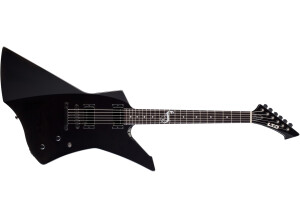
    A 1988 beauty made in the USA. This is an older Explorer Pro with a 10% undersized mahogany body and normal neck, 24 jumbo frets on an ebony fretboard with killer split diamond inlays, one bridge pickup (a non original EMG 81) and one volume control, tune-o-matic bridge with string through body. UTILIZATION The guitar neck is nice and slim, like a 60's LP carve, but a bit thinner after the 12th fret and up. The neck combined with the lower horn cut away provides very good access to the upper frets. The guitar is limited in the sounds it can produce because it only has the bridge pickup and one volume control. The 10% reduced body makes this more ergonomic than it's regular sized brothers. I found it to have a nice balanced weight. SOUNDS I used this guitar with custom built Peters amplifiers, which are kind of a cross between a Peavey 5150 and high gain Marshall/VHT with a little Boogie thrown in. The amp was paired with an Avatar 4x12 that had Celestion G12h -30's and a Splawn 4x12 with Governor/ManOWar speaker combo. I usually go for a nice thick Jerry Cantrell AIC tone, to use with my modern rock/metal band. The guitar had a very focused sound that all mahogany guitars seem to have. It was nice and balanced all across the frequency spectrum. It held up well with high gain lead and rhythm playing. The EMG didn't clean up very well for clean sounds. OVERALL OPINION Overall this was a nice guitar. I bought it used, so there were some dings - but nothing too bad for being 20 years old. The guitar had nice sounds across the board with distortion and useable sounds for clean, due to the single EMG pickup. I liked the neck carve, the weight and distorted tones the best. The cleans were passable. For being used, the action, fit and finish were very good. I have been through many guitars and had a number of years where I would buy, try and flip, which enabled me to have many guitars around to try out. I bought this via the internet and was not able to play it before purchase. I bought it because it looked cool and had a good price and I knew I could resell it without too much of a problem. In the end, it was too limited in sounds without having a neck pickup and it seemed to be very small when strapped on, I think I would have liked the regular sized better. Knowing what I know now, I would have passed on buying it, even though I broke even.

  • « Phil Campbell's Number One deserves its nickname »

    As a big Motörhead and Phil Campbell fan, I've always dreamt to own this guitar so when Lâg decided to release this signature model (especially one built in their Bedarieux custom shop) I didn't hesitate before ordering one. No need to develop the kind of music it's aimed at, but it also sounds very well for clean sounds especially with the SH4 bridge pickup - the neck pickup being too soft and almost useless anyway. Of course, it really shines on big good ol' rock & metal riffs as well as solos, and for all this it's just the best guitar I've ever paired with my Marshall JVM215C. No tone know (useless anyway :-D), just one for volume. Take it up, put it at full volume and play Rock n' roll. I don't know exactly why, but while I own several guitars with the same SH4 bridge pickup the PC2000 happens to be the one with the bigger and more powerful output level. Perhaps the wood? It's quite heavy by the way, 9 lbs ain't any light. The wood is really great, the Made in France finish and fretwork are perfect, the top is beautiful (a real change from black guitars, ain't it?). The only cons is when I bought it new it was delivered with a straplock on the upper part of the body, while the original's is located where the body and neck meet, so I changed it myself as this position is more practical - except that now I have a hole on the upper part of the body (which I could fill or put a second straplock) - anyway if you order one new remember to precise where you want it to be located. As for its grade? Out of ten, this one goes to eleven ;)

  • « What a cool guitar! »

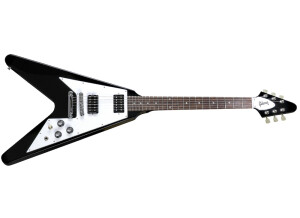
    Body Species Maple Body Type Slab Adhesive Franklin Titebond 50 Neck Species Mahogany Profile Melody Maker Truss Rod Traditional Adjustable Joint Angle 1.75° (+/- 15 seconds) Adhesive Franklin Titebond 50 Neck Fit Joint Mortise & Tenon Adhesive Franklin Titebond 50 Joint Angle Tolerance +/- .005" Fingerboard Species Baked Maple Frets 22 Radius 12" Nut/E.O.B 1.695"/2.260" Inlays Dot Nut Material Corian Width 1.695 Slots Gibson PLEK System Headstock Truss Rod Cover with Hot Stamp Gold Gibson Logo Black Antique Bell Tuners Model White Button Tailpiece Type Wrap Around Tailpiece Plating Chrome Hardware Knobs Black Top Hat Strings .010 - .046, Genuine Gibson strings Strap Buttons Aluminum Pickups Bridge Position Seymour Duncan HB-103 (Ceramic) Electronics Potentiometer 1 Volume Control Type 300k Linear Volume Coil Wiring Machine Wound Output Jack Traditional 1/4" Finish Sealer Nitrocellulose Process 1-1.5 mils Satin EbonySatin BlueSatin WhiteCase Type Gigbag Accessories Additional Materials Gibson Owners Manual UTILIZATION Cool! I started playing guitar in the 80s, and regularly going to guitar stores (and pawn shops) in the early 90s. Back then, there were all sorts of 60s Melody makers around. Most had the traditional Les Paul shape, some had the sharp doublecut shape (like an early Epiphone Olympic), and some had the SG shape. I always thought the SG -shaped MM was a very cool guitar, but I wondered what would happen if Gibson gave the same Melody Maker treatment to some of their other iconic body styles. Here's my answer! The Flying V has become a Melody Maker now, and to great effect. Gibson did a good thing and gave this guitar a humbucker pickup instead of the single coil they usually put in the MM models of the past, and it is a much better guitar because of it. SOUNDS The guitar is pretty simple - one pickup, one knob. It sounds bright and cutting, all the time. The only real way to affect any change is to change amp or effect settings. What you see is what you get with this guitar, and it's great for any rock style, even metal. OVERALL OPINION I'm a fan of this. The cool factor is way up there, and it's good to have available a USA-made Gibson Flying V for under $500! It's for minimalist guitarists - players that don't feel like futzing about with their knobs and players that just wanna rock. Very nice, Gibson.

  • « Could use some work on pickups »

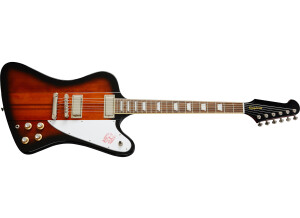
    USA made. Mahagony body and rosewood fingerboard. Crazy tuners. 4 control setup. Typical firebird pickups. It's a fairly stripped down guitar. The scale I believe is Fender instead of the shorter length you usually see on gibsons. For such a pricey guitar it's not a massive feature set but on the other hand these are not the most popular guitars. Seems like they don't make very many. UTILIZATION Some people say these are awkward to play. I can see how some would say that and I think it's because the longer scale length kind of throws some guys. Personally I'm used to the length so I'm right at home playing this guitar. The body shape is pretty comfortable and kind of reminds me of an SG in a lot of ways. All things considered it's an ergonomic design despite what the wacky lack might make you think. Fret access is great. Knobs feel pretty solid. These are definitely well made unlike a few models that Gibson makes which are know to have QC issues. Maybe I just got a good one. SOUNDS Here's my gripe with these. The pickups on them sound nothing like actual vintage Firebird pickups. I have played a couple original Firebirds and the pickups they put on this reissue model are way too hot and not EQ'd right. They're very muddy and don't have that high treble the old ones do. I realize it's hard to recreate a pickup perfectly, but saying that the reissue doesn't get close is putting it nicely. The new ones sound more like P90 single coils than anything. The original sounded more like a ticked off telecaster. That said, they aren't bad pickups. But if you want the original sound you'll have to shell out the extra $200 or so for a repro set. A guitar that costs this much should not need an upgrade like that however. OVERALL OPINION I'm impressed with everything but the pickups. Actually this is a really nice reissue despite being a bit hard to find sometimes. Like I said before, I have seen and played a few original ones and this remake does do the design justice. If you are more concerned with getting the look down, this will be a satisfying axe, but if you want accurate sound and looks, expect a pickup switch.

  • « Very solid for the price »

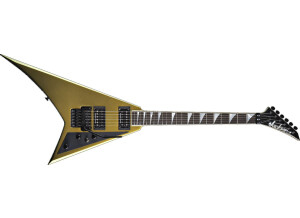
    Jackson is working on making a bit of a comeback on the medium priced guitars lately. The new X series is a throwback to the old school X series they used to have, but these seem to be a bit higher quality from what I've seen. The guitar features a basswood body, a neck-thru maple neck design with a rosewood fretboard, 22 frets with sharkfin inlays, a licensed floyd rose bridge, two EMG pickups (81/85), one volume, one tone and a three way switch. UTILIZATION The guitar itself was put together quite nicely. There are no issues with the neck joint thanks to it being a neck-thru design. The fretwork on this was pretty good, too. The frets were fairly level, and the ends were beveled enough to where it doesn't slice your hand when you move it up and down the neck to various different fretting positions. No need to worry about the nut being cut properly because it has a locking nut. The floyd on this is decent, but there are better floyds out there, in my opinion. It's not the worst, but I wouldn't say it's the best, either. Fluttering was a little stiff, and the way the arm secured seemed to be sloppy thanks to the tolerances. The rest of the guitar was put together quite well. SOUNDS The guitar had EMGs installed in it stock, and that's probably its biggest selling point. EMGs alone are worth a good chunk of change, so these real pickups are definitely a selling point. Anybody who has played EMGs before already knows how they are, what they excel at, etc. These are no different, even with the basswood wings. The 81 is super tight and compressed. It can deliver some crushing metal tones with ease, but the cleans suck, and it can be a bit sterile at times. For recording, it's one of the best pickups in the world. The 85 is super fat and compressed. It does awesome fat, smooth leads. Perfect for legato and sweeps. The cleans are a bit bland, but it's not too bad. For genres other than metal, they're probably not the best pickups. OVERALL OPINION These are pretty solid guitars, and if you're looking for a good quality V without breaking the bank, this could very well be the guitar you're looking for. The guitar is pretty good stock, and aside from a setup, not much else would be needed. I'm interested in seeing how much these'll go for on eBay.

  • « 80s Explorer with active EMG's »

    This is a cool new guitar from Epiphone. Recently Gibson reissued a small number of 84 Explorers as part of its Guitar of the week line. Now Epiphone has a model out. I dont know how long they make it for but I hope they make it for a long time because it is a great model. It is called the 1984 Explorer EX. It is based off of the famous mid 80s Explorer that James Hetfield is most famous for using. It has all the right hardware as well. It has a mahogany body and neck with a 22 fret rosewood fretboard. These 84 Explorers had no pickguard and nor does this one. It has fully active EMG's in the Zakk Wylde set. It has an 81 in the bridge and an 85 in the neck. The controls are simple with a master volume and master tone with a 3 way switch. Uptop are Grover tuners and the bright is a Locktone tune-o-matic and stop tail setup. UTILIZATION Explorers are nice guitars for the most part. The neck is pretty big but not too big. It is a D profile. The Explorer shape is all about balance. The guitar balances perfectly as you play it. Epiphone threw in some locking strap buttons on this guitar which are great. Small useless strap buttons can kill a guitar like nobodies business. The active EMG pickups require a battery and Epiphone has included a built in battery compartment so you can quickly change the battery for the pickup without opening up the entire control cavity. Only thing this guitar is missing is locking tuners and a locking bridge. SOUNDS The active EMG pickups mean this guitar punches above its weight class. If you played the Gibson version right next to this guitar (and I have) you wont be able to hear a difference. The pickups in this guitar are a classic metal setup. The EMG 81 and 85 are used by just about everyone in metal. They are a known commodity when it comes to metal. I am glad they didnt cheapen out and put some passive pickups in this. The 81 is a great bridge pickup. It has a great high end grind and lots of output and distortion. You can get your big chunky riffs with it and and it has a nice high end crunch. The 85 in the neck is great for leads and good for cleans. The 85 has a smoother sound than the 81 with more low end so it has a better tone for lead runs in the neck position. The 85 is also good in the bridge if you want a super thick sound. The 81 is not very good in the neck though. OVERALL OPINION You can get these guitars for about 600 dollars new which is a great deal compared to the Gibson version which is at least a couple thousand dollars. The guitars come with the same pickups and are made out of the same wood. This is the best alternative to the Gibson version. If you want a real 84 Explorer but cant afford this is your guitar. Its pretty rare for Gibson or Epiphone to put out a guitar that doesnt have their pickups in it so if you want one you better get one quickly because guitars like this usually do not last long.

  • « Fabulous sound and great playability »

    When you understand this guitar, you'll not need anything else... Turn off the active circuit (switch in centre position), have both pickups on and set vol to 10 on both - a typical full Les Paul sound. Then set the active switch to rear position - oh no! it will be all a bit overblown and not very musical. This is because the volumes need to be set to 5 to equal the non-active levels, 10 is far too much. I think this is the reason some people have doubts when they first encounter this guitar. For an ideal sound set the active switch to rear position, front p/u volume to 7 and rear p/u volume to 5. This gives that beautiful Les Paul scooped creamy mid sound (like Gary Moore on 'Still got the blues') but with an even longer sustain that goes on for ever without sounding falsely compressed. Leave the front vol at 7 but tweak the rear from between 4 - 8 if you want to change the brightness and attack depending on what or whether you a taking a solo. You'll get all those favourite LP sounds but with a little bit of extra goodness. The scale is long like a Strat so strings stay nicely in tune, the neck is very slim so allows really fast playing and this is helped by the hard ebony fingerboard with fat and low frets. Yes it's a bit heavy but it's a good shape for playing whilst seated so not a real issue. I have had this guitar since the early 80's and it's still the best in my collection and the one I always turn to.