Log in
EN
FR

TLC-Shaped Guitars

1176 products found

Filter
Sort by
Brand
Evaluation
  • Reviewed or not
  • Editor’s award
  • Reviewed by Audiofanzine
Availability
  • Available or not
  • Sold new or used
  • Sold new
  • Sold used
Must-have products
  • All products
  • Flagship products
  • Best rated products
  • Hot products
  • Popular products
Price
  • Freeware
  • Low-cost (< $650)
  • Mid-range ($650 - $1,500)
  • Premium (> $1,500)
€
Clear
Sort by
  • Popularity
  • User ratings
  • Price - low to high
  • Price - high to low
  • Used price, increasing
  • Used price, decreasing
  • Name (from A to Z)
  • Name (from Z to A)
  • Added on
Sort results
  • Popularity
  • User ratings
  • Price - low to high
  • Price - high to low
  • Used price, increasing
  • Used price, decreasing
  • Name (from A to Z)
  • Name (from Z to A)
  • Added on
Filter results 1,176 results found
Brands
Evaluation
Availability
Must-have products
Price
  • Freeware
  • Low-cost (< $650)
  • Mid-range ($650 - $1,500)
  • Premium (> $1,500)
Show results

The best TLC-Shaped Guitars reviews

The reviews Audiofanzine members found the most helpful.
  • « Elegant-looking – and, most important, great sounding!!! »

    Which amplifier and/or effect(s) do you use with this guitar? I’ve used it with a Marshall DSL50 and currently with a VOX MV50 AC with analog pedals (Trex Nova Comp, Trex Moller Tube Screamer, MXR Fet driver dist/fuzz, MXR Carboncopy delay...) and a DV Mark small 112 cab. What playing and musical style(s) do you play with this guitar? Blues/Rock, Country What are your thoughts on the workmanship, electronics, and finish of this instrument? I chose the Ice blue metal finish. The finish is very carefully done, the finely glittered paint is very classy and remains sober-looking while delivering that little extra that characterizes high-end models. The chrome hardware and the neck’s wood nuances come together perfectly. Ass for the luthers’ work, no problem, this is American Standard quality and you get a god wood resonance. The electronics is noiseless. The neck is just perfect for me, and after trying many a Telecaster model I can tell it’s only slightly under the Elite series but clearly above the usual Standard series models. The knobs and switches are nice, neither too hard or soft. How is its intonation? Does its neck, touch, feel, shape, etc complement your playing style? It perfectly stays in tune, even playing heavy bends. The neck matches my playing style. I consider the Telecaster to allow a very wide array of styles and sounds if you pair it with the right effects and amps. The nech is perfect for picking and fingerpicking.To me, the rosewood fretboard sounds more precise and pleasant than the maple one while retaining the same snappiness. Do clean, crunchy and distorted sounds adapt well to different microphone positions? Are the guitar's different frequencies and sounds well-balanced? The clean sounds are just perfect with the neck and middle pickup positions (although sometimes too bright, which can be EQed on the amp or corrected using the guitar’s Tone knob). I find the Vintage 58 pickups to sound more precise and “organic” than the Noiseless series that I’ve owned on one of my previous Teles (the Noiseless are good piuckups of course, but they tend to eat frequencies away). For distorted sounds, I put a Dimarzio ChopperT (a single-space humbucker) in the Bridge position to have more gain with my distortion pedals without altering too much the guitar’s personality. Wired in parallel with the neck pickup, the combination is excellent for rhythms. Of course, the original pickup is better-crafted and sounds wonderful but it still lacked a bit of punch to my taste (I’ll also mention I was just out of a “humbucker-only” period). Since then, I’ve put the original pickup back on as I have to sell it to finance another project, and I rediscover its original vintage sound with more snap, brightness, twang… Depuis, j'ai remonté le micro d'origine car je dois la vendre pour financer un autre projet et je redécouvre ses sonorités plus vintage avec plus de claquant, de brillance, de twang... What are the pros and cons of this guitar? Pros : - one of the most beautiful models in a limited edition - very good pickups, one notch better than the series standard models - the whole is well-balanced and up to par for such a price range Cons : - None that I can think of

  • « A formula one/fighter jet guitar - but oddly equipped »

    Hi all, I’ve played this fender qmt tele on two amps (rectifier Boogie and Jcm 800 (1982)), mainly for metal and prog metal up to math core for those who know. This guitar reminds me of the fender tele flathead, those which inspired the "Jim root" tele models. This guitar has a great neck, it’s really its main asset, big kudos for its ultra-fast neck ala 1980s jackson/charvel with jumbo frets with a finish that’s here and then better to feel than to look at – lol – but no real catastrophe, it’s just a bit disconcerting. The guitar is very stable and stays very well in tune with its auto-locking tuners, the nut is well conceived and the ebony fretboard is a real pleasure. The electronics is where I find its real flaws as the guitar’s concept really doesn’t match itw woodwork. Two splittable HBs to give them a wider range (to play everything heavier). In theory it should work, the idea is great but in the end the result is not up to expectations. It sounds like BZITBZIT, very un-natural but I can’t find the exact word, it remains in the spirit of whichever style you want to plan but it still sounds cheap and while the pots look nice they’re not easy to use as they lack adherence – so they ain’t much efficient. While the push-pull system is a nice concept (I’m still a bit frustrated), for a three-position split there’s no problem, classic, very efficient. The guitar’s body has a very nice shape with the same contour as the Jim Root model and the same enhanced access to high notes , another kudos (perfect finish). The one cons of the body is that it doesn’t resound enough to my taste, the sound spectrum lacks width. The guitar lacks expressivity for nuance players. All in all, this is essentially a metal-oriented guitar. That’s its true nature with an unbelievable ease of play, just a nice jigsaw away (lol) to please high gain addicts. To me, this guitar is great but it takes changing the pickups for ametal set such as Blackhawk, EMG 81/60 or Seymour Duncan Blackout... Only then will the electronics reveal its true potential for what it does best : WAR!!!!!!!!!!!!!!! ;)

  • Audiofanzine FR's review

    (Originally written by pmilani/translated from Audiofanzine FR) Fender American Vintage '62 Telecaster Custom Made in the USA, in Corona CA. Features: Alder body Maple neck Rosewood fingerboard 21 vintage-style frets Scale: 25.5" Radius: 7.25" Nut width: 1.65" Fender/Gotoh vintage-style machine heads Chevalet Original Vintage Style Tele Bridge with 3 Brass Saddles and "Ash Tray" Bridge Cover Chrome hardware '62 Tele Custom single-coil neck pickup '62 Tele Custom single-coil bridge pickup 3-way Blade toggle switch Sold with a Fender deluxe hard case UTILIZATION Until now, I used to be exclusively a Gibson fan but I wanted a single-coil guitar in my small collection so I started to try out different instruments. I thought about a Telecaster for a while, especially because of its mythic history... I've seen it in the hands of so many famous guitarists. The first ones I tested didn't impress me because I was used to the Gibson sound. I found their sound too sharp and their necks uncomfortable. The neck is very important for me! When I discovered the Tele Vintage '62, it immediately blew me away. Its neck is very impressive... I was used to Gibson's slim necks (60) but the neck of this Tele is even more comfortable. I guess it comes from the C profile, the 7.5" radius (which I've heard isn't everyone's taste), the slim frets and the nitrocellulose varnish. I also tried out the Tele '51. The sound is wonderful but the neck is much thicker (I guess it has a U profile). maybe it's the perfect neck for people with longer hands than mine. But in all other respects, the Tele '62 is really wonderful (mine has a sunburst finish). Sometimes I look at it as if it were an old furniture. It gives you the feeling of old varnished wood. And I'm sure it will get better with age. Just look at it, take it in your hands and you'll know it's a high-quality guitar with high-class components. It's a bit minimalist but that's normal for a Telecaster! Notice that in the factory setting, the guitar was wired in "no tone" mode, meaning that the neck pickup produced damped highs as if the tone control was turned fully down (and when you turned it, the sound didn't change). The modification for a standard operation requires only three solder points and a capacitor, which is provided in the guitar case. SOUNDS This guitar is somewhat versatile: I use it to play blues, rock, jazz and even folk music (no acoustic folk, but Dylan also played a Telecaster). On the contrary, I can't imagine playing heavy metal with this guitar and a shredder friend of mine couldn't play with it. It was not made for that! But the guitar is great for stuff like Jeff Buckley (Hallelujah for example, although he plays a '51 Tele) because the clean sound is stunning. Most people are looking for the twangy and aggressive Telecaster sound but I use it for its fine clean sound. It's the paradox of this guitar. I use it with my Fender Twin amp and a Maxon AD999 analog delay pedal and it's a delight. Playing with the tone control allows you to get very fine, smooth and subtle lows, as well as bright and crystal-clear highs; The sound ranges from very soft to aggressive (with the bridge pickup) but not harsh, perfect for crunchy blues and rock rhythm parts. It might be possible to make it scream (like Radiohead) but I use my Gibson DC Pro for that. OVERALL OPINION As a summary, the American Vintage series is a reasonable choice if you want an old school Fender (real vintage guitars are not affordable anymore!). Right now I'm thinking about a Stratocaster American Vintage '62 because its neck seduced me. I'll probably go broke because they are not cheap, but that's the price of good quality. Anyway I'm sure I'll keep these guitars all my life.

  • Audiofanzine FR's review

    (Originally written by coolzapp/translated from Audiofanzine FR) Made in the USA. 22 frets Two Alnico III single-coil pickups 3-saddle vintage bridge 3-way toggle switch Volume control Tone control Maple neck UTILIZATION Not too thick, very pleasant and easily playable neck ^^ Easy access to the upper frets. Quite light and very ergonomic (both sitting and standing =) SOUNDS The sound is the main asset of this guitar! It's amazing! Real typical Telecaster sound. I had the opportunity to try out more expensive Telecasters like the American standard and I didn't notice a huge difference! This guitar perfectly matches my needs. It's very versatile. I get a super sound with my Marshall MG 50 DFX. The clean sound is wonderful, the bridge pickup sounds twangy and the neck pickup warm! I love its sound with distortion. With the adequate settings you can play anything you want =) I play a lot of Bon Jovi stuff and the sound is terrific! OVERALL OPINION I've been using it for several months. I love its typical Telecaster sound, which is on the same level as its bigger sisters! I previously tested other Fender, Gibson, Ibanez guitars. But I fell in love with this one =D. The value for money is unbeatable for a guitar made in the USA! I'm sure I would buy it again! I took my time choosing a guitar fitting my needs. I tried out many models and this one was my favorite for its quality and looks. I recommend it to anyone looking for a good Telecaster at an affordable price. It's a killer guitar =) I give it 9/10 because nothing is perfect =P

  • « Excellent value for money »

    I don't pretend to have the ultimate truth so all info must be confirmed...However, currently, from my point of view, things are this way: - Vester is a US brand from the '70s/'80s/'90s which had a good reputation, especially, for its (very?) good Fender and Ibanez copies... - They were made in Korea or Japan - The company closed in 1994, after Fender sued them considering that their copies were too similar to the originals... Concerning this Telecaster Stage Series: - The body is made of massive alder, in theory - The neck is made of maple, in theory, too - The bridge is Tele-type - 2 single-coil pickups - Volume and tone controls plus 3-way toggle switch. Do note that Tele copies usually have a different headstock shape, but that isn't the case with this one. An important detail if, like me, you are somewhat of a purist in terms of aesthetics. And Vester even went so far as to copy Fender's logo (which, partially, explains the lawsuit...). USE The neck is very nice and fast. The guitar is weighty, but I love it anyway. It's not a shredder guitar (and I'm not one either), so access to the upper frets is average, in my opinion. At first I was surprised because, as I mentioned above, the truss rod can't be accessed from the headstock, but rather from the body/neck junction. Personally, after purchasing it, I had my luthier replace the tuners with a Gotoh set, among other things, which makes tuning more reliable than with the original ones. SOUND Before I say anything else, I must say that this guitar is totally new to me.... Being used to a Gibson Les Paul with fat humbuckers to play punk-rock/rock'n'roll, I'm exploring new territories... I kept the original neck pickup, which provides a very nice warm and round sound, typical Fender (I wonder if it hadn't been replaced before). I had a ball playing songs with clean sounds. I mounted a Kent Armstrong pickup on the bridge and it's wonderful. It's twangy, with a good punch, but precise and it crunches really fast depending on the attack on the strings. I alternate between a 90W Fender Transistor Deluxe (for clean sounds) and a 40W Marshall DSL40C tube amp (for crunch and distortion) to play The Gaslight Anthem, The Hives, The Clash, and even ZZ Top... One last point: I can hear a buzzz when I plug it to the amp without playing it, but you only need to line the interior of the guitar with tin foil to reduce it considerably (that was a tip from my luthier). OVERALL OPINION I've been using it for two months.. For the record, I paid 49 euros at a secondhand store (it was on top of a shelf covered with dust and it had a couple of scratches) and with all upgrades it came to almost €200. So it's an excellent value for money!! I love the Telecaster design, so I looked for a while for a Squier, a Mexican Fender, etc... But I can now tell you that this upgraded Vester clearly outclasses any Squier and some Mexican Fenders, which cost way more. Specialized sellers with whom I have talked about it have confirmed that it is indeed a very good guitar. I'm really happy and do not plan to part with it. If you ever run into a Vester, give it a try, it might be what you're looking for...

  • « Thinline in Fenders new Modern Player series »

    The Fender Modern Player series is a new line of guitars from Fender that provides beginner players Fender quality with low prices. Most of the guitars in this series are around 400 bucks which is great for a real Fender. This is the Thinline tele of the bunch. The Thinline Telecaster was introduced in the late 60s to help lower the weight of the guitar when Fenders supply of lightweight wood ran low. They gave the guitar a hollow compartment on the upper part of the body and gave it an F-hole for resonance. The body on this guitar is made from mahogany. It has a bolt on maple neck with a maple fretboard. The neck has 22 frets with a C neck carve. The pickups in this Thinline Tele are a set of P90s which is cool. The controls are setup like a 72 Deluxe with a volume and tone for each pickup and a 3 way toggle on the upper bout. UTILIZATION This guitar has a bit more modern feel than most Telecasters. The radius on the neck isnt as old school as some Teles. The radius on this model is 9.5 inches which is still round by modern standards but pretty flat for a Telecaster. This means you can get a lower action and lead playing is much easier. This guitar has a Stratocaster style hardtail bridge which I think is better than a normal Telecaster ashtray bridge. This bridge lets you intonate every string and doesnt have sharp edges to get in the way of your playing. SOUNDS The mahogany body and the thinline design gives this guitar a unique sound. This is not an all out twang machine like a traditional Telecaster but a lot of the twang is still there. The P90s in this guitar you get a more refined twang. They are single coils but they have a thicker sound. With the p-90 pickups this guitar is great for mellow stuff. You can get really jazz sound with some tone knob tweaking. The guitar is also great for blues. In the bridge position some of the tele twang comes out but it compliments the smooth sounds nicely. OVERALL OPINION The Modern Player series is great. This guitar could easily sell for double the price but they are selling it at a reasonable cost so younger people can get a hold of it. With these lower cost unique guitars younger Fender players will be able to try out something different than your typical Stratocaster or your typical Telecaster. If you are a younger Fender player and are looking for something different you should look into the Modern Player line up. They are selling their unique pawn shop style guitars for a really low price so you can check out some cool takes on your classic favorites.

  • « Mellow sounding Telecaster »

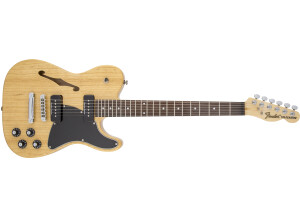
    Jim Adkins got together with Fender guitars to make his ideal Telecaster. This Telecaster features an unusual but great comination of features that help make this guitar sound very unique for a Telecaster. The guitar is based on the classic Thinline Telecaster design. The Thinline Telecaster was introduced in the late 60s to help lower the weight of the guitar when Fenders supply of lightweight wood ran low. They gave the guitar a hollow compartment on the upper part of the body and gave it an F-hole for resonance. The Telecaster is a thinline semi-hollow body with a two piece swamp ash body. The neck is a maple set in neck with a rosewood fretboard. There are 22 medium jumbo frets on the rosewood fretboard. There is a Gibson style tune-o-matic and stop tail bridge on the guitar. There are dual Seymour Duncan p-90 pickups in the guitar and a 3 way Gibson style pickup selector. Each pickup has its own volume and tone control. UTILIZATION This guitar plays better than most Telecasters because of the neck construction. The set in neck means there is less of a heel to get in your way when playing the upper frets of the guitar. The fretboard is a little flatter than what you would normally find on a Telecaster and is closer to that of a Les Paul. I find the Gibson style bridge setup more comfortable than a normal Telecaster ashtray bridge setup but this is subjective. SOUNDS This guitar does not really sound like a Telecaster to me which is good for me since I am not a big fan of the Telecaster sound. The semi-hollow thinline body matched with the swamp ash and p-90 pickups combine to provide a very mellow sound. The lack of a big ashtray bridge also helps tame the twang a little bit too. The Gibson style neck construction helps it get the mellow Gibson tones too. I wonder why Jim Adkins doesnt just play a Les Paul he has pretty much turned his Telecaster into one. With the p-90 pickups this guitar is great for mellow stuff. You can get really jazz sound with some tone knob tweaking. The guitar is also great for blues. In the bridge position some of the tele twang comes out but it compliments the smooth sounds nicely. You can really feel the resonance of the thinline body whatever you play. OVERALL OPINION This guitar is really nice but some Tele enthusiasts might be surprised when they plug it in. This guitar is like a Les Paul in a Tele costume. This is also a proper signature guitar. There are no silly logos anywhere. It is just a guitar with a little different setup than you could get a on a normal Telecaster. This is how signature guitars should be. If you are a Tele player and are looking for a mellower sound or you like mellow sounds and want a Tele this guitar is on of the few that can do it.

  • Audiofanzine FR's review

    (Originally written by Hobbie/translated from Audiofanzine FR) Squier Telecaster with a pair of Duncan Designed P90 pickups (Seymour-Duncan low-end). 3-way toggle switch, volume and tone controls for each pickup, Tele Custom-style pickguard, C profile neck with maple fingerboard. Vintage blond finish. UTILIZATION Rather thick neck like I like them, good overall finish. Very pleasant maple fingerboard. The instrument is well-balanced, not too heavy nor too light. The only defect in its design is the custom pickguard, which makes accessing the electronics more complicated. SOUNDS I play 70's punk music (thus mainly rhythm parts). I use the bridge pickup mainly with the distortion sound of a Fender Hot Rod. This combination sounds full and warm, and it has a strong personality with a good sound definition when the distortion is not excessive. Small con: this pickup has a lower output level than the neck pickup. Sometimes I use the neck pickup or the combination of both pickups for arpeggios in clean mode with a reverb. The sound is thicker but still quite brilliant. You can sweeten it turning the tone and/or volume controls. But the controls generate noise, which is annoying if you want to control the volume with some precision. But it isn't my case. OVERALL OPINION I've been using it for four years and I'm very satisfied with it! It's a good-quality guitar but not expensive, so I don't get angry when I see new scratches on it. The only problem I've had was with the connector, which got loosen. But that's a well-known problem on many Telecasters.

  • « Hohner Limited Edition 2007 The Black Prince Guitar »

    Well this one was a real surprise. I saw this for sale online, not in my area, so would not be able to play it before purchasing. Tried to do some research on the background of it but was unable to find much information. Its made up of some pretty nice components so I thought I'd take a punt. When it arrived and I opened the hardcase, straight away I could tell it was a quality instrument. It's based on a tele body shape, a Supertele if you like, with a body of alder, an American hard Maple neck with a Rosewood fingerboard, Wilkinson/Gotoh VSVG tremolo, Schaller M6 locking tuners, hand wired Harry Haussel hot humbucker at the bridge position, two Harry Haussel hand wired Blues single coils in the middle and neck positions, 5 way switch, Dunlop Stainless Steel frets, German carve headstock, locking strap pins, mother of pearl dot fingerboard markers and really nicely done hand inlaid alternating ebony and maple binding on the body. There's a very comfortable tummy carve, and a nice recessed design where the neck meets the body allowing easy upper fret access. The body is gloss Black, while the neck has a natural satin finish. The guitar is quite heavy, not overly so in my opinion, and feels very solid and well balanced on a strap and comfortable sitting down as well thanks to the tummy carve. It's a tele shaped body but it's set up more like a SSH Strat with the very good tremolo system and 5 way switch. Cool in-between sounds and I really love the neck pickup for clean but slightly dirty bluesy stuff. With the humbucker in the bridge it really is a very versatile instrument. The neck is a beautiful piece of American Hard Rock Maple, I'd call it something like a modernish C-shape and is topped with a Rosewood fingerboard. Again, very comfortable to play all the way. I've plugged this in to an old ac30 and my word, beautifully quiet powerful cleans and overdriven goodness. The tones from this make it sound like a bunch of different guitars. I've also plugged thru the clean channel of a V22 and played around with some pedals and these pickups did a great job there too. In my small apartment it goes into my THR10 and does the job very well. It's a great playing and sounding guitar!

  • « Great playability, clear biting tone and a unique Backlund look »

    Features Weighing 7.5 pounds (3.4 kg), the Backlund 200 guitar has a mahogany body with a polyurethane finish (it comes in blue, black or red, whereas the model I’m reviewing is blue). With a Telecaster style body, there are obvious design elements of Art Deco and Streamline Moderne, making it look very Americana (and particularly from the 1950s, albeit with some modern aspects and tone). Its looks reminds me of the old 1950s diners found across middle-America, which is a good thing, since I like nostalgia. It has a solid maple 24.75-inch scale maple bolt-on neck (and maple fingerboard) with a soft-C shape. The fingerboard radius is 14-inches (350mm), with 23½ medium jumbo nickel frets, shark teeth position markers and a 1-5/8” carbon nut. The pickguard (which covers much of the front of the guitar in two sections) is plastic, but has a brushed metal-looking finish. The bridge is a Tune-O-Matic (with flat edges for better comfort while palm-muting) with a through-body tail. There is a slight neck heel bevel (upper frets are easy to access) and an ample belly contour and arm rest. Both pickups are medium output passive custom wound, with a humbucker in the bridge position and a blade at the neck. The electronics (volume and tone) are quiet, whereas the 5-blade switch has some modest clicking when changing pickup selections, but a very typical level of ‘noise’ (nothing of consideration). The jack cover appears to be a countersunk Telecaster style. There is a Volume and Tone control, as well as a 5-blade switch for a host of very usable sound options (bridge humbucker, bridge tapped, bridge + neck tapped, neck tapped and neck). The machine heads are Wilkinson tuners and the hardware is chrome. The Buckland 200 does not come with a gig-bag or case (an option for an additional fee), nor was there a truss-rod tool (that may have been overlooked in shipping as Mike Robinson over at Eastwood rush-shipped the same day as ordered and then was received the next day – all the way from Memphis TN to Northern Ontario!). Sound The pickups are very clear and cutting, including the neck pickup. They are not shrill or thin, but simply sizzling and clear. There are five variations in pickup selection and there seems to be a very nice transition from one to the next. In other words, when switching from a bridge to a bridge tapped you can hear the difference, but it’s not extreme (thus making it very practical when you want a slightly different tone from one pickup selection to the next). The same is true when selecting a bridge + neck tapped, neck tapped or neck. I’m uncertain who makes the pickups, but Eastwood indicates they are custom wound. The Volume control does not roll off suddenly, but produces a very gradual reduction until backing off to about 90% (where it drops much faster). The Tone control has a good range, and due to the crisp clarity it comes in handy (to back off the treble) when playing some higher-gain distortions. Action/Fit/Finish This guitar has a very nice setup with no adjustments required. Pickups were adjusted at a good height with no concerns in that regard and all routing for pickups was done with precision. The neck blade pickup had a slight slant to it, so that the bass (heavier strings) did not over-power notes in the higher registry. There were no flaws in the paint, the neck is incredibly smooth (satin finish), and the frets very well dressed (a slight bevel or roundness to their edges). The neck heel has a smooth carve, as do the armrest and belly contour. The carbon nut has a proper cut/finish, and the tuning pegs have a solid feel. You can see the wood grain under the yellow paint (which is translucent, as opposed to solid like the blue pantone color on the body) and there does not appear to be any bleeding or sloppy work in that area. Reliability & Durability A professional-level instrument, the Backlund 200 plays as well and sounds as good as any guitar in its price-range, and when compared to other guitars in my collection. The Wilkinson tuners (a trusted name in the industry) have a very solid feel, the knobs are steel, the strap buttons well-secured and of a good size and contour/shape, and the pots are quiet and feel of good quality when turned. All elements are up to standard for a quality instrument, and with a Tune-O-Matic through-body design not much can go wrong. The frets are nickel, which means faster wear than stainless steel, but that would require several years of regular play. Overall Impression The Backlund 200 may be ideal for softer styles of music (jazz, blues, country), but it handles rock and higher-gain rather well – and with a pleasant ‘edge’ to the tones (although most hard-rock or metal players may not be keen on its design). The pickups absolutely cut through the mix and are clear and sizzling without being overly bright and definitely not brittle. At a price of $1249 USD it is of typical value (neither overly expensive nor a bargain), but in large part you are buying a Backlund design, which is one of the elements that drew me to this guitar – I love the looks, although it’s not for everyone. It certainly plays as well as any guitar I own, it has a great finish and fret-work, and it sounds good with just about any gear I put it through. For its price range I would like to see locking tuners and stainless steel frets, but overall I’m enjoying playing it very much.

  • « Build Your Own Dream Guitar »

    I have become a guitar snob. I lay the blame at the feet of Warmoth. Before I found their website I was happy to buy guitars off the rack. Now, if a guitar does not have ALL the features I want, then I just walk away. It took three years to assemble all the parts that make up my Warmoth Telecaster. It was a long time to wait, but worth every second. I learned more about what makes a guitar tick during that time. I also learned what I wanted in a guitar. If I had ordered the guitar I made in their virtual builder that first time on their website, I believe I would have ultimately been disappointed. During the time while I was saving for each piece I learned something new. Like the time I played my wife’s uncle’s guitar that did not have a heel contour, and realized I needed it. Or, my good friend mentioning that my guitar had all the comfort contours, and that I might want to add that to my Tele. Or, playing my other friend’s Les Paul and falling in love with the neck. Yes, my Tele has the neck dimensions of a Les Paul. It is made from Goncalo Alves wood that requires no finish, and is absolutely stunning to behold. The body is made from Swamp Ash, and is painted a transparent red finish with a black burst edge. It also has natural masked binding a feature I did not know I needed until I saw the example on the website. The finish on the body was perfect (I’ve since christened it with a couple of dings). My heresy did not end there. I have EMG-T active pickups and Graph Tech Ghost saddles. The addition of the piezo pickups actually came from looking through Fender’s website, and seeing the Acoustasonic model. My Tele has two outputs; one for the EMG’s and the other for the piezo. I have stacked knobs that control the volume and tone of each set of pickups, while from a distance the controls look pretty standard. I have a modern bridge eschewing the barrel saddles of Leo’s original design. All the hardware is black. Warmoth is not a cheap route to take, but you get what you pay for. My Tele is a great instrument, and many have marveled at its beauty and playability. I will admit it was scary to pay some much to build an instrument that I would not know if it was good until it was complete. The years it took to save up, and buy this instrument was time well spent. This route is not for everyone. I would recommend it, but totally understand when someone tells me they would never do it. I learned so much about how a guitar works, and how each component works with the others. The many options that are available make it possible to build a guitar for any style and for any taste. Once you build one you cannot help, but to start building other instruments in your mind. I have at least three more builds I would like to make. If nothing else, check out their virtual builder on-line and see what your imagination can dream up. Their products are excellent, and their customer service is very good as well. I could go over every last little detail of the guitar that I built, but if you decide to build a Warmoth guitar it will be different. The best advice I could give is play as many different instruments as possible. Even a guitar that is nothing like the one that you intend to build. You never know what you will learn.

  • « Good Lord, what a killer guitar »

    Korean-made guitar. 3-saddle bridge that, contrary to what many people say, doesn't detune the guitar anymore than any other. Magnificent neck in birdseye maple with a fingerboard of the same wood. Relatively good Seymour Duncan pickups, the guitar has punch. 3 pickup selectors. Awesome. UTILIZATION The neck is disconcertingly easy. It slides like butter, it bends like rubber, it borders perfection. It has nothing to envy high-end models. The weight is very well balanced, the guitar isn't heavy. Access to the upper frets is easy, too, you can go all the way to the top of the neck and do bendings without any problems. Awesome. SOUNDS This is where it kicks serious ass: It suits almost all possible styles. I play essentially the clean channel, but I also like to use a good overdrive or distortion or wah-wah and it rocks. Very funky, it's great. The lows are jaw-dropping, we once used it to replace the bass in a rehearsal with my band. I never use a big amp, I only have a small Vox Amplug with speakers. But that doesn't stop it from sounding big, very big. The middle channel is my favorite, but the other sound possibilities (even if I haven't tried everything) balance a good quality sound. Awesome. OVERALL OPINION I love it. I bought it 4 days ago and I can't stay away from it. Its value for money is simply unbeatable, the price difference to get an American Standard isn't worth going broke. Excellent guitar, especially for $400. If you ever stumble into one, give it a try, you'll be seduced. Awesome.