Log in
EN
FR

4-string bass guitars

3051 products found

Filter
Sort by
Brand
Evaluation
  • Reviewed or not
  • Editor’s award
  • Reviewed by Audiofanzine
Availability
  • Available or not
  • Sold new or used
  • Sold new
  • Sold used
Must-have products
  • All products
  • Flagship products
  • Best rated products
  • Hot products
  • Popular products
Price
  • Freeware
  • Low-cost (< $550)
  • Mid-range ($550 - $1,000)
  • Premium (> $1,000)
€
Clear
Sort by
  • Popularity
  • User ratings
  • Price - low to high
  • Price - high to low
  • Used price, increasing
  • Used price, decreasing
  • Name (from A to Z)
  • Name (from Z to A)
  • Added on
Sort results
  • Popularity
  • User ratings
  • Price - low to high
  • Price - high to low
  • Used price, increasing
  • Used price, decreasing
  • Name (from A to Z)
  • Name (from Z to A)
  • Added on
Filter results 3,051 results found
Brands
Evaluation
Availability
Must-have products
Price
  • Freeware
  • Low-cost (< $550)
  • Mid-range ($550 - $1,000)
  • Premium (> $1,000)
Show results

The best 4-string bass guitars reviews

The reviews Audiofanzine members found the most helpful.
  • « Great toy »

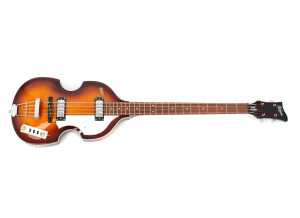
    Black Beatles bass. Manufactured in Asia, which means bad quality components assembled with care: The finish is good but you only get your money's worth, nothing more, the wood seems to be plywood, the tuners are really cheap. I only got it recently and the jack came off already. I tightened the neck and adjusted the height of the strings, with care not to go too hard on it, and the result is okay. USE I read all reviews before buying this bass. They all said it had a pleasant and small neck. Which is true, but be careful, when I say small it's really SMALL. I might have big hands (my other bass has a fat neck), but this bass feels more like a banjo! The strings are too close to each other, my fingers don't fit between them, so I play with my fingertips. SOUND It has lots of controls but, personally, I only use one position and simply vary more or less the mids and bass controls. It's exactly what I was expecting: It's not a double bass but it really sounds like wood! It has a truly nice and characteristic sound, although it may sound like cardboard guitar if you are too demanding. I like it a lot, but to get it sound really pro, you need a compressor, EQ, and what not. I use it to write songs in my home studio and I could also use it for gigs, but more like a gag than a real instrument. OVERALL OPINION I've had it for several months and I'm entirely satisfied with it. I got this bass to have a different sound and it didn't disappoint me. To me, it's a great toy, I love to play with it, it's light as a feather, you can take it anywhere with you and, in terms of looks, it rocks! It doesn't like sound much unplugged, but you can still hear it and, since I have it lying around in the living room, I often just pick it up and start playing...and as a result I'm playing much more now than before! It's a good value for money, since it doesn't cost much but you can have fun with it. It's okay as a secondary bass, but definitely not as your main bass. Otherwise, why would there be another version that costs ten times as much?

  • moosers's review

    Ovation's Magnum I is an electric bass guitar that is definitely on the unique side. I believe that these basses were made in the late 1970's, although there are a few different models of the Magnum bass. The Magnum I has both a neck and a bridge pick up, along with tone and volume knobs for each of them and a pick up switch selector to choose between the two or to blend them. Uniquely, it also has two 1/4" connections on it for sending it to either one or two places, which is really cool and unlike any other instrument I've seen that I can think of... UTILIZATION The overall feel of the Ovation Magnum I is definitely more than enjoyable. It has a heavy sort of feel to it, in that I found the strings and action on the one that I played to be quite thick. It isn't hard to play, but does take a little bit more force than something with a more fluid feel. To me this isn't a bad thing, it just means that it has a different feel and therefore a different type of sound. The look and style of the body is really quite cool looking and very unique. SOUNDS The sounds that are possible with the Ovation Magnum I can definitely be manipulated in a variety of ways, but overall it has a very thick and heavy sound. It's great for getting more of an aggressive sound rather than a smooth one, but it is capable of getting a wide array of tones between the way you play it and the pick ups. I've used the bass in the studio, where we recorded it both direct with a Sansamp DI and through an Ampeg amplifier and got a really outstanding sound. OVERALL OPINION Other than the one that I've used, I've never seen or used another Ovation Magnum I bass guitar. Upon first seeing this guitar in the studio where I used it, I was definitely instantly impressed by the look and make up of it. I was even more surprised to find that Ovation made it, as I'm used to seeing them only make acoustic guitars. The Magnum I is one of the coolest bass guitars that I've had the pleasure of using.

  • « Perfect Studio Bass »

    I bought this a few years back looking for something to use in the home studio and this was one of the best musical purchases I've ever made. I picked up the 1983 model with toaster pickups and with so many knobs and switches, you can really get this bass to sound like just about any other type of bass. The drawback, as I'm sure other owners will mention, is the weight. This thing is heavy. I only really use this in the studio, so it's usually sitting in my lap, but standing up with this around your neck gets a little uncomfortable after awhile. Probably not the best option if you're looking for something to have onstage for an hour long set or a long rehearsal. It's not horrible, just worth noting. That being said, I bought this for the studio and you'd be hard pressed to find a more versatile bass. tl:dr This is a dream in the studio and sounds great. It is heavy, so standing and playing for long periods can be uncomfortable.

  • « Testing it is buying it »

    Everything was very well said in the first review, I have nothing more to add. USE Its neck is a Rolls, fast and precise, easy to take control of, a real treat. The bass rests perfectly on the shoulder. As for the weight, well, it's a jazz bass (made of ash wood), so it's heavy, which is quite normal. A good strap is very practical and you can play hours without end. SOUND This bass is great for all types of music, from jazz to the most ballsy rock (if there's a problem it has to do more with the person playing the instrument). You can get whatever you want from this beauty: You only need to use it as passive to understand all its potential. However, the preamp is not the best, but if you know how to use it and don't go too extreme on it, it's quite all right. I have played it with about 20 different amps and it always responds fine. Many people stare in awe at how it cuts through a mix, especially in passive mode. OVERALL OPINION I've been playing bass for 10 years, it's my main bass and I've played more than 400 gigs with it without any issues. It has taken some hits, kissed a couple of very low ceilings and it has fallen a couple of times, but I've never had a single issue with it. It can also stay 3-4 weeks in its flight case and when I take it out it's perfectly in tune. It has also undergone some extreme thermal and hydrometric conditions and it always delivers, it never detunes (or at least all strings detune the same). As an owner of several basses, including some real gems from the '60s (Framus, Ohio, PB), this is the one I always take with me on tour, it's a safe bet!

  • « One of the best slap basses ever made »

    Phillip Kubicki is a visionary instrument maker. He first began with Fender in the mid 60's researching and developing new designs for acoustic and electric guitars. He left Fender in the early 70's and began producing his own instruments. In 1983, he introduced the Factor 4 bass, driven by a desire to produce unique, inspiring instruments. It was soon endorsed by Stu Hamm, and Vail Johnson, and demand for the instrument skyrockte, so much so that Kubicki could not keep up with the orders, and consequently signed a licensing production deal with Fender. When the Fender contract expired, Kubicki resumed manufacturing them in his own capacity for special orders. UTILIZATION The Factor 4 bass has a 32 piece rotary cut veneer maple neck, ebony fretboard with 26 jumbo frets, and an eastern soft maple body. All of the hardware and electronics are designed specifically by and for Kubicki, including the pickups, which are a hybrid active/passive design. The stringing and tuning system for the Factor is rather unique, and employs a design where the string ball end, typically anchored at the body, are seated at the headstock, and each string travels over its own saddle slot and is wound around a ratcheting gear mounted in the body. The string is then fine tuned with a threaded post. What's more, the Factor allows the E string to be dropped to D automatically by modifying the scale length only for that string, giving it two more frets and its own small nut section separate from the other strings. A spring-loaded bar clamps the string at the 2nd fret to produce an open E note, functioning much like a built-in capo that only operates on that string. This makes going from standard tuning to open D tuning and back as easy and quick as flipping or releasing the lever. Access to the upper frets is generous, and proper string action makes playing in the upper registers enjoyable. Truss rod adjustment is conveniently located in the end of the headstock, and can be adjusted with a medium-sized flathead screwdriver. SOUNDS The Factor bass comes with either a 4-Way or 6-way selector switch depending on the model and when it was made. This particular model sports the 4-way switch. This is where things get interesting. The Kubicki factor bass features a hybrid active/passive pickup system, that allows you to switch between two active modes and one passive mode. For controls, it includes a stacked EQ knob to control treble and bass response, and a stacked knob that controls Volume and Pan, which controls the balance between the neck and bridge pickup output. The active circuit runs on either one 9v battery, or two 9v batteries for 18v operation. The first mode is Standby, which mutes the bass output. Mode 2 is active mode with presetable boosted mid frequencies. The bass and treble controls are also active here. Mode 3 is a flat active mode. The bass and treble controls are also active here and can be adjusted. Mode 4 Passive mode. In this mode, the Bass control acts as a standard tone control. The Bass control is not functional in this mode. Despite its maple body and neck, the Factor is capable of warm, soft tones, but it truly excels in the high frequency spank and attack. The pickups are punchy and powerful in active mode, and passive mode offers a softer, more traditional subdued tone for blues and jazz runs. OVERALL OPINION The Kubicki Factor 4 bass is a truly unique instrument, even 30 years after its conception. No other bass employs quite the same set of features or technology, and for that reason, the Kubicki has a sound and a feel that's tremendously difficult to replicate with another bass. Two design flaws of the Kubicki Factor bass are that the Switchcraft 125B output jack is positioned dangerously close to the preamp circuit board, and in some cases the solder terminals literally touch the board. With much jostling around, this can lead to shorts in the circuit, and as a result intermittent signal and audible pops. The other flaw lies in the drop D lever. Since it's designed to hold the string at the 2nd fret (like a capo) to achieve the open E note, over a relatively short amount of time the string begins to dig into the fret, and intonation can be compromised and string buzzing can occur. New custom shop Kubicki models sell for $2,000-4,000, whereas the original Factor models are difficult to find and fetch not much less than that. If you come across an older Factor bass, I highly recommend buying it. If not, there's always the Kubicki custom shop. You can even get your new Factor bass in your choice of exotic veneer.

  • « As good as it gets. »

    There are bass guitars, and then there is THIS bass guitar. This is an icon in the world of music, for many reason. Firstly, I'll list some of the features of the bass, then I'll give my opinion about it. The bass is a neck through, with a maple body and neck, 2 truss rods, and a rosewood fretboard. The fretboard has Rickenbacker's signature triangle inlays and 20 frets. The bass has 2 single coil pickups, a 3 way toggle switch, and 2 volume and 2 tone controls. It also features stereo output, for a huge sound! UTILIZATION This bass transcends all other 4 string models. It is a masterpiece, it is an island, it is a religion. The 4003 is so darned cool that it will make even the snobbiest bassist smile. The neck has a very positive, solid feel, and it wants to be played with a pick. The playability is out of this world, and very inspiring. SOUNDS Cliff Burton! Lemmy Kilmeister! Chris Squire! There are all sorts of bassists in the classic rock realm that play a 4003, but the one think they all have in common is that their tone is enormous! Is this a coincidence? NO - IT'S THIS BASS. The pickups have an incredible growl to them, and the dual outputs aid in obtaining a huge sound. One thing I've experimented with is plugging one side into a clean amp rig and the other side into a fuzz pedal into an amp, and blending them. It sounds positively elephantine! OVERALL OPINION This might be the most enthusiastically glowing review I ever write about any instrument, but it is deservedly so. The 4003 has been around a long time, and is an icon in the world of the electric bass. It doesn't do everything, but what it does it does better than anything else out there. This bass absolutely rules.

  • « What a fun bass! »

    Color: Heritage Cherry Body Wood: Mahogany Neck: Mahogany Scale Length: 30-1/2" Machine Heads: Shamrock Fingerboard: Rosewood No. of Frets: 20 Pickups: Neck: Vintage-style TB Plus bass humbucker; Bridge: Bass mini-humbucker Controls: Two volume, one tone Pickup Switching: Bridge: Combo Hardware: Chrome; black top hat knobs w/silver inserts Case: Hardshell UTILIZATION This bass is a reissue of the EB-3 that Gibson put out in the late 60s. I don't know why they decided to change the model name, but it does make sense to call it an SG bass, since the body shape is the same as the SG guitar, and that's what everyone called the bass anyways. The fit and finish of this instrument are great, and it plays very well. The strings get this fun sponginess that most basses don't get - I like to play this in a guitar stack with loads of distortion, and play sludgey doom riffs with it, because it just reminds me of a great big baritone guitar, not really a bass. SOUNDS The pickups are quite interesting. A mini humbucker in the bridge, and a big giant neck humbucker - this is an odd combo, indeed. The bridge gets a bright, almost Les Paul-like cut. And the neck pickup is woofy and muddy as all get-out, but in a really fun way! This is a doom band, stoner rock bass dream. It almost begs for fuzz. It does a great Cream tone as well, or Grand Funk Railroad. OVERALL OPINION The pickup combination of this bass combined with the short scale make this a very fun bass to riff out on. This bass wants to be played like a guitar - with a pick, with a fuzz box, through a loud amp. It can certainly do other things very well, but it is such a hoot to just imagine it as a bigger guitar. This is areal winning axe!

  • Audiofanzine FR's review

    (Originally written by xsl/translated from Audiofanzine FR) Maple body for a clear sound. Wenge neck for compressed and tight mids and highs. Mine has a Seymour Duncan preamp: http://www.seymourduncan.com/products/basslines/cutting-edge-1/stc2_stc32_3ban/ with a push/pull to shape the mids and boost the lows. The Warwick preamp doesn't sound that great, but it's close to the Seymour (especially regarding high frequencies). UTILIZATION The neck is thicker than that of a Jazz Bass, the fingerboard is flatter. Perfect access to the upper frets. The horn gives a good balance to the instrument. What about the sound? It's good when you use each pickup separately. The middle position sounds different from a J/J combination because the bass has a a P/J configuration. It doesn't have the sound of a Streamer but it's close to Jamiroquai's sound. SOUNDS Don't expect the round sound of a Jazz or Precision bass. On the contrary, the sound is accurate, and with a Seymour or Aguilar preamp it turns really good. It doesn't sound like a Jazz Bass with ash and maple neck, which is the wood combination of all twangy basses à la Marcus Miller... The sound is more compressed with powerful high-mids... Even with the Seymour Duncan preamp you get a Warwick sound: tight, without muddy low-mids but not crystal-clear either. It's an authentic old Warwick, different from a Streamer and with a better playing comfort thanks to the long top horn. I would prefer a swamp ash body to get deeper lows. OVERALL OPINION I find Warwick has three reference models: Streamer (Jazzman or Stage II) with Seymour Duncan... Thumb NT and the Fortress... Excellent value for money. I give it a 9/10.

  • « A great bass for beginner! »

    It was my first bass and I've still got it today. I must say that choosing this bass was really a no-brainer because it is great value for the money. The PJ pickup configuration is imho the best to begin with the bass as you get the punch of a Precision Bass and the honkyness of a Jazz Bass. I gigged a lot with it plugged in good amps and I can say that I was not ashamed of its sound. The playability is great and having 24 frets is nice at this price. Of course, do not expect to have a boutique instrument and very clear sounding pickups - they can sound quite muddy sometimes - but it is a very good sounding bass to start with. I often recommend it to people who want to learn how to play. The only thing I find a bit deceiving is the knobs. They're not very precise and it can be a hassle to mix and match the different configuration you want - especially the tone knob. But a lot of bass players leave everything full on so it's not a problem for them.

  • « Fender sound without broke my wallet »

    I use to fix, buy, sell or trade instruments basses and some bass equipment for hobbie. But off course, I always have my personal arsenal. I really love two sounds. One is the percussive Musicman Stingray sound and the other is the classic Fender Jazz bass sound. For my hands passed four MIM jazz basses, two USA jazz basses, theree MIJ jazz basses and off course, lot of Squiers. Yes, I write a lot but when you have the opportunity to own or try many basses, then you can compare fair. I start telling you that this is not a USA bass. You will find some cosmetics details in some of this basses that you should not find in a USA bass but this is not the rule. I saw many high end basses with tons of terrible details. In terms of paint my bass was OK but not perfect. About the settings, factory action was OK but I love low action so I made my personal setup at home. I can have the low action that I want and have no fret buzz at all. This bass is very light but not feel like a toy so I can play two hours without hurt my back. (I have back spasm). Body is light but doesn't have neck dive witch is great. The most beautiful part of this bass is the neck. Great feel and excellent fret job. Sound is fantastic. I change the strings to my preference too. I put the pickups a little closer to the strings and have a great output sound. I add a baddass bridge to it, but don't get me wrong, stock bridge works find and has good sustain. It was just my personal preference. IF you like the sound and feel of a fender jazz classic sound, and don't have problems like some friends of mine with the "Squier" name on the headstock (the sound is in your hands anyway), you should try this one before broke your wallet with a USA model.

  • « Vintage WASHBURN SCAVENGER »

    Made in Japan faite à la main dans les règles de l'art dans l'atelier Matsumoko. deux micros, un genre de jazzbass en position chevalet et un genre de precision en position manche. electronique passive, sillet os et chevalet laiton il me semble. Qualité des bois et des assemblages irreprochables (ça a 30 ans et pas bougé d'un poil). Aujourd'hui pour trouver une qualité identique faut aller chez le luthier et encore les acajous d'aujourd'hui ne sont pas les mêmes !! UTILIZATION very rare si vs en choppez une foncez c'est de la tuerie ! SOUNDS Le son est doux et rappelle le vieux son de basse d'un melody nelson de gainsbourg par ex. huge mite ! On choppe a peu pres tout le spectre passif avec, entre une gibson basse une jazz et une precision avec un je ne sais quoi de different ! perfect ! Les sensations sont vraiment cool côté manche, ça rappelle un peu ma vieille gibson the ripper ! OVERALL OPINION Super basse avec une lutherie irreprochable et un vrai son qui rivalise avec les meilleures references passives du genre. Encore faut il en trouver une !

  • « POWERFUL. »

    Modern Player series Alder body Gloss Polyester finish "C" Shape maple neck Gloss Polyester neck finish Maple fretboard Synthetic Bone string nut Pickups: Modern Player Wide Range Precision Bass® Pickup (Middle) Modern Player Wide Range Precision Bass® Pickup (Neck) Controls: Neck Volume, Bridge Volume, Master Tone Nickel/Chrome hardware Open Gear Tuning Machines Vintage Style 4-Saddle Bridge with Brass Saddles Knurled Chrome Dome knobs Pickguard: (503) 3-Ply Parchment, (550) 1-Ply Black Strings: Fender® USA, NPS, (Gauges .045-.105) UTILIZATION This is the bass I always wanted Fender to make. The original Tele bass was cool, but very one dimensional with one single coil pickup. Later updates to the style added a big humbucker in the neck, which was a slight improvement, yet only allowed for one dark tone. This bass has a second humbucker near the bridge, and it makes a world of differece. With these pickups, high quality tuners and bridge, and a great finish, one can tell right away that Fender means business on this axe. The playability is a lot like an older 70s P-bass, yet with a bit thinner neck. The fretwork on this particular neck is very nice, as well. SOUNDS These two humbuckers are amazing! From playing around with it, I found that I could get all sorts of good tones out of this bas, from funky, to soulful Motown, to modern rock, sludge, doom, metal, country, jazz.... anything, really! The tones from this bass are monstrously powerful - you certainly FEEL every note, and the audience would too. This is really a bass with a lot of versatility to its sound, and it provides for an inspiring (and entertaining) playing session. OVERALL OPINION This is one of my favorite basses I've ever played. I love the style of the design, and the playing action on the neck really helps me play this bass with ease with any technique. The dual humbuckers has been standard fare on guitars for the past 50 years, but never caught on in the bass world for some inexplicable reason. Here it seems quite natural, and it allows for a huge range of great sounds. Highly recommended.