Log in
EN
FR

Sennheiser Microphones

252 products found

Categories
Series
Filter
Sort by
Sennheiser
Evaluation
  • Reviewed or not
  • Editor’s award
  • Reviewed by Audiofanzine
Availability
  • Available or not
  • Sold new or used
  • Sold new
  • Sold used
Must-have products
  • All products
  • Flagship products
  • Best rated products
  • Hot products
  • Popular products
Price
  • Freeware
  • Low-cost (< $150)
  • Mid-range ($150 - $350)
  • Premium (> $350)
€
Clear
Sort by
  • Popularity
  • User ratings
  • Price - low to high
  • Price - high to low
  • Used price, increasing
  • Used price, decreasing
  • Name (from A to Z)
  • Name (from Z to A)
  • Added on
Sort results
  • Popularity
  • User ratings
  • Price - low to high
  • Price - high to low
  • Used price, increasing
  • Used price, decreasing
  • Name (from A to Z)
  • Name (from Z to A)
  • Added on
Filter results 252 results found
Brands
Evaluation
Availability
Must-have products
Price
  • Freeware
  • Low-cost (< $150)
  • Mid-range ($150 - $350)
  • Premium (> $350)
Show results

The best Sennheiser Microphones reviews

The reviews Audiofanzine members found the most helpful.
  • mooseherman's review

    These mics can be used in both live and studio settings, and actually work great in both situations. They are dynamic mics, so they don't require phantom power. It has a cardioid pickup pattern and it has a switch that switches between tones, which are labeled fat, bright, and smooth. <span style="white-space: pre;"> </span> OVERALL OPINION I like the tones that this mic gets out of an electric guitar. I've used it with my Fender Stratocaster and Fender '65 Deluxe Reverb in the studio, and I couldn't believe how much better it was than the mics I'd been using (mainly the SM57...old habits die hard.) I like the variety of tones you can get from it; mic placement alone is no longer the only factor with these mics, as the three switches allow for drastically different sounds. I ended up choosing the setting based on the different types of songs I was doing, and it was almost always perfect, sometimes only requiring a slight change in position. The versatility I got out of one dynamic mic was impressive. The quality of the sound wasn't quite up there with some of the higher-end Sennheiser mics like the 409, but I think it is still great, especially for the price. The differences between it and other good Sennheiser mics, at least as far as tone is concerned, is minimal, with the exception of the switch that gives you greater versatility, which makes it more ideal than other mics in the price range. I didn't really look at this model until I heard that Robert Randolph uses it on his guitars, so that alone made me at least curious. After trying it, I was sold. If you are a fan of Robert Randolph's tone, it's worth your while to check out this mic, because it allows his tone to ring through clear and powerfully, and it will do the same for you, if you know what you're looking for in your sound. I would highly recommend this mic to anyone with an interest in recording or gigging, especially if you are a stickler for sound quality.

  • « Sennheiser E865 »

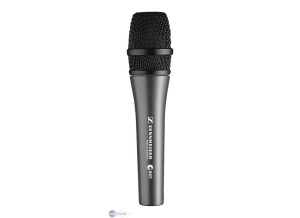
    I recently aquired the e865 from a Lukert Productions, motion picture production company who happened to be a Sennheiser dealer. No one else in the Phoenix area had them in stock, but they had plenty. Interestingly, they said they sell a lot to churches because they're so rugged. Had seen them dropped of scaffolding onto concrete without ill effect. I paid $249. Have been in search of the perfect vocal stage mic for years, have gone through SM-58's, a number of EV mics and most recently an AKG D-3700. Crystal clear highs, great punch, good bottom end without being boomy, little need for EQ. Sounds great EQ'd flat. The hype said Sting wanted a mic that has "air" and that's true. There's no distortion even if you scream into it, (I don't, but someone else did, actually cupping her hand around the end). Good feedback rejection and no handling noise. There's a clarity and spacial sound that you just don't get with a dynamic mic. This results in not having to sing with as much effort to be heard. Nothing, as close to perfect as you can get. Included items are a little Spartan, just a clip and a nylon pouch, but I'd rather have all the money go into the mic, and not some fancy carrying case anyway. High quality, good finish, good looks. Comfortable in the hand, although I play guitar, so it's on a stand. Mic clip is also good quality, not cheap-looking and holds the mic securely. I know the Celine Dion also uses this mic, don't know who else. I just know my search is over. I have a very dynamic vocal style and this mic suits me to a "T". I don't know anyone who wouldn't like it, unless someone wanted the muddiness of say, an SM-58 to cover up flaws in their vocal timbre, or a funky sound. Singing through this mic is like being in the studio. I don't think many people are that aware of this mic, appears only intermittently in the MF catalogs, so at this point it's like a secret weapon. People will think you sound better and they won't know why. It's not cheap of course, and you have to have phantom power to run it, but most PA's have phantom power any more. It carries a 10-yr warranty unlike many other mics. Just save that documentation... and don't let it out of your sight. This review was originally published on http://www.musicgearreview.com

  • moosers's review

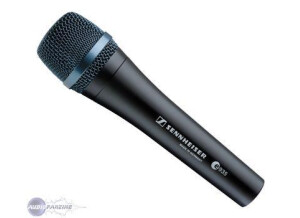
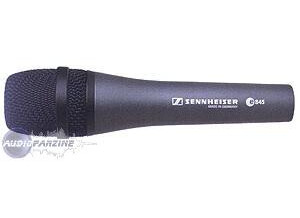
    The Sennheiser E 945 is a dynamic hand held microphone that is best suited for use during live shows. It has a hyper cardioid polar pattern pick up and the shape makes it perfect for vocals. While it would certainly be usable in the recording studio, I would say that it doesn't excel in this situation and should probably only be considered a mic for use on the stage. The Sennheiser E 945 is a sturdy microphone that has the ability to last a while if used and treated right. OVERALL OPINION I've been using the Sennheiser E 945 dynamic microphone for about two years and I've found that it is great at what it is suited for, which is on vocals for live shows. This is what it is made to do and it works great for this. Sennheiser has a great reputation for making top notch microphones and I've found that this microphone is a nice choice for the professional singer who wants a nice vocal microphone to use for live shows. The sound comes in cleanly and is always pretty full sounding. While I like to use the Sennheiser E 945 for vocals, it can be used for pretty much whatever instrument you would like to use it with when it comes to using this for live shows. The price of this mic is about double for the Shure SM 58, so I would probably first recommend the 58 because of this price difference. However, if you are looking to spend a bit more money on something that sounds slightly better, the Sennheiser E 945 wouldn't be a bad choice. Sennheiser makes some great microphones and I have definitely come to trust them and the products they make. Overall, the Sennheiser E 945 is a great microphone for live shows for amateurs and professionals alike.

  • joshsound's review

    These dedicated snare and tom mics are pretty much just cheaper priced and cheaper sounding Sennheiser 421's. They do have some of their own virtues however. They are dynamic mics, and they will connect with an XLR cable. You don't need to have phantom power running for these ones. There is a medium sized diaphragm, which is going to help you get a larger low-frequency response for some added weight on your toms and snare. There isn't a low end roll-off switch, so you will have to hit the EQ if you want a tighter sound. The best part about these mics is the great convenience of the way they are mounted. They come set on clips that specifically designed to latch on to drum rims and not budge. They are raised from that a couple inches and are then on a pretty much 360 degree pivot, so you should be able to manage to get this mic pointing at the drum heads in any way you want. Usually with other mics there is a lot of hassle and taping to deal with, but these you can get set up in under a minute. As for the sound, it does seem to lack a little bit of clarity and richess. You get a lot of point on the drum hits, and a lot of power from the lows and low mids, but the high end detail is just not really there or it's kind of wishy-washy. You'll definitely want to make good use of overhead blending to get a balanced drum sound if you're using this for drum mics. OVERALL OPINION I have used these on a couple of sessions at other studios. They really don't sound as good as 421's do on snare and toms, but they are much cheaper and have convenient clips. I would probably recommend these to someone new to recording who doesn't have the budget yet to go for some of the nicer mics. These are not bad drum mics, it's just that they're not that good either. Very cheap though, so it's a good value.

  • « Very versatile addition to a beginner's studio »

    The Sennheiser e609 is advertised chiefly as an instrument mic, and at that it excels. As advertised in its description, its shape makes it excellent for miking not only guitar cabs but also various drums (especially toms, and it also gives a unique, slightly diffused sound when use to record kick). The microphone does a bang-up job of preserving the clear tone of these instruments. That's about where Sennheiser's description ends, and the e609 greatly exceeds it. As you can see from its $109USD price, it's being marketed primarily towards beginners in need of a microphone for standard studio instruments like guitar amps and drums. The sound quality is comparable to similarly budget, studio-standard instrument microphone the Shure SM57. However, the microphone's interesting shape and construction give it a clear resemblance to the iconic Sennheiser MD409, and share's that microphone's excellent work with horns and loud vocals. Though the mic's high SPL capacity is mentioned by Sennheiser, they fail to mention how well it works with belting or harsh vocal singers (or simply loud, clear vocalists) in addition to loud horns and some woodwinds. Though it lacks a built in pop filter like other popular vocal microphones (like the near-universally used SM58) when used with an external protection its sound is remarkably clear where other microphones fail to deliver. The same effect occurs with brass and other loud instruments. This combined with its unusual shape create an excellent alternative for vocalists who do not like the traditional vocal microphone design. THE BOTTOM LINE: As a budget instrument microphone, the e609 measures up to similar studio staples. Although its sound quality is limited to similar models by its price, its versatility and usability as an alternative vocal microphone well makes up for the nearly unnoticeable difference in quality. The Sennheiser e609 is one $109USD mic that can do the work of three.

  • « Not for live use! »

    The sennheiser e815S is a dynamic vocal microphone that is very affordable only costing 130 dollars for the 3 pack of them which is what I bought. At first I thought I was getting a great deal on a great microphone but after using them I noticed they were not very good with handling stage noise. I ended up returning them about a week after I purchased them because if they cannot handle stage noise then I will have no use for them. OVERALL OPINION If you are in a completely silent room using them the sound was not too bad, but in a real club or night scene using these sounded awful! It was a good thing that we also do a quick run through before we do the real show; we had a chance to use them with just some general bar sounds going on in the back ground it picked almost everything up. We knew that we could not use them when it came time to go live so we sent them back and got a refund. These would be great practice mics because they are small and have decent quality but if you want to use them for performance I just don’t think it is possible to use them because of everything they pick up. It will make you sound horrible using these on a stage with noise going on all around them. I do not recommend getting these for live use, I do however think it is a great practice microphone and if you are getting 3 of them for that price it is almost a steal. Just do not use them for a real live show or it could end your career quickly. On the upside they do have an on and off switch on them and they are rugged and built to last.

  • « Ok, but I prefer Shure »

    Vocal microphones are always an up and down buy, especially when you are dealing with microphones in this price range. But with the Sennheiser E825S you will get pretty good recordings but nothing that will make you feel like you got a great microphone. This microphone is very rugged and made to last the home recording artist a long time. But the range of this microphone does not sit right with me. I have had many issues when recording other artist (mainly females) and trying to pick up the high frequencies they put off. When recording myself with it and other male artist everything is fine and the tone is very warm and full. Females have higher frequencies (in most cases) and when using the Sennheiser E825S on their voices I felt like the high end frequencies would get slightly muffled and were not as clean and crisp as they should be. OVERALL OPINION I was using this mic a lot back in 2006 to 2007 and it was one of my main microphones because I just did not have money at the time to upgrade. For the price I really did not expect to get much better than this, but after using other microphones that cost a lot more has allowed me to see just how many flaws this microphone has. While I was using it I knew that something was not right but I was in the early stages of my career and just could not put my finger on it. Now that I am more seasoned in recording and have worked with better gear I see what the issues where. If you are looking to spend less than 100 dollars and need a vocal microphone I prefer going with the Shure SM mics. They will give you a great recording and can be a more versatile microphone than the E825S can be.

  • « For your low frequencies »

    If you are in search of a great sounding kick drum or bass microphone then the Sennheiser e 602 II will serve you right. It cost under 200 dollars and has a fast response and low frequency extension. If you have a bass instrument or a kick drum that has that really low frequency this is the microphone to have that will pick it all up. It has a cardioid pick up pattern and it is a very rugged microphone. When its all said and done, it will depend on the angle that you have the Sennheiser e 602 II pointed toward your instrument or kick drum. If you find that sweet spot (on the kick drum) it will really give you the punchy sound and make those low frequencies pop. You will really tell when you listen to the play back of what you just recorded. We have used this microphone for about 4 long years now off and on depending on where we are recording at. OVERALL OPINION The ability to pick up those really low frequencies is the Sennheiser e 602 II finest quality. I don’t have anything bad to say about this microphone. It is very rugged and is made to be dropped a few times. We are very happy that we chose to use this microphone and after using it for 4 years we still have it and still use it, it sounds and looks brand new. I recommend getting this microphone for your kick or bass instruments if you really want those low end frequencies to pop in your mix. The sound quality for the price is un-beatable, a microphone this good could easily cost around 300 bucks today. You can compare this microphone to the D112 but I still think the Sennheiser e 602 II sounds a lot better even though they have similar specs.

  • « great speech mic »

    The 5009 is a super cardioid mic, this mic will provide you with great quality for a speech or some sort of simple audio or spoken audio. In my opinion its not really a mic for music, and none of the 5000 series from Sennheiser really where. They are mainly speech mics or event mics that are pretty expensive also. No matter where you look if you can still find one of these on the shelves it will still cost a good amount of money because of how good it really is and they actually don’t manufacture the 5009 anymore it has been changed. When you purchase this mic you will get a carrying case which is a must have because if you are doing speeches chances are you are traveling a lot and you need to protect your investment because if you drop this mic one good time it could be the last time you will be able to use it. I have had several bad experiences with dropping Sennheiser mics and they rarely ever work after that one good drop. OVERALL OPINION Very easy to use, no set up at all. Basically just a plug and play type of situation. It has a nickel color finish with some base back as well. This mic is very good for clicking a popping noises. Because it is used for speeches you will be having some popping and clicking issues with a lot of mics that are used in speeches but they have developed a technology for this series that pretty much eliminates those pops and clicks. Very good mic, though its no longer made you may still be able to find one somewhere. You will just have to keep your eye out for one. If you find one, grab it up if you are in need of a mic for speeches or events. It will work great for you.

  • « good horn mic »

    \the E 908 B is made by Sennheiser and this particular mic is pretty expensive but it is a special scenario mic. Its mainly for Saxophone and a few other wind instruments. I have seen a few mics being used by saxophones and other wind instruments and comparing the E 908 to those I would have to say that it is better than the rest. It will give you a crystal clear recording very easy. The mic is rather expensive but if you are a sax player or in a band then this is a must have. You cannot purchase a cheap mic and expect great results. This mic is perfect for live jazz bands as I have see and used it several times in that situations. OVERALL OPINION It does have a shock absorber that will get rid of any handling noise or noise from movement of your instrument. When you purchase you will get a pouch or carrying case to keep it in and a clamp for it to go onto your sax. You will get a manual but you wont need it unless you don’t know how to clamp a mic to your horn. Great sound quality , one of the best sax mics that I have ever heard. It does cost more than 400 bucks though. Which really isn’t a lot when you look at similar mics, and when purchasing a sax mic you don’t want to take that decision lightly. You will need a good mic to carry your sound throughout the room and make it sound very clean and clear. This mic does require phantom power and it comes with the phantom power adapter so you wont have to worry about that. This mic is ready to go right out of the box , just clamp it and start playing. Its great in live situations.

  • « great »

    I purchased the Mce 10 from a UK vendor years ago when I was looking for some mics for live recording situations. My job is to get shows ready and make sure everything is mic’d up and ready to record. The MCE 10 was great, I have used it in classic rock to opera and jazz shows. I feel this mic is really underated or at least it is here in the states and at a certain time many of my UK connects where talking about this mic so I decided to purchase it and I got a great deal on it from a UK vender that was on Ebay many years back and he gave me a great price and a return policy if I didn’t like it. The first time using it was for a Christmas chior performance by a local church group and it came out great. I was using several of them directly in front of all tones of singers and it worked out perfect for me. OVERALL OPINION For the price of it, you really cant get much better. Plus the MCE 10 is a few years old now so I know its probably cheaper than what it was years back, but im sure you can find one. They might be hard to get your hands on here in the US but there are a lot of people and stores online from the UK that are still selling the MCE 10 so I suggest you get your hands on them if you are into some live recordings. They really arent for studio recordings though, I havent tried them there yet but will soon just to see how it turns out. But they music store in UK didn’t recommend the mic for those types of situations so I havent tried it yet. But they sound great live.

  • « Sennheiser MD 421 »

    The Sennheiser MD 421 is a dynamic cardiod microphone known for it's hi max SPL. I am a student, musician, writer, and pretty good line dancer residing in beautiful Nashville, TN. I've been a drummer and guitar player on and off for the past 10 years of my life and have began engineering and producing in the past 4. I currently play drums for the band Brookline and you can see me rockin' an Orange County Drum and Percussion or Mapex kit decked out with Zildjian K Hybrids. Our studio bought 4 of these about 3 years ago for around $400.00 from Sweetwater. We purchased as a part of creating a good mic library for a new studio at our Recording Arts College in Nashville, TN. The MD 421 has an incredibly hi max SPL making it great for miking amps and drums. It also has very good bass response and is used a lot in broadcast much like the EV RE 20. This mic features a 5 position bass roll-off switch making it very tunable and gives it the ability to virtually act as 5 different mics and works great for reducing the proximity effect. This is my go-to mic for tons on a drum kit and lower end guitar tracks. The bass roll-off option is very difficult to navigate because it isn't labeled correctly so you have to go in blind and just listen. This isn't necessarily a bad thing - just be sure to check your settings every time that you use this mic. This mic has been hit with drum sticks more times than I can count and the grill, although a bit scratched up, still remains dent-less. The clips to hold to mic have a release button that lets go pretty easily so you have to be very caution when setting up and tearing down. Bottom Line? The Sennheiser MD 421 is a studio workhorse and is valuable in so many scenarios. Individually they are rather affordable and it's definitely worth the investment if you decide to get three or four. This review was originally published on https://www.musicgearreview.com