Log in
EN
FR

Other Instruments

1005 products found

Categories
Filter
Sort by
Evaluation
  • Reviewed or not
  • Editor’s award
  • Reviewed by Audiofanzine
Availability
  • Available or not
  • Sold new or used
  • Sold new
  • Sold used
Must-have products
  • All products
  • Flagship products
  • Best rated products
  • Hot products
  • Popular products
Price
  • Freeware
  • Low-cost (< $200)
  • Mid-range ($200 - $550)
  • Premium (> $550)
€
Clear
Sort by
  • Popularity
  • User ratings
  • Price - low to high
  • Price - high to low
  • Used price, increasing
  • Used price, decreasing
  • Name (from A to Z)
  • Name (from Z to A)
  • Added on
Choose a category
Selected category: Other Instruments
Sort results
  • Popularity
  • User ratings
  • Price - low to high
  • Price - high to low
  • Used price, increasing
  • Used price, decreasing
  • Name (from A to Z)
  • Name (from Z to A)
  • Added on
Filter results 1,005 results found
Evaluation
Availability
Must-have products
Price
  • Freeware
  • Low-cost (< $200)
  • Mid-range ($200 - $550)
  • Premium (> $550)
Show results

The best Other Instruments reviews

The reviews Audiofanzine members found the most helpful.
  • « Attractive, versatile, and well made »

    It’s made in China and this one is branded Laka by the JHS distribution co. (I have seen them on sale elsewhere with different branding and I think the actual maker is Nanjing Aileen Trading Co) . Mine came in the “transparent” (you can see some of the wood grain through it) red satin finish. I have seen them in solid gloss black but the red is much more common and I actually wanted the red as it is quite a close match to the colour of my friend Charlie's Gibson SG Guitar. The finish itself is very nicely applied with no misses, smears, dribbles or inconsistency in its transparency. This even extends to the very nicely matched and pretty well fitted plate on the back covering the electrics. Since it does cover everything I’ll take JHS’s word that it is all solid mahogany and from the look of it all made from one piece with no sign of a bolt on neck or any other join, though they have done such a good job with the fretboard, (which may be rosewood but is certainly stained to look darker), hiding the joins. I could be missing something? Continuing on the fretboard, it is 18 frets long meeting the body on the 16th and with top and, (right hand), side circular markers at 5, 7 10 and 12. The markers are all inlaid MOP like plastic not just paint and the frets themselves are smooth and reasonably dressed. The nut and saddle are plastic and the bridge is rosewood in a tie around design with a decorative stained plate on the top. The tuners are all chrome, even the buttons, sealed and work very smoothly. Dimensions are a 38cm (15 in) Concert scale with a neck width of 3.6cm at the nut and 4.4cm at the twelfth fret. I’m not going to give measurements for everything but it is all well proportioned around its Concert scale and of course, as a solid body Ukulele it is very thin at a fraction under 3cm at its widest point. The active electrics all work well, possibly too well as they are very sensitive and turning the volume up does make it distort a bit or at least give percussive string noises. The tone control doesn't make much difference though and the fittings are OK without being spectacular, I think the plastic parts for the electrics are, without being specifically bad or cheap, the least attractive part of the finish, (followed by the rather ineffectual logo on the headstock, black on darkish red makes it look more like a smear from a distance). There is plenty of natural sustain and the intonation is very, very good, all the way up to the 18th fret, particularly for a non-compensated bridge, it also has quite a good and loud unamplified sound for a solid body (possibly why the electrics are prone to distort?) It is a very nice Ukulele to play, the neck is very smooth and to my mind about perfectly proportioned in both width and radius The frets are smooth, rattle free and work very well, though they probably could have done with a final fitting. The action is spot on (though has it is suppose to be an ex demo model there may have been some after sale set up?) and it has sufficient un amplified volume to make it a good choice for quiet practice. Amped up it’s a bit trickier finding the right setting to give a nice non distorted sound. It’s even tricky when you want distortion and its easy to over distort, especially when the level of distortion increases the harder you hit the strings (the issue does lessen with a flatter battery, but that’s a tricky balancing act too) As a gigging instrument you would need a good sound guy – and probably a heavy metal set, but what else are you going to play on this shape of Ukulele? – but it’s certainly solid enough for gigs. I think it will last pretty well, the translucent finish looks delicate but that’s just a look, I've had mine a few months now and it doesn't seem to mark easily, and everything else is rock solid (the plastic work is a little unattractive not flimsy) - and it came with a better than average gig bag too! (but I mustn't talk about gig bags) Would I get another if I lost this one? Almost certainly, I like the shape and it’s as good as any solid body Ukulele I have played (apart from being prone to distort when amplified, but I don’t amplify it often and its very nice for quiet practice). If Ukulele corner was destroyed in a small (and very focused) nuclear accident It would kind of be in the top 5 to get again as I would want a nylon strung solid and I can’t think of anything I've played that is any better (The Risa Stick sounds better amplified but isn't a nice to play) but there are a couple of others that would equally fit the bill.

  • « Said it was a Tenor Scale but was actually Concert »

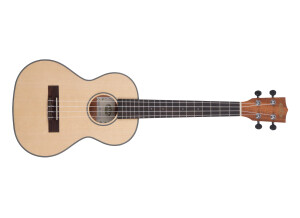
    This is quite a pretty Ukulele. The wood inlay rosette around the oval sound hole is very well done, as the rosewood veneer on the asymmetric headstock, (that reminds me of the headstock of my Ibanez Talman). The fat deep cutaway body and the middle strip in the quite clunkily profiled neck are nice too, though possibly the body is a bit deeper that it should be? There is never a lot to say about the look of spruce, but the rosewood back and sides are beautifully grained and it's all finished off with a very… very high gloss coating. The front of the fret board is blank, though there are marker dots on the side at the 3rd, 5th, 7th 9th and 12th frets with the 5th and 12th being double dots. As I’ve said it is a Concert with a 381mm (15in) scale and while I’m doing measurements a couple of other interesting ones are the depth of the body, 83mm (3¼ in) and the width of the lower bout, 244mm (9½in) so a very big, deep body for a Concert. The sound hole label say “Hand crafted by Strunal” and “made in Luby, Czech Republic” so now I know a little more about the actual maker but it also has “Kapua” written by hand in it but I have no idea what this means? It is solid wood, (well top certainly the advertising says it’s all solid and it should be for the money, but the advertising hasn’t been entirely correct – I’ll take its word here though), and with the sound board quite thick, (3+mm). There are at least 3 bracing bars across the bottom and the top is certainly cross braced so it is very solid and if anything over braced. The build quality everywhere else is very solid too, with everything precise, smooth, clean and neat, including the fairly large enclosed tuners which in addition to looking smooth clean and precise, work this way too. The nut and saddle are not compensated and, (I think), bone; well made and well fitted though I think the saddle is a little high, a sign that it was produced in some kind of factory process as it shows a “Factory” type setup, (always start high as its easier for punters to lower the action so not set up fully at the factory). Overall when I look closely at it I get the feeling it’s been made very very well, but by Guitar makers who are having a go at Ukuleles and like the very first Martins they have made it a bit too much like a Guitar, over braced and over solid. I suspect they may also have used a Tenor Ukulele to make the body template which is why it is so big and there was a degree of confusion about what scale it was suppose to be, (the old favourite – we’re going to make a Ukulele, we need a template, I know we’ll draw round a Ukulele and use that – but they got a Tenor, drew round it and ended up with a template that was even bigger than the Tenor body? – but that’s enough speculation). Sound wise it is very weak, very quiet, not very bright, no depth and this really lets it down! It has all the faults of a spruce top like no bass, but none of the pluses. You look at what I have said about the build and there are any number of reasons for this - depth of body, thickness of soundboard, over bracing, gloss finish, and it’s so weak I think they all contribute. The intonation is very good though, pretty much perfect on the easy string and not far off on the C, (could easily have been perfected if they had used a compensated bridge – though is still better that most Ukuleles best efforts). I think it would probably also work well if a pickup was fitted. It’s certainly strong enough to take the drilling to fit one and being so “built” it would probably be a good and reliable Ukulele to gig with. I don’t doubt this Ukulele would last, it is very well made. But one of the reasons it will last is because it would never be the one you reached for to play. Anyone who spent this much on a Ukulele will already have at least one; and the one they already have will almost certainly sound better than this. Would I get one again? Well I’m not keeping this one and I would only consider the one with the 3 and 1 headstock that I first saw if it was a tenth the current price, (I think it’s that much overpriced for the sound!) To sum up – very well made but a very poor sound and for the money you could get ones that are equally well made but sound a lot better.

  • « Very Versatile Baritone Ukulele »

    This is my biggest proper Ukulele, bigger even than the other Baritones. It has a nice spruce top, (as time goes on I am increasingly getting to like spruce), a good passive pickup, (so it doesn't need batteries), and a very smooth and quite thin bodied, almost travel size, plastic composite round back, (which is cold against your skin if you play it bare chested and a bit slippery to hold if you have a shirt on!). It does have a strap pin though so you can use a strap, (not that I do - that's how I know its cold against the skin!), and it does sound nice when you play it. When it came it had D'Addario strings, which were 2 wound and 2 black and I didn't think the black suited the spruce top so I have replaced them with 2 wound and 2 white Aquila's and I think they look much better. Clearwater source their models from the same factory in China as some of the more prestigious brands like Ohana With this model its the same one as Ohana BK 70RB, (except that Clearwater's have a passive pickup fitted), and they both come from the Artiny Guitar Factory

  • « Great instrument, somewhat troublesome electronics. »

    When my boss's old epiphone mandolin finally became so fragile that it could no longer be used on tour, we acquired a new Epiphone MM-50E to fill the void left by an instrument that had served him well for many years. The MM-50E is naturally finished out of Sitka Spruce, with a maple neck, and simple appointments such as cream binding on the neck, headstock and body, and a beautiful ornamental inlay in the headstock. It boasts 23 frets set into 14 inch scale rosewood with simple dot inlays, and a 1.06 wide genuine bone nut. Hardware is simple but elegant, comprised of vintage-style inline tuners with pearloid buttons, adjustable rosewood bridge, and chrome-finished string anchors with snap-off cover. amplification is provided courtesy of a NanoMAG pickguard-style pickup and preamp system, with individual volume, bass, and treble controls. Individual string output levels are controlled via miniature trim pots on the pickguard. UTILIZATION Right out of the box, the MM-50E plays decently well. This one required a setup, but most of them do. String spacing is comfortable, unlike cheaper mandolins, which can have their strings too closely spaced. The Nut was adequately cut and polished, allowing the mandolin to be properly intonated throughout the length of the scale, and allowing string vibration to resonante sufficiently throughout the instrument. It's also worthy to note that one should buy a specialized jack-tightening tool, as accessing the inside of the Mandolin is virtually impossible. The jack tends to come loose from time to time, and tightening it with a standard wrench can cause the jack to turn, to the point of breaking the wiring inside, and then you're truly screwed. Stewmac sells several models of these jack tighteners that prevent this from happening. SOUNDS The MM-50E plays decently well unplugged, but most people purchase it for its amplified capabilities, which is where the NanoMAG pickup comes under scrutiny. The individual controls for Bass, Treble, and Volume are quite nice on the NanoMAG. However, we typically leave them wide open and control EQ and volume through an LR Baggs Para-Acoustic DI unit, which works beautifully. Physically, the pickup portion of the NanoMAG is poorly designed, using a threaded wheel to support one end of the pickup, and raise or lower its height. I found that very little adjustment was capable without the wheel coming off completely, and having to be carefully re-attached. Another issue with the NanoMAG pickup is noise. It generates buzz and hum in the upper frequencies that is nearly impossible to completely eliminate, so our FOH engineer tries to gate it off as best he can. I would elect to bypass the EQ/Preamp circuit of the NanoMAG if I could, as I suspect this has a lot to do with it the noise. When properly set up, the MM-50E produces a nice, full, rich sound through the sound system, with good note separation and warmth. OVERALL OPINION The Epiphone MM-50E is a reasonably professional instrument, and has served us well on tour for over a year now. It hasn't been without its issues (such as the noted pickup problems), but we've been able to deal with them. It's unfair to compare the instrument to vintage or high-end mandolins, but for a modern, production model mando, it is a very good instrument, nicer than most Fender or Ovations I've played. Perhaps in the future Epiphone can improve on their pickup system.

  • « Extremely bad. »

    This is a six string banjo which is tuned E A D G B E, like a standard guitar. It is designed for guitar players who like the sound of a banjo but don't want to go through learning how to play in the different tuning. This banjo has a mahogany neck with 25 inch scale, a mahogany body, an 11 inch head, 22 frets, and Grover tuners. UTILIZATION I wish I had good things to say about this "guitanjo", but I just don't. It was a nice idea on paper - after all, the guitar and banjo are two fretted, stringed instruments, right? How different can they be? Well, any guitarist who has tried to pick a banjo (or vice versa) has discovered right away that the answer is "extremely different". So getting the banjo sound into a guitar configuration is a good idea, but this Backwoods Banjo is just poorly made, all around. The neck had a huge bow in it, the fret edges were sharp, and the nut slots were improperly carved. All these problems mean that the guitar was just not fun to play or tune. SOUNDS It sounds fairly banjo-like. But the sound is of a cheap banjo. I am by no means a good banjo player, but I do teach in a store with one of the world's top banjo players, and I hear his instrument, and his many student's instruments, and I can tell a great difference in their tonal qualities. This Dean was on the low end of the ladder in sound quality, unfortunately. OVERALL OPINION Bottom line - this is just not a good instrument. If the craftsmanship had more attention to detail, and the woods were made of a higher quality, I'm sure the story I'd be telling right now would be different. But this is about as good as an abused pawn shop special that's been sitting in the shop for years - that is to say, bad! This instrument is so terrible that I am actually recommending anyone to check it out, just to have a gauge on the lower end of the scale.

  • moosers's review

    The Epiphone MM-50 is a mandolin based on an early 1920's Gibson model. This isn't an acoustic/electric, so it doesn't have any pick ups of setting controls. The mandolin has two 'F' holes and is made up of a rosewood fingerboard and a maple body. UTILIZATION The Epiphone MM-50 has an overall great feel to it, as I find the instrument very easy to play. It is easy to play up and down the neck, but I mostly stick to chords on it as I've only been playing for about two years or so. As all mandolins are, this is a very light instrument and is incredibly easy to carry around. The shape of the mandolin is pretty awesome looking, as is the sunburst finish. SOUNDS While not as great sounding as a true Gibson mandolin, the Epiphone MM-50 has a pretty awesome sound of its own. I've used it for recording, so cutting through a mix is always a big concern for me when it comes to mandolins, and I found that I didn't have any troubles at all getting it to do so. It has a very bright sound, even for a mandolin, but this isn't something that I mind and don't feel it detracts at all from it. For the price, I really haven't been able to find a better sounding mandolin. OVERALL OPINION I had struggled to find an 'in between' mandolin, meaning one that has a great sound but doesn't cost a fortune, but I think I have found this in the Epiphone MM-50. Like I said earlier, the sound doesn't compare to the top tier mandolins out there, but it will blow the cheaper ones out of the water and certainly can match up to some models above this price. I wouldn't recommend this for those just looking to start off on the mandolin as I would recommend getting your feet wet with something a bit cheaper, but if you're looking to take it to the next level, I'd encourage you to check out the MM-50 and to give it a play.

  • moosers's review

    The Fender FB54 Banjo is a pretty standard five string banjo as far as make up goes and is a good one at that. It isn't an electric banjo of any sort so it doesn't have any pick ups or connections and I'm not sure where this instrument is made but I don't believe it is made in the USA. UTILIZATION The feel of the Fender FB54 Banjo is pretty good for such a reasonably priced banjo. The action is pretty good all along the neck and I've never had any trouble playing what I wanted to because of the action. It is easy to play the high notes and like most banjos it is somewhat heavy with the standard shape and look of a traditional banjo. Getting a good sound isn't too hard if you know how to play as the tone of the FB54 is pretty good. SOUNDS The sound of the Fender FB54 Banjo isn't something that will blow you away but it definitely will get the job done in most scenarios. Unless you using banjo on everything and banjo is your main instrument, this will probably work fine for you. Guitar is my main instrument and I use the FB54 as a side instrument when I want to record some banjo and it works great for this. It has a really nice sound and while it won't compare to top end banjos of course, as far as banjos on the lower end of the spectrum this is pretty great. OVERALL OPINION I've been using the Fender FB54 Banjo for about a year and I've really grown to like. While I'm not all that proficient of a banjo player, this gets the job done perfectly for me when I want to add a banjo to a recording. The price is the best part about this instrument as it won't cost much at all making it perfect for those who want a decent banjo but don't want to spend too much money but also don't want to get something that isn't playable. If you are looking to get a nice banjo on the cheap, the Fender FB54 Banjo is a great place to start looking for one.

  • moosers's review

    The Rogue Guitars STR-1 Pro Electric Sitar Guitar is the cheapest way possible to get an electric sitar. My experience with the STR-1 Sitar Guitar isn't as extensive as it is with some of the higher end electric sitars, but I wanted to try out this one for a number of reasons. The first and foremost reason is the price. By far the STR-1 is the least expensive electric sitar that I've seen, making something like this available for almost any player. I've only gotten the chance to play this guitar a few times, and didn't get to do any recording with it. However, I definitely got a good feel for what the instrument is capable of and what it isn't capable of. The guitar is a standard 6 string, but also has 13 sympathetic strings for droning. It's got three different pick ups, each with it's own separate controls for volume and tone. While the pick ups aren't the best sounding out there, the guitar overall has a good enough sound quality to portray that of an electric sitar. The other electric sitars that I've used are really in a whole other ballgame, which are those made by Jerry Jones. The Coral and Baby Sitars are in another class, so it isn't really fair to compare them with the STR-1, but yet again those are the only other electric sitars that I've used. The Jerry Jones models are much more expensive than this one, so the comparison really doesn't hold any weight. So while the Rogue STR-1 isn't up to standard with the Jerry Jones sitars, it's still very playable and definitely has a decent enough sound to pass for an electric sitar. If you can afford one of the Jerry Jones models in any capacity, I'd absolutely recommend going with them instead, but if you can't afford one and are just looking for something on the cheaper end, the Rogue Guitars STR-1 Pro Electric Sitar Guitar is the only available option that I've found...

  • moosers's review

    The Jerry Jones Baby Sitar is a mini version of the Coral Sitar, offering up a less expensive option for those looking to get an electric sitar sound, or something close to a sitar while still playing a guitar. Let me start off by saying that Jerry Jones has some extremely impressive and unique line of guitars. I've also used the Coral Sitar and the Neptune Baritone guitar, and I've been nothing but impressed by the top quality feel and sound of these instruments. As far as the Baby Sitar goes, it has the same great feel and sound of the Coral Sitar, but in a smaller body. The only major difference that I can tell of between the two besides the size is that the Baby Sitar doesn't have any sympathetic strings and doesn't have as many setting controls, although the Baby Sitar does have tone and volume knobs for the single pick up. If you've never played an electric sitar, these things are just so cool overall. The Baby Sitar in particular has a very realistic sitar sound that is the perfect mixture of the sound of an electric guitar and the sound of a real sitar. It even has a leg mount for holding this up right like a sitar. While the Coral Sitar definitely has a fuller and more realistic sound in my opinion, the Baby Sitar has an awesome sound of it's own as well. Although it might not have the sympathetic strings to give it some drone, it still sounds incredibly like a sitar. If you can afford the Coral Sitar I'd recommend going with that, but for those who are looking to save a couple of bucks or who might not need the full Coral Sitar, the Baby Sitar is the perfect little electric sitar, not to mention how awesome it looks!

  • moosers's review

    The Gold Tone GT-1200 is a 12 string banjo that has the same string configuration as a 12 string guitar, so I guess this is really as 12 string banjitar/git-jo. As you can tell just from this brief description, this is a unique instrument! I had not ever played an instrument like this until a few weeks ago when I tried one out. Obviously I was struck by it's uniqueness, but upon further review I found that this is not only unique, but is an overall awesome instrument. I know it has a pick up in, but I'm not sure what the exact specifications are on it, but there is only a single pick up in it. To be honest I haven't plugged it in, so I can't really say anything about the sound of this pick up. Either way it's definitely cool that you have the option to plug it in if you want to. There aren't any setting controls for the pick up that I'm aware of. UTILIZATION The feel of the Gold Tone GT-1200 is outstanding. I didn't find that using a pick was as easy as playing it with my fingers. While I'm trying to get better, I'm not the best when it comes to finger picking, but I definitely found it very easy to finger pick on the GT-1200. The weight of the instrument is about right for a banjo that has a pick up in it as it isn't exactly light, but isn't too heavy to carry. Getting a great sound acoustically is definitely an easy thing to do. SOUNDS The tone of the Gold Tone GT-1200 is unlike anything I've ever heard. I do own a 6 string banjo, but the GT-1200 really doesn't sound anything like it. The GT-1200 is really the perfect blend of a banjo and a 12 string guitar in terms of tone, as it is lush like a 12 string, and has the sticcato sound of a banjo. I've never had the chance to record with the Gold Tone GT-1200, but I would imagine that this brilliant sound would transfer well to the reel... OVERALL OPINION Unfortunately, the price of the Gold Tone GT-1200 prevents me from getting one, but I've definitely added this to the list of gear that I'd like to acquire someday, as I think there's a whole lot of cool things that could be done with it. It isn't like the price is outlandish for an instrument of this caliber, but I personally just couldn't justify spending this much on something like this. Hopefully someday this will change as the Gold Tone GT-1200 is a unique and special instrument...

  • mooseherman's review

    This is a nice banjo that is made by Deering. This Banjo has five strings. The banjo's features include a Maple Neck & Resonator, an added Steel Tone Ring, a Metal Flange With Sound Holes, and an 11" diameter. There is a nice satin finish, and an adjustable tailpiece. This banjo is acoustic, so there are no controls for volume or outputs. Likewise, there are no pickups. UTILIZATION This banjo is a great one to play, and the tone and feel are well suited to the busy, rapid picking of bluegrass. Getting a great sound is as easy as picking it up and plucking. The feel of the neck in particular is great, it's narrow enough to be able to navigate really efficiently, but it's not too narrow as to be crowded when trying to play it. The drivers on this banjo are very stable, and it's a breeze to play it. SOUNDS I really like this banjo a lot. It has a nice sound that can be very versatile depending on the player. I've seen bluegrass players get a nice, relatively smooth sound out of it, while I've heard more bluesy/country players get a far twangier sound out of it. Mostly though, I'd recommend it to bluegrass players. It's got a fantastic sustain, which is always cool in a banjo. If I had to describe it, I would say that it sounds almost as though the harsh midrange that sometimes comes with banjos is considerably toned down. OVERALL OPINION I think the best thing about this banjo is the fact that it is a simple, elegant design, and also has great playability in sound. I don't know if I would choose this one above all else as I'm not a bluegrass player, but I know that if I was, this would be a great choice, simply because of the tone and playability. I wouldn't choose it because I prefer the twang and harsh mids that other banjos do better, but since many people can't stand that sound, I recognize that this banjo is great for what it does.

  • moosers's review

    The Hondo HM6N Mandolin is an inexpensive mandolin and is one that is pretty hard to track down. I'm not sure where exactly the instrument was made, but I know it is either from Korea or China. The mandolin isn't acoustic/electric, so it doesn't have any pick ups or setting controls. UTILIZATION Playing the Hondo HM6N Mandolin actually isn't too bad. While it doesn't play like a top tier mandolin will, I wasn't expecting it to at all. This being said, this is more than playable as I actually find it pretty easy to play overall. The weight is quite light and the overall shape and design is pretty standard for a mandolin, although the top of the body is a bit more rounded off than most. Getting a nice sound isn't to hard, but the only thing that you have to control the sound if you don't like it is your playing! SOUNDS I found that the sound of the Hondo HM6N Mandolin is good enough for what I do with it for sure. I've actually done a good amount of recording with the instrument as well as have used it for live shows. While it hasn't been my first choice to record with, when I don't have anything else available, I find that it gets the job done for me. It doesn't have the fullest tone out there, or even the cleanest, but it definitely doesn't sound bad at all and will be fine for those of us who aren't pros with the mandolin and are somewhat beginners with the instrument. OVERALL OPINION Other than the one that I purchased, I haven't seen too many Hondo HM6N Mandolins out there. I have maybe seen one or two of them on eBay, but this isn't the type of instrument that you seek out, rather you'll run into it as I did when I found it in a local music shop. As far as cheap mandolins go, I've found this to one of the better ones out there that I have tried, as I find it easy to play and to have a good enough sound quality for what I'm doing with it. There are plenty of options out there for an entry level mandolin besides this one, so if you can't find this one as I don't think that you'll be able to, there are definitely other options out there from the likes of Fender and other brands...