Log in
EN
FR

Electro-Harmonix Saturation effects pedals

69 products found

Categories
Series
Filter
Sort by
Electro-Harmonix
Evaluation
  • Reviewed or not
  • Editor’s award
  • Reviewed by Audiofanzine
Availability
  • Available or not
  • Sold new or used
  • Sold new
  • Sold used
Must-have products
  • All products
  • Flagship products
  • Best rated products
  • Hot products
  • Popular products
Price
  • Freeware
  • Low-cost (< $75)
  • Mid-range ($75 - $90)
  • Premium (> $90)
€
Clear
Sort by
  • Popularity
  • User ratings
  • Price - low to high
  • Price - high to low
  • Used price, increasing
  • Used price, decreasing
  • Name (from A to Z)
  • Name (from Z to A)
  • Added on
Choose a category
Selected category: Saturation effects pedals
Choose a series
Sort results
  • Popularity
  • User ratings
  • Price - low to high
  • Price - high to low
  • Used price, increasing
  • Used price, decreasing
  • Name (from A to Z)
  • Name (from Z to A)
  • Added on
Filter results 69 results found
Brands
Evaluation
Availability
Must-have products
Price
  • Freeware
  • Low-cost (< $75)
  • Mid-range ($75 - $90)
  • Premium (> $90)
Show results

The best Electro-Harmonix Saturation effects pedals reviews

The reviews Audiofanzine members found the most helpful.
  • « Electro-Harmonix Big Muff »

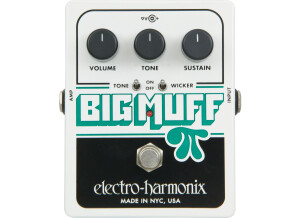
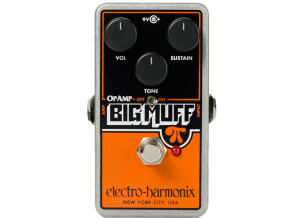
    I bought this pedal from shopoftheworld.com (has a good selection and delivers quickly in the UK) for £62.00 . I bought it because I was looking for a good distortion and heard that bassists such as Cliff Burton (Metallica), Chris Wolstenholme (Muse) and others used this pedal. Although this is designed to be a guitar pedal, it works GREAT on bass, in fact it keeps some of the lower tones (even on a five string) equal with the rest better than some bass distortions I have tried. This pedal has 3 controls, (Volume,Tone,and Sustain) which can be used to create a great sound that fits perfectly with a guitarist distortion, and is also great for any bassist in a heavy band looking to play distorted solos and if can really cut through if the tone is pushed. No major complaints, one thing that is a bit of a downside is the fact it is quite load on bass. There is some noticably background noise, but this is to be expected as this pedal does boost volume a lot. This, as all EHX pedals is built like a rock. Strong, heavy and theres no chance of the control knobs causing any problems. The wiring on the inside is a bit messy (lots of wires with a lot of slack). But this is obviously not a major flaw as I have played this pedal for about 2 years now and despite quite a lot of abuse, is still working fully. And the only other slight problem is the paint work, the black surround of the footswitch gets scratched easily. This is a great pedal for anyone wanting to get a really big sound with themselves and their guitarist but still keeping the low end nice and clear. I would definatly recomend this pedal to all those into bands such as Rage Against the Machine, Muse etc. Bassically any song with bass distortion this thing can emulate quite closely. This review was originally published on http://www.musicgearreview.com

  • « thick and full »

    The Electro Harmonix Metal Muff is an analog distortion guitar pedal. It has a 1/4 inch input and output and is not a rackable unit as it is a foot stomp box. It needs some sort of nine volt power to run on. UTILIZATION The configuration of the Electro Harmonix Metal Muff is really simple and straightforward. It simply has three knobs - one for distortion level, one for filer (EQ), and one for volume level. It is easy to get a thick sound from this and is easy to manipulate the different parameters to get a sound that suits your needs. I don't have a manual for this, so I don't know how useful it is when learning this pedal. SOUND QUALITY The distortion sound from the Electro Harmonix Metal Muff is really thick and full. I would recommend this if you are looking for some really heavy, metal-like distortion for your guitar. I have only used this with guitar and it probably isn't all that useful for other instruments or genres other than metal or hard rock. Turning the distortion all the way up will give you a huge tone that is great for getting that fat distortion tone heard on many metal records. OVERALL OPINION I've been using the Electro Harmonix Metal Muff for about two years. While somewhat narrow in its ability, for getting a thick distortion sound it sounds really great. I would use this more for big rhythm playing rather than lead, but will work fine for both. It is hard to find a pedal that has as thick of a tone as this and the price is dirt cheap if you can get one used and quite reasonable new. If you are playing heavy metal or hard rock and need a pedal that will give you a tone for these types of genres, this pedal is worth a definite look.

  • « Great little Muff »

    This is a smaller version of the Big Muff Pi. I have a 1980's version of it. It has a Volume knob and a tone switch. The sustain on it is set at a predetermined amount, but can be adjusted by rolling off of the volume knob. It has an 1/8" style plug, not a BOSS style, so it can't be daisy chained without an adapter for it. It's center negative and 9V DC. UTILIZATION It is VERY easy to use. Hook it in, set the tone switch to one of two options, set the volume so it's equal when bypassed and rock out. Super Easy to use, and super-easy to get a good sound out of. SOUND QUALITY This sounds a lot like the Big Muff Pi's they make today. Thick, hairy, and aggressive. I can't comment on an older one because I've never played them. The tone switch has to settings. The the top, it seems to add more treble, like the tone knob on a Big Muff is cranked. At the bottom, it seems like the tone knob on a Big Muff is at half or less. It's a very thick and bassy sounding fuzz/distortion. Like a full sized Big Muff Pi, it lies somewhere between a fuzz and a distortion, while simultaneously being not quite either. The input is connected to the output via a buffer. Being an Electro Harmonix pedal, it's a good one. Not much treble loss while bypassed. OVERALL OPINION This is a great pedal. It sounds great and is very easy to use. I would still have it, but I don't like the Muff sound. I prefer a thinner, teblier, fuzzier fuzz. I am unbiased in rating this. It sounds great if you like the sound. This is one rockin' pedal that will keep rocking for a while longer.

  • « Great Metal Distortion »

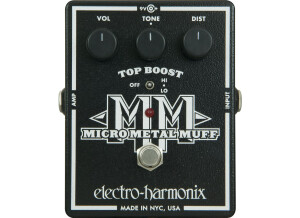
    This is one great Metal pedal. It has two knobs, one labeled VOL and one labeled DIST. It uses a 3-position switch (labeled SCOOP) with three predefined Mid curves. The three settings are Off, LO, and HI. It uses a standard, BOSS style, Negative Center 9v DC plug for an adapter. It's an all-analog pedal. It has an input, and an output, both 1/4" jacks. UTILIZATION It is very easy to find a good tone using this pedal. The DIST knob isn't super touchy, but it's still have a lot of gain on tap. Plug in, set the SCOOP switch where you want it, then set the gain to a level you like, set the volume so it's equal when bypassed, and play. SOUND QUALITY The distortion knob isn't too touchy, but it has a lot of gain on tap. It can go from classic rock to death metal levels of gain with the scoop knob set right, The scoop knob has three settings. 1. Off. The mids are unaffected and the sound is more British and crunchy, 2. LO. The mids are scooped a little, but it still has enough to cut. More American voiced, but tight and slightly crunchy, 3. HI. The sound is super scooped and somewhat muddy. It is good for death metal or nu-metal. The input is connected to the output through a buffer, and it seems to be a good one. Not much tone loss when it's bypassed, which is a very good thing. EHX buffers always seem to be quality. OVERALL OPINION The pedal does better than most pedals for around twice the price. For $65, this pedal annihilates every other one around. This pedal sounds great. End of story. I've tried a Digitech Grunge, a BOSS MT-2. and countless other Metal pedals. This one was the best I tried that I could afford.

  • « All the Big Muff Power in a smaller pedal! »

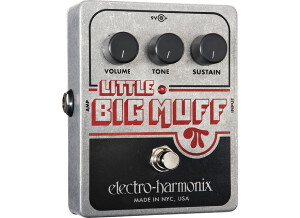
    This is a (physically) smaller version of the legendary Electro Harmonix Big Muff Pedal. It is a heavy fuzz and sustainer, a unique combo when the Big Muff was first introduced. This pedal's larger predecessor became legendary after being used by David Gilmour and Jimi Hendrix, amongst many other, newer players. It is an analog pedal through and through. There are no excess connection types other that the 1/4" input and output, as well as the input for a power supply (sold seperately, unfortunately). This isn't rackable of computer/midi capable. UTILIZATION This is a really easy pedal to use, just like the original. There are three knobs, Sustain, Tone and Volume, all of which are rather self-explanatory assuming you know that sustain is virtually the same as compression. There is really no need for a manual. SOUND QUALITY When I first saw the Little Big Muff, I assumed that it was a less powerful, cleaner pedal than the original (whatever that means anymore) Big Muff. I later tried one out and was actually really surprised. This thing sounds very much like the Big Muff Pi, and has minimal differences from the larger ones that came out in the same year (2000). This is a supremely dirty, powerful fuzz pedal. It's great for really rocking rhythms. Some people complain about leads, I tend to either switch pickups and increase volume on the guitar or even use a boost of some type to get a better lead sound with it. When you have enough clarity and high end, you can really make this pedal sing! OVERALL OPINION This is a perfect way to make the Big Muff easier for most people. If you're crowding your pedal board to make room for your big muff, you might want to think about this alternative as you'll suffer virtually no tonal differences. The price is totally worth it for the killer tone.

  • moosers's review

    The Electro-Harmonix Double Muff is a distortion foot pedal designed for use with electric guitar but can be used with any electronic instrument. The pedal has two different channels in it, so you're getting two muffs in one here. However, this isn't the same Muff circuitry as the USA Big Muff, rather is from the original Muff from the late 60s. The pedal has 1/4" connections for input and output and can be powered with a nine volt power supply. It isn't rack mountable since it is a stomp box. UTILIZATION Most users will definitely not have a problem when it comes to the utilization of the Electro-Harmonix Double Muff. The pedal is very simple, straight forward, and easy to understand. It simply has two knobs marked muff one and muff two, and a switch to choose either having the single muff engaged or having both engaged. Having both of them engaged just gives you a thicker distortion. Beyond the two knobs and switch, there isn't anything else to work with here, which is kind of a bummer as I really enjoy having the tone and sustain parameters on the standard Big Muff pedals. I've never seen the manual for this pedal, but one isn't necessary unless you're having technical problems or some sort of other issue. SOUND QUALITY The sound quality of the Electro-Harmonix Double Muff is overall quite good. For me, it doesn't stand up to the USA Big Muff or any of the other Big Muff pedals simply because it lacks versatility. However, having the two different channels is definitely cool as it at least allows you to have two varying tones with the flip of a switch. The pedal certainly sounds like it is in the Muff family, but lacks the sustain available with the Big Muff. Having said all of this, if you're looking for some simple thick distortion or fuzz, the Double Muff will definitely give you that. OVERALL OPINION I first used the Electro-Harmonix Double Muff about six months ago when I got interested in checking out all of the pedals in the Muff family to see what would work best for me. While I ultimately decided on the standard Big Muff, the Double Muff definitely has some cool features to bring to the table. Having the two channels is a big plus, but it does trade off with having less versatility in the end because it lacks the controls. The price of the pedal is very reasonable, and I'd encourage anyone out there interested in a Muff pedal to check out the Double Muff as well as the other Big Muff pedals.

  • sat4n's review

    Three knobs: Volume, Tone, Distortion. A non-true-bypass footswitch. No power adapter jack so you must use a battery. I should say that many pedals, in my opinion, don't need to be true bypass. Boss pedals, for instance, have a well-designed buffer stage so that sound quality is actually, if anything, enhanced by having the pedal in the signal chain but off. Anyway, this is not one of those pedals. Noticeable dulling of tone when the effect is not engaged. Also, the shafts of the pots, to which the knobs attach, bend really easily. UTILIZATION It's hard to get a good sound out of this thing. Often the best results come from running two amps so you can mix the affected signal from one amp and the dry signal from another. In my experience this allows both for some clarity to be preserved so you can hear what you're actually playing and it also puts back the midrange frequencies that the pedal, when on, scoops out. That said, in this application, this pedal has got me some really incredible fuzz tones that I've not heard anywhere else. I know I'm dissing it pretty hard right now, but, believe me, I have no intention of selling it. It has its place, and there's always going to be songs in any band that call for this particular kind of thick-fuzz-buzz-madness cocktail. SOUND QUALITY I can't really imagine using this live. The sound of the guitar when the effect is off just suffers too much, and there's no way you'd want your guitar to sound like this on every song. Also, as I said before, when the effect is on, even though the quality of the distortion is great, there's this weird mid-range scoop that happens. Unless you're playing metal only, it seems like you want to have a mid-boost rather than a mid-cut when you turn the distortion on. I don't know, maybe that's just me. Anyway, the distortion has great boomy low end and sparkling high end fizz. Like -- I don't know -- carbonated molasses, maybe? As I said before, I've found the need to overcome the lack of mid response and the sometimes muddy-ing quality of the distortion by running a mid-heavy clean sound on a secondary amp. This has given my one of my favorite fuzz tones in the studio. Whenever I record other guitarists I make them do a take like that, and they're always pleased with the results. OVERALL OPINION Everything about this pedal says Russia: Depressing pseudo-military aesthetics, shoddy construction, temperamental and ill-humored tone, and the vague sense that an AC power source constitutes a luxury reserved for others. I also would not recommend gigging with this pedal. But in the studio, I go back to this thing again and again. I'm constantly surprised at how good it can sound under the right circumstances, and how well the sound coming out of the amp, with nothing more than the usual SM57, translates to what you hear on tape.

  • TheStratGuy's review

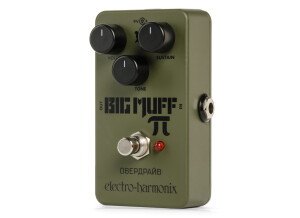
    ***WARNING: THE FOLLOWING (RATED G, FOR GENERAL AUDIENCE) REVIEW APPLIES FOR THE BLACK RUSSIAN-MADE ELECTRO HARMONIX BIG MUFF (THAT ON THE PICTURE ABOVE), NOT THE EARLIER (USUALLY MORE EXPENSIVE) TANK-GREEN MODEL WHICH MAY SOUND DIFFERENT*** This analog stompbox is something in-between a distortion and a fuzz. The controls are Volume, Tone and Sustain (which also controls the amount of distortion). No D.C. in, and the input and output jacks are reversed compared with ALL other pedals that I've ever seen or owned... Please note that although some units (like mine) were provided with a true-bypass switch, not all were... This model is no longer produced, replaced by the U.S. Big Muff which is said to sound a bit cleaner. UTILIZATION Well, three mere knobs... could be worse, couldn't it? SOUND QUALITY It took me some time to get used to this very dark, grainy, almost experimental kind of sounds. I rarely use it alone, most of the time I have it follow a cheap overdrive which gives the Big Muff the mid frequencies that it lacks, and the whole provides for one HUGE distorsion sound... The way the tone knob shapes the sound is a bit surprising as you get in no time from an almost total lack of treble to a shrieking sound. This pedal is rather versatile as it goes easily from punk to vintage rock to a growling metal sound (needless to say that in the latter case you definitely shouldn't expect a sharp-edged sound -- hey, that's a FUZZ). OVERALL OPINION I've had this for 3 years now, although it's not always suitable for any situation it can be adapted to almost any style that needs heavy guitar sounds (some use it with a bass too, generally with great results). One among many versions of a true classic, always nice having one around...