Log in
EN
FR

Analog Modeling Synths

86 products found

Filter
Sort by
Evaluation
  • Reviewed or not
  • Editor’s award
  • Reviewed by Audiofanzine
Availability
  • Available or not
  • Sold new or used
  • Sold new
  • Sold used
Must-have products
  • All products
  • Flagship products
  • Best rated products
  • Hot products
  • Popular products
Price
  • Freeware
  • Low-cost (< $500)
  • Mid-range ($500 - $1,500)
  • Premium (> $1,500)
€
Clear
Sort by
  • Popularity
  • User ratings
  • Price - low to high
  • Price - high to low
  • Used price, increasing
  • Used price, decreasing
  • Name (from A to Z)
  • Name (from Z to A)
  • Added on
Sort results
  • Popularity
  • User ratings
  • Price - low to high
  • Price - high to low
  • Used price, increasing
  • Used price, decreasing
  • Name (from A to Z)
  • Name (from Z to A)
  • Added on
Filter results 86 results found
Evaluation
Availability
Must-have products
Price
  • Freeware
  • Low-cost (< $500)
  • Mid-range ($500 - $1,500)
  • Premium (> $1,500)
Show results

The best Analog Modeling Synths reviews

The reviews Audiofanzine members found the most helpful.
  • « Almost flawless! »

    Modeling synthesizer with two oscillators per voice: analog+FM, Hard & Soft Sync, 4-part multi-timbral with effects, arpeggiator, LFO. Everything can be synced to the internal clock or to an external one via usb or midi. Light 49-key keyboard without aftertouch. 396 programs + 99 Performances. For more information and specific details visit NORD's website directly. UTILIZATION I haven't had the need to open the user's manual after one week of use. It is well designed and, except fro the Mutator mode (an automatic program generator that I haven't tested), I have perfectly mastered this synthesizer, which is a great tool to create one's own sound palette without the need to be an expert on synthesis. I like particularly the Performance mode, a real blessing live thanks to its Impulse Morph mode that assigns seven modulations directly to three buttons that are easily accessible right next to the wheel and pitch. Very practical to manage with the left hand. The feel is very nice and firm, even if I personally find the key return is not fast enough, which demands some practice if you want play a bit more technically and fast. I think an aftertouch would have been useful, given the modulation possibilities. In my view, the keyboard is the synth's only weak point. Nevertheless, we can connect a modulation pedal to which we can assign the volume or the wheel. This allows us to keep both hands on the keyboard while modulating the sound and, anyway, aftertouch is rather random and hard to master in practice. But it wouldn't have hurt to have it and be able to disable it as well, like on the minibrut. So, to cut it short: for the price I would've liked to have aftertouch too. I love its build quality and lightness. It's compact while still remaining ergonomically impressive. I noticed that the buttons are more flexible in their movements than before, while remaining firmly on their axis! I think their movement is very well adapted for fast playing with a synth, which is great. The multi-timbral mode can be easily split in two parts, A&B on the left side and C&D on the right, the split point is obviously adjustable. SOUNDS Simply put, its sound is the best and most versatile that I have heard in terms of synthesizers. It sounds deep and very similar to an analog synth (which I know a bit about) with a modern touch and flexibility for modelling, I love it! The nord lead 4 covers all domains without any particular weakness: deep lows, a sharp lead synth, pads and FX, everything is possible, and the sound is always pleasant to the ears, even when taking it to the extreme. It also has a round and warm side to it, a bit like an analog synth, but also a cold one with its FM mode and Sync, in addition to the modulations that are very easy to set up, it's child's play and a real pleasure to play with, you can simply concentrate on your creative side and technique. OVERALL OPINION For me, apart from the lack of aftertouch and the keyboard keys' sluggish return, it's almost flawless. It's simply the best nord lead ever. The price is hefty but it really is enough for everything that has to do with synthesis, thanks to its richness of modulations and the great versatility of its oscillators and filters that cover almost all eras and genres. The quality of the modeling brings it very close to an analog synth, especially given the quality of its filters, which are perfect, in my opinion. Live or in the studio, it can perform very well in both situations. In short, if you have the money, go for it. You won't regret it.

  • « This is going to be big »

    Desktop Expander sequencer Digital emulation of the Roland Tb-303 Very compact, about the size of an A4 sheet Comprehensive audio connections, plus MIDI in and out, USB The latter allows you to establish a MIDI connection, to power the TB-303 and to transmit audio (awesome). Minimalist controller, cutoff and frequency knobs, the touchpad allows you to go further in terms of adjustment. Great number of presets, among which is Bank A, including the sounds of the TB-303. Plenty of patterns, 8 banks of 8. Each preset has an editable effect per program but most of the time they are well matched. 4 oscillators for a very fat mono sound or an acid one, it's up to you. UTILIZATION It has a short learning curve and is user-friendly. As I've said before, sound editing is minimalist but, after all, it has everything it needs and everything is well though-out. Thus, preset A1 uses the sine wave of the original TB and preset A2 the square wave. The cutoff and frequency knobs do their job well and allow 95% of the variations you usually do live with such devices. The rest of the classic edit functions are done via the touchpad. It features two modes to record patterns: Step and Real Time. The ideal workflow is to start with Real Time and then switch to Step with accent and glide Multi-language and basic manual on an A4 sheet. SOUNDS Several videos on youtube prove that it's very close to the original in terms of sound. The great number of presets classified in banks allows you to do everything that mommy (the original TB) did. Regarding the effects I mentioned above, they are preassigned to the sounds. I'm amazed by the quality of the effects on this sort of devices. I expected metallic reverbs, delay that flanged...Bu that's not the case at all, they are very well implemented and have a great quality. The only thing you can modify is the intensity of the effect thanks to a knob that also allows you to cut the effect completely. My only disappointment is that some of the sounds of the FX bank are hardly usable. On the other hand, the TB, bass and lead banks are a real delight. OVERALL OPINION I've used it for about 15 days. I think I have mastered it. I have never had an original TB but I do know how it sounds (from samples, emulations, software). To be honest, this small unit is AMAZING, in terms of sound, versatility and usability. It is particularly well conceived and well though-out. The engineers at Roland did a great job recreating the sounds of the mythical TB-303 I don't see any reason to go broke for an antique, except maybe for people who really yearn for vintage stuff (or snobs, which is a tautology....) To finish, just a word on its value for money. I'll be brief, for less than $300, it's an excellent value for money, especially when you consider the manufacturing quality. Probably made in China, but impeccable all the same.

  • « Waldorf Q /32 voice Phoenix edition is becoming a collectors synth »

    The Waldorf Q is a direct descendant of the famous PPG 2.3, but with extra features. It differs a lot from the Microwave or XT/K in that way that the Q has 3 oscillators of which 2 are independent Wavetable OSC's (not so with the Microwave or XT/K) The Q has a phenomenal filter section, and a very extensive Matrix Modulation. The sound of the Q is extraordinary, super quality, aggressive, but also can be honey sweet, warm analogical like. It simply is a top-tier synthesizer. I wanted to trade my Q Phoenix for a newer Quantum, but after trying in my studio, I decided not to do so because although the Quantum offers a zillion possibilities, but sound wise doesn't even come near a Q Phoenix. There are of course downsides like with every synth. That is the power supply that can break. Skipping pots if you are unlucky with buying a second hand unit. But of course, they can be repaired easily. Then there is the Nextel coating which is a nightmare on following Q types: original blue Q Keyboard, some of the dark blue Q Rack units, the "Halloween Edition" Q, and the early yellow Q versions. The Nextel coating is a nightmare and becomes dirty, peels off. Repaint is the only option. But again, sound quality wise, the Q is a monster and has not many competitors in that sense... Finally, the one to have as only about 300 units were made is the Q Phoenix 32 voice or the Phoenix Q+ (with analog filters) However, the Q+ tend to have problems and bugs and the analog filters don't do much different than the digital version. These last versions 2 will become true collectors.

  • « Just starting tweaking knobs »

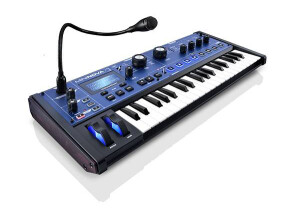
    The Novation MiniNova is a synthesizer that is very small and compact but packs some great sounds. It has some of the same features as the regular model UltraNova. The MiniNova has 256 sounds on it, you can tweak and transform each one of those sounds very easily with the knobs on the front of the MiniNova. The MiniNova does not have speakers on it though so you will need to have some sort of an interface to plug it into. Or you can purchase some sort of monitor just to send the audio signal through. Especially if you are live musicians and use the MiniNova, you will want to have a good monitor to play it with. UTILIZATION One thing you will notice with the MiniNova is you can get some great sounds very easy. You can just tweak a few knobs after loading a preset and get some good stuff. There is no programming involved and no need to read the manual or watch any tutorials. Just load a sound and start turning knobs. I have found some really good sounds that I use in my electronic music just by messing around with knobs on the MiniNova. SOUNDS The MiniNova also has a voice-tune effect and vocoder on it. I do not use the vocoder that much but it does come in handy sometimes. The MiniNova is well built, all of the material it is made out of seems to be strong. I can tell the MiniNova will last a long time for me as long as I don’t drop it or knock it off the stand. OVERALL OPINION Using the MiniNova is like a breath of fresh air. I have not had many synthesizers that give me such good sounds with little to no effort at all. I think anyone who makes electronic music or even dub or bass music needs to get this synthesizer now.

  • « let the fun begin »

    The Korg R3 is a small and portable synthesizer that has a built in vocoder in it. It has a microphone input a front panel XLR input and a ¼ phone jack. There are also outputs for MIDI in out and thru, plus MONO right and left outputs and ¼ headphone outputs. There is also a place to put your foot switch or pedal. The Korg R3 runs by a CD adapter and only weighs 6 pounds. It is well built and very portable. For this keyboard to be so small, the keys feel very good and have nice response to them. UTILIZATION There are 2 oscillators plus a noise generator on the Korg R3. The first oscillator has 8 types of waves including pulse, triangle, sine, formant, noise, and a few others. The second oscillator has 4 types , saw tooth, square, sine and triangle. SOUNDS At first I could not decide which was better, the Access Virus Ti or the Korg R3. Too this day I still will say that the Access Virus Ti is better because I like the sounds more, but the Korg R3 is way more portable and has better feeling keys. It is also more user friendly than the Access Virus Ti. OVERALL OPINION I have been using the Korg R3 for 2 years and still use it a lot now. I do take this with me to other studios when we go there to record. I don’t even have a case for it I just put it in a extra bag that I have and it still has never broke or been damaged in any way. It is built like a tank and will last you a long time, not to mention give you some really great sounds to use in your music. Mess with the knobs and let the fun begin!

  • « Great Synth »

    This roland SH-201 is a 49 key synthesiser with 2 oscilaters. It has 8 waveforms to choose from on each oscilator (osc) It has everything that an analogue synth would need in my opinion. The D beam is a really cool feature and you can set different filters to that also. You can make any sound you want really with this synth, from dirty bass wobbles all the way to trance leads and fx sweeps. I use mine as a controller also and it is very useful as I can set filters on a vst to the knobs on the synth and have a lot more flexibility. Connections are midi, jack and usb. There is also a slot for pedals if you want to use one of those with it. UTILIZATION With synths like this, editing sounds is as easy as a walk in the park. Each knob effects the sounds and you can have a great time trying to make new sounds from the presets that are given. The manual is more than clear, it tells you everything you need to know about synths and how to make new sounds. I mean... if you did not know anything about synths you would do once you have read this manual. Set up is more than easy, just plug it in hook it up to some speakers and your ready to go. SOUNDS With most synths the sound is not realistic, you can never create a perfect violin etc with one but they are very nice sounds non the less. Id say that the velocity touch is ok, not the best but pretty good. Some sounds a really cheesy but you can make them nicer with a twist of a knob. All the effects are good, I would like to have seen more filters but apart from that its great. OVERALL OPINION Favourite thing. Playing with the lfos. Least favourite thing. A bit weak eg the knobs can be pulled off really easily. Very good value for money for the size and the features. I have always played with synths such as microkorg and moogs and I would say moogs are my favourite but very expensive. Quality of sound is great in my opinion, if it was not I would have sent it back straight away. If I had more money I would buy a little fatty moog but since I did not I bought this and it is a great synth.

  • moosers's review

    The Waldorf Micro Q Keyboard is a smaller and less versatile version of the regular Waldorf Q keyboard. The Micro Q Keyboard has 37 keys, which is about three octaves. It has both pitch and modulation wheels and 1/4" outputs for pedals and most of what you'd expect from a synthesizer. This synth isn't an analog one, but is indeed made up of digital components. It doesn't have full polyphony, but I've never had a problem playing it because of this... UTILIZATION The Waldorf Micro Q Keyboard certainly has a ton of parameters to work with. While off the bat this can make it a little bit confusing to get used to, in time you'll find that this helps more than anything as it gives you complete control over your sounds. The keyboard has a ton of filtering options, as well as a built in vocoder and a ring modulator. You can expand the keyboard as well to give you more polyphony and other features. A manual might be a good thing to have around when trying to learn this versatile synthesizer. SOUNDS While not a true analog synth, as far as digital synthesizer emulating analog sounds, I haven't heard a much better one than the Waldorf Micro Q Keyboard. You can get some seriously awesome sounding synth sounds to start with, and then they can be manipulated in all sorts of cool and interesting ways if you so choose. All of the sounds are extremely realistic sounding for a digital synth, and I'm a pretty big critic when it comes to digital synths. The sounds are pretty unique to Micro Q, but this isn't a bad thing at all as I think most users will find this to be a big plus... OVERALL OPINION As far as compact synthesizers go in this price range, they don't come much better than the Waldorf Micro Q Keyboard. They also make this keyboard in a rack mountable version if you want to just have the sounds and use a MIDI controller. I'd definitely encourage those interested to also check out the Waldorf Q, even though it is more expensive to see if it might suit you needs better, as it does have some things to offer that this synthesizer does not. A must see for anyone looking for a great synthesizer at a great price...

  • FP User's review

    Very satisfied with the features. Only real downfall is the number of voices it's capable of at once. $450 UTILIZATION Tweaking the predefined settings is fairly straight forward and the menus for the UI are your standards for Roland. If you know Roland gear, it's very straight forward. If not the manual helps sort out the stuff that's harder to find. The manual is deffinitely geared more towards individuals looking to use it for it's intent, aka a VA synth. There is also a technical pdf doc that can be downloaded from Roland site that covers the technicalities of how the sounds are produced. Why it was omitted from the manual I don't know. I'll deffinitely be hauling it to gigs. It's a pretty heavy duty machine, but not as sturdy as the old metal casing used with the S-50 samplers. Having owned an S-50 years ago, i do think that over time the contacts are going to wear out (for the keys as well as the buttons for the menus). They are easy to replace (at least on the S-50) and require very little saudering. Had to contact customer service to get the manual asi bought it used. The manual was on backorder, but it was still on my door in under 3 weeks. SOUNDS Solid VA synth. It does have a few issues with sound clipping and popping if you don't tweak the settings enough. That's really the only downfall to it. Deffinitely focused more on the dance/electronic genre of music, but there are enough predefined patches to work from to apply it to others (namely the strings and organ sounds) . Has a handful of selections of different types of chorus's that can be applied to sounds, as well as panning and delay/reverb. It might be nice to see a few more, but i think going with outboard processors is the way to keep everything consistent in a track. OVERALL OPINION I think the JP8000 is going to be a long lasting item in my growing aresenal of gear. Just retro enough (VA) to be an enjoyment to use, but new enough to have the midi support that we all need. If you plug it into you midi interface you will see a constant signal coming from it for sync. I doesn't interfere with anything that i'm aware of, but i haven't found a way to use it or the menu option to turn it off. Originally posted on FutureProducers.com Posted by: Unknown ( 5-, 2002)

  • « Vintage synths »

    The Arturia Origin Keyboard is a 61 key synthesizer, it comes loaded with some really good vintage sounds. The first thing that I notice with the Arturia Origin is how many actual sounds are own it. You will be using these sounds for a long time because it gives you so many of them. It has some of the most classic synths in it like the CS-80, Prophet VS, and Modular (there are a few others that I cannot remember). It has a built in 16 and 32 step sequencer. There are up to 32 voices and it has MIDI in , MIDI out, and MIDI thru. UTILIZATION The Arturia Origin does have an arpeggiator on it and a total of 9 outputs. You can have 1 foot pedal (footswitch) and 1 foot controller plugged in to the Arturia Origin. There are about 10 different effects on this synth. I do wish there were more effects built into it because for the price I would expect to have a lot more. The Arturia Origin is very expensive, I do not own it but I use it at the studio all the time and the effects are the only downfall of the Arturia Origin. The ones it has are very good, but there should be a lot more. They spent a lot of time developing the sounds to model classic synths, but they did not spend time adding effects. SOUNDS The sounds and presets are great, if you are into vintage sounds then this is a must have because you are getting the sounds from some really good synths. You are getting sounds from boards that cost more than this does. OVERALL OPINION If you went out and purchased those boards individually you would be spending about 3 times what this keyboard cost. So you can have those vintage synths all in this synth for one decent price.

  • « Yamaha AN1X »

    I purchased this for $500 during the great Sam Ash blowout of 2000. Before the blowout it was retailing for three times as much. Lovely sound. Relatively warm and full featured for a virtual analog synth. Appearance and controls: It has a five octave synth-style keyboard, a ribbon controller, 8 programmable knobs and a two dimensional ribbon controller. Synthesis Architecture It's a ten voice virtual analog synth with two oscillators, two LFO's and a single multimode filter per voice. An additional high pass filter is located at the end of the signal chain, but it's passive with no resonance. The AN1X sports a ring modulator and white noise generator as well as FM and Oscillator sync functions. The oscillators have an "edge" parameter which allows you make them more rounded or more jagged. So you can go smoothly from a bright saw to a sine wave. One feature that stands out is the amplifier's feedback parameter. This emnulates the minimoog trick of taking the output of the amplifer and feeding it back into the filter. This adds a smoky, tubey saturation sound, warming things up nicely. There is a well featured modulation matrix in the synth which can control nearly all synthesis parameters. Sixteen concurrent routings can be mapped in a single patch, allowing for a lot of expressiveness. Two unusual features in this synth are the free envelope generators and the scene morph function. The four free envelope generators can modulate virtually any of the synth's parameters and can be set to run free or be triggered by the keyboard. They can be synced to midi, and looped in different ways. The scene morph function allows you to morph (i.r. interpolate) between two patches with the mod wheel. The morph yields lots of complex timbres and is much more expressive than a simple cross-fade. Effects and arpeggiators: The effext section is quite comprehensive which each voice passing through a multi-effect, a delay, a reverb and an eq. There's an arpeggiator on board as well as an analog style sequencer. Sounds: As you might expect it does analog polysynth sounds very nicely. In monophonic mode it does yield brassy Moogy sounds as well as some rather nice Roland type "wet" resonant sounds. It does lovely synth effects since it's filter self-oscillates. Of course it doesn't do natural instruments like pianos and violins at all. It has a clunky wall wart power supply, The filter does stair-step on high resonance settings. I wish it had an octave/transpose button. It's well made The casing is plastic but feels sturdy. It's extremely lightweight and convenient for gigging. I have had no problems in the 2 years I have owned it. And I am thinking of geting a second one because I like it as a controller. It's emerging as a cult synth. Although Yamaha has put much of the functionality into the AN200 board and the PLG-AN plug-in card, the AN1X appears to have an ardent following. With good reason. This review was originally published on http://www.musicgearreview.com

  • mooseherman's review

    This is a digital synth that has three octaves. There are connections for a microphone (input) as well as a 1/4" output for amplifiers and PAs. There's also an XLR out. The Microkorg has a built-in vocoder which is the reason for the microphone. There are wheels to adjust pitch, modulation, and sustain. It can be used for monophonic or polyphonic purposes. The sounds on this machine are finite, meaning you cannot update them with a computer. UTILIZATION Using this machine is pretty simple overall. While there are a bunch of sounds, there isn't an astronomical number of them, meaning you can get around them pretty easily and program your favorite ones for easy access. THe hardest thing about using this keyboard is the size of the keys. These keys would be relatively small for any player who isn't a child, and my hands happen to be quite large, so I sometimes struggle to fit the notes in. However, I think this is a relatively small problem considering that my main use of this synth is for single note lines, though. The manual is really good at explaining how to work the synth, and it definitely made things easier once I got started. SOUNDS I love the sounds that come out of this synth. Don't let the size fool you; this guy really brings it! My favorite sounds are ones that can best be described as throwbacks to 80s new wave and 90s dance music. I think that if this is what you are looking for, these sounds are great. It also does a decent job of emulating mellotron and organ sounds, which I wasn't expecting. I wouldn't buy it specifically for those things, but they are a nice bonus. To top it all off, the Vocoder is undoubtedly one of the best features of this synth, and almost worth it for this alone. The sounds are only as realistic as a synth can be. It emulates synth sounds, not the sounds of real instruments, so I'd say they are overall pretty realistic. There isn't much in the way of touch sensitivity, but the sounds that come out of this guy aren't really the kind you'd need a whole lot of sensitivity on anyway. I like some of the effects, particularly the modulation and reverb effects. I haven't had a single complaint with any of the sounds that have come out of this synth. OVERALL OPINION This synth came highly recommended by a few friends of mine. They didn't steer me wrong. I am very happy with this purchase. I like the diversity of synth sounds, the vocoder, and the relatively compact size of this keyboard. It's a bit pricey but I am very much convinced that it's worth it. I think that the sound quality is solid throughout, and assuming you use the right amp or DI this thing can work wonders. If broken, I would certainly replace it.

  • Audiofanzine FR's review

    (Originally written by Bill3107/translated from Audiofanzine FR) I use it with my Macbook Pro + RME Fireface (to reduce the CPU load) under boot camp, but I only use Midi and audio from the RME. UTILIZATION It's a war machine and in spite of its 50 controls it remains logical and intuitive... it's a delight for sound editing. One control = one function... Clear user's manual. SOUNDS Nearly everything is possible regarding the sound... just spend some time with it. When you listen to the presets the first time you'll immediately think of the 80's, but you can also get modern sounds. The device has an analog and digital feel... That's its main advantage (compared with a Virus, which is more expensive). Very good keyboard and metallic wheels... You can also use it as a control surface for your favorite VSTi... I love the lead sound, and you can also create good pads... Ideal if you want to embellish your songs. It's very versatile (you can use it for any music style unlike the Virus that only provides modern sounds) but it also has its own sound character. It's exactly what I was looking for!!! OVERALL OPINION Pro: sound Pro: versatility Pro: playability Pro: controller number ;-) Con: you need to work your butt off to get the right sound! Con: you need a computer (or a Qcard) to save your presets. Con: it requires you to spend a long time with it (but that's the purpose isn't it?)