Log in
EN
FR

Digital Synths

375 products found

Sort results
  • Popularity
  • User ratings
  • Price - low to high
  • Price - high to low
  • Used price, increasing
  • Used price, decreasing
  • Name (from A to Z)
  • Name (from Z to A)
  • Added on

The best Digital Synths reviews

The reviews Audiofanzine members found the most helpful.
  • « A terrible disappointment »

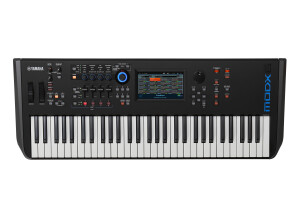
    After 3 months spent watching videos and dreaming to lay my hands on this new synth, the day has finally come. As an owner of an MO6 and Motif XS, I really believed the Montage would be Yamaha’s most elaborate synth, but in the end the longer the wait, the cruellest the disillusion. The mere unboxing step already reveals a rushed product: the machine lays in a hastily rolled plastic cover with four old-looking yellowish tapes on the corners, a power cord and a hastily written manual with blurry pics and little explanation at all… Quickly plugged on, but a sturdy stand is necessary as the keayboard is particularly heavy. Manufacturing quality is good, it gets turned on in no time and everything works so no problem so far. This is the moment you’ll want to listen to its sounds. Here comes the first surprise: everything is messy, hard to find anything and the so-called “performances” include complex sounds featuring arpeggios, motion control and other basic –effectless– sounds… And there are many crappy sounds that’ll never get used… HEY, YAMAHA, you DO know that not everyone buying this kind of keyboards is a programmer, don’t you? There are also musicians who don’t want to wait for two years before being able to play something interesting! This is a bitter disappointment, as except for perhaps ten sounds nothing is even just playable, let alone the rhythms that were forgotten on most sounds – the same goes with the arpeggiator. While we’re at the arpeggiator, it’s way too complicated – so much as it’s almost unusable, plus too many steps are necessary to just insert one. The designers of this pretty toy wanted to please themselves, but in the end this synth is like a cake with so much flavor that it just ends up being plain disgusting – and there we are, you can’t find anything intuitively and making the best out of the Montage requires spending thousands of hours. So you spend your time toying around with ordinary Voices – the same you find on a Motif, except that the Motif’s performances actually do the job. I’m sorry to only be able to give a musician’s advice, in contrast with what an electronic genius’s might be so perhaps this device wasn’t designed for me but they really could have included great sounds – especially considering the many blank memory banks. In the end, the Montage is a last-generation war machine without an ammo, and Yamaha provides a half-empty box. Now I understand why all the demos and videos feature the same PEARLS, DJ and piano sounds – as usual. I feel like I’ve thrown 3000 euro away, and all I can do now is cry over it while trying to sell it.

  • « Simply the best! »

    USE a) It's really hefty! It's beautiful...it's a Roland! b) Manual? What manual? It's so intuitive and user-friendly that I haven't even bothered to open it...Once you've understood how the banks are organized (which takes you five minutes), you can start enjoying! c) Ultra-comprehensive editing, it's simple and intuitive: It's perfect!!! SOUND It's great for all kinds of music, from accordion music to metal, pop and rock! Between the kronos, which obviously features karma (although incontrollable), and the jupiter80 with well-made and effective arpeggios...I wouldn't hesitate a second! The supernatural sounds, as well the other sounds, are superb. They have punch! And superimposing the layers you get wicked results...I L O V E I T!!! OVERALL OPINION A small recap: I have the roland juno g, roland fantom x7, korg kronos 61, and now the jupiter 80! I chose it due to its 76-key keyboard, aftertouch, huge editing possibilities, look ...but also for its ease of use! I bought a kronos61 earlier his year...and sold it right away! The sound quality is great. The possibilities of the kronos are stupefying and without a doubt better than those of the Jupiter 80 (in terms of sequencer, sampling, etc.)...But unfortunately, it's no fun to have to meddle 30 minutes to program a sound, browsing the unreadable sub-sub-sub-sub-menus. Sound engineers can keep the kronos to themselves...I have only one hour to play music, every second counts! The Jupiter is a stage keyboard, a sort that's not easy to come by! You can create sounds in less time that you can say it...and not just any sounds! Wow!!!! What a punch!!! Sounds are ultra-realistic! The Jupiter is perfect for musicians who don't have too much spare time! It turns on in 10 seconds, the display is easily readable, beautiful and precise (unlike the kronos!). Installing the drivers on a PC poses no issues. I would've liked to have more connection options on the rear...but other than that, I'm very happy with it! I wouldn't hesitate to buy it again!

  • « An M1 on steroids »

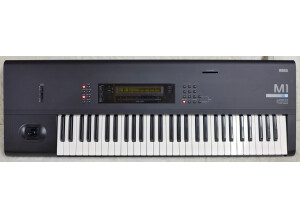
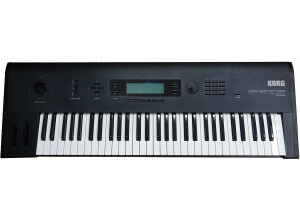
    In 1991, Korg debuted the T series with three different versions: the T1 (88 keys), T2 (76 keys) and T3 (61 keys). The Ex versions – "T2ex" and "T3ex" – feature an extra ROM with 512 kb of PCM acoustic piano sounds, the best you could get at the time, which was originally featured on the T1 model. Introduction The T series succeeded to Korg’s famous M1, aka the best-selling synth ever and the first general public workstation. It features an 8-track sequencer, 16 tracks of polyphony and dual multi-effect inside. The T series’ sound engine is the same as the M1’s, and the patches are even compatible with one another. It’s a subtractive synthesis ROMpler, with the sound part taken care of by PCM samples (4MB for 144 samples). The T, aka the “M1 on steroids”, features a larger screen, a floppy disk drive, two additional 100-patch banks, and 8MB of waveform (instead of 4MB). With a price of 200 to 250€, its current value-for-money on the used market is very good. Apart from its manufacturing quality, it features the punchy sound of the synths of its time, such as the D50 or Wavestation. Its dynamics is a pleasant surprise, in particular in the lower register with powerful and precise bass sounds that don’t crumble down. The output provides very little hiss or noise. Soundwise Its strength resides in the versatility and variety of its available sounds, with a palette ranging from synth sounds (bass, leads, pads, FX) to “realistic” instrument sounds – though their “realism” now appears quite debatable. In a nutshell, the synth can reproduce every General MIDI instrument (piano, organ, strings, winds etc...) with a quality only slightly better than GM sounds, so as a whole it sounds cheap. However, some patches are worth a listen, plus you’ll easily something fit for you among the numerous (20,000+) sysex patches available on the web. The user has 2 banks of 100 single patches each, “PROG A” and “PROG B”, plus an extra “Combi” 100-patch bank. - each Combi is made of 8 single patches or 8 multitimbral parts that can be used at taste (as a separate instrument, keyboard split or layering modes). I personally use layering quite a lot, by mixing 3 or 4 carefully chosen sounds you can easily enrich the basic sounds. For those into it, it’s an occasion to buy a piece of legend. The M1’s sound has contributed to write uncountable hits of all kinds in the beginning of the 90s, in styles including pop ballads, synth pop, pop, radio rock, house, new beat, jungle, techno, hip-hop, dance, ambiant, ethnic, TV themes and so on... In terms of synth sounds, the result is quite basic but it provides generous lows. - a variety of nice pads - synth brass - analog synth-type bass - convincingly-sounding leads - son percussive sounds and FX As to the realistic sounds: - the typical 80s drum sounds are awesome, full of punch - the Hammond, Rhodes and church organs are not bad, especially the mythical “M1organ” from Robin S – Show Me Love fame - beautiful LA piano sounds (piano + strings) - pianos are little realistic but perfectly suit piano house, italo disco, new beat or old school jungle registers - cheap sax sounds which still work in an old school house or hip-hop context - 1 electric guitar patch with an igniting feedback, very nice to play (6-7 minutes into the demo down the page) - Convincing acoustic guitars - 2 or 3 convincing slap basses - Some nice sounding clavinets Pros + overall sound quality, punch with little background noise, lush bass sounds typical of Korg’s old synths + many patches available on the internet, and various sounds + easy to program, good ergonomics (except for the sequencer) + a good, minimalistic design, sturdy with its metal frame + 4 separate jack outputs + 4 MIDI outs + MIDI in and Thru + pleasant keyboard with aftertouch and joystick Cons - no arpeggiator - non-resoning filter - the sequencer part (its ergonomics and editing features lack something) - among all available patches, many sound poor and General Midi-like - quite a big keyboard - when aging, the backlight tends to diminish and disappear. When it happens, it can come with a trebly noise coming from the synth’s frame (and not the audio outs), which comes from the voltage inverter which supplies the backlight with 12V. It’s a well-known problem on synth with an electroluminescent leaf-type (“EL”) backlight (such as the Wavestation, Kawai K5000, Yamaha SY and TG, K2000, Korg 01W...). The backlight and inverter can be changed, or the entire screen changed for a LED model. - sometimes, disconnecting the backlight’s supply (CN6 connector with two wires, plugged on the KMI-077 supply board) stops the said noise - with time, the switches tend to do what they like (but they can be changed) In the end… If you listen to the demo, you’ll get an idea of the patches on the KORG Legacy VST which features the M1 and T series models’ patches as well as those of the Korg expansion cards. I compared using an RME interface, while the sound timbres ate faithful to the original the plug-in lacks depth and dynamics compares with the synth. Sound samples These are raw stereo recordings of a T2ex, recorded using an RME FF800 with no processing. Or, listen to the demo. https://www.youtube.com/watch?v=PPrrqJeCZI4

  • Audiofanzine FR's review

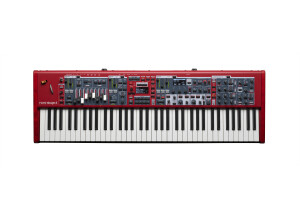
    (Originally written by Septentrion/translated from Audiofanzine FR) I have to admit that I miss my Gem ProMega 3 but I sold it because of its weight, reliability problems, and because Gem has no reliable after-sale service anymore. What other European brand do we have left? CLAVIA (from Sweden) of course!!! I bought a NordStage76 and WOW!!!! It has everything I liked about the ProMega3: ease of use, musicality, manufacturing quality, keyboard quality, simplicity (one function per control like with the Gem, although some buttons require that you press an additional button, which isn't very convenient). It's a real instrument, not a Japanese toy! And compared to the ProMega, you get additional advantages like more accuracy! Yes, even Rhodes sounds are great! And let's not forget the latest piano provided by Nord as a free download... It's amazing!!! My hands can't believe it yet. On top of that it is light (especially the 76 version) and versatile. Like with the ProMega, you actually feel that the Nord Stage is an instrument made by musicians for musicians and with a strong European character. I would have liked to keep my ProMega at home but I didn't have enough space or money. I don't regret having upgraded to the Nord Stage, which is like its modern reincarnation. Small cons: The limited memory space is a pity (the new EX model solves that problem). The USB connector isn't Midi compatible (it's only conceived to download sounds, configurations, or update the OS). No arpeggiator, split points aren't fully adjustable, lack of punch in the audio output (the overall sound quality compensates this disadvantage). But I'm being picky because I actually love this instrument and I look forward to lots of years of pleasure with it. UTILIZATION Everything has already been said about this device. Intuitive, simple and easy to use. It has the same spirit as the ProMega. Everything is musical and inspiring to play and create music. SOUNDS I don't know anything better for piano, rhodes and organ sounds. Even though I've tried out virtually everything on the market. Some provide better pianos but none of them offers such a comprehensive solution nor a well-balanced sound. And the playability is incredible (I was a bit afraid that the keyboard would be too light but it's perfect for me and it reminds me an old piano). I was positively surprised by the synthesizer section. It's a lot of fun and very convenient for additional sounds. The effects are awesome too! For example, a rhodes + leslie with distortion and you're ready for Echos! With a hi-fi system the sound lacks a bit of punch but it is terrific when you play with a PA system. OVERALL OPINION It's been a two months honeymoon. I use it at home, for rehearsals, for recording sessions and live on stage with a band. Even my musician friends noticed the precision, the presence and the dynamics of the sound, but also the stereo depth and the presence within a mix (strong but not overemphasized). I hesitated a long time before buying it (and my banker did too), but like all other musicians who have it, I don't regret it. It's a real instrument, made for musicians.

  • « A towering gear with interesting sounds »

    The basic synth is called the DS202 , with two expansion – the DS310 digital synthesizer and DS320 sequencer. Once everything mounted on the synth, the size is quite impressive. A sturdy and well-conceived gear, for a total 16 to 17 lbs. No MIDI out. Basic sounds (namely PIANO ORGAN HARPSICHORD FLUTE STRINGS ELECTRIC PIANO JAZZ ORGAN VIBRAPHONE CLARINET BRASS) are crystal-clear. They can be edited using the LPF filter, Envelope Selectors 1-4, 4 sounds that can be saved and two chorus effects. The delay (off, short or long) and sustain attack and release can be set using the ‘Time” sliders which happen to be very precise (values include 0, 0.01, 0.02 , 1, 2, 3, 5 or 10 seconds). Every parameter can be set using the LCD screen, the 4 envelopes available can be visualized as well as the spectrum settings (over 16 harmonics). Effectwise, there’s a Chorus 1 that offers a slow cycle around 0.7 Hz, while Chorus 2 is around 1.7 Hz.,and a Vibrato effect can be added. The keyboard can be transposed. Many variations are available, so as a consequence the user bank is bit short. The key’s touch is pleasant, it’s easy to use but the sequencer and digital synth still require reading the manual. As for the rhythms, the drum machine provides a Roland CR78-ish sound. The “one-finger” bass auto-backing is very cool. I haven’t had an opportunity yet to use it during one of my sets, so let’s wait and see… This synth is so rare that it’s a real collectible, with these options it cost around 1000 MARKS back in the days but I got it for 200€ + 75€ per module, and that’s a purchase I clearly don’t regret.

  • Audiofanzine FR's review

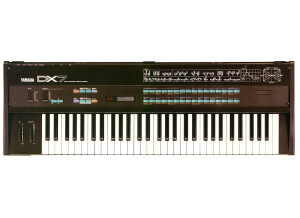
    (Originally written by elriton/translated from Audiofanzine FR) 4-Operator Digital FM synthesizer with 8 octaves and MIDI 61 keys Pitch and modulation controls Sustain via footswitch Breath control (very rare) 8-voice polyphony Connections: MIDI in, out, thru Mono line output Headphone output Yamaha footswitch Breath Control Supply 24 user sounds 8 banks of 24 presets each UTILIZATION I'm not too complicated, I just pick one of the user presets. Possibility to switch between different banks. The sound editing is totally empirical. You'll need a good number of hours with this synth to get to know its real possibilities. Avoid theoretical approaches! FM synthesis on the DX range was perhaps the biggest intellectual rip off in the pro audio world of the 20th century. The user's manual is clear but there's nothing like real-life experience. SOUNDS The easily identifiable sound of the DX range requires you to process the sound with effects or mix it with something else in order to hide the synth's characteristic sound. The sounds aren't realistic. But then again which synthesizer sounds realistic? No effects. The keyboard isn't velocity-sensitive. But you can play with an expression pedal via MIDI. In this case it's very empirical again. The best sounds are: electric bass, lead (Feed Lead), clav-sounds, special presets (Space talk, Schmoo). OVERALL OPINION I purchased a secondhand DX27 in 1987 and I still have it: indestructible and ever trusty. Previously to the DX27, I worked with a DX21, a Korg Poly 800II and a Roland SH101. I've noticed that it produces more noise than the DX 21 and FB 01, but it doesn't matter, it's still my DX27. I only miss a pitch envelope like on the DX21 and the DX7.

  • « Tone Generators »

    The Yamaha EX7 has some really good tone generators and it allows you to sample. I remember when it first came out, it was out of my price range at the time but about 5 years later I ended up getting a great deal on it and had to buy. It has some of the best effects that any synth I have ever owned had; you will get over 80 effects like reverb, delay, distortion and chorus. There are also 512 presets that are all usable as is without having to do any editing. The engineers and programmers that designed these sounds deserve a pat on the back because they did a great job. UTILIZATION There is a 16 track sequencer and an 8 track pattern sequencer that can be synced up to your other gear via MIDI. You can actually use this synth as the brain of your whole set up if you want to because it has everything you need to get other sounds into it and MIDI it up quickly. There are 2 MIDI in and 2 MIDI outs with a MIDI thru as well. SOUNDS The sampling ability of the EX7 is also amazing; I am all about sampling because of being a producer and a DJ. This keyboard is even compatible with Akai and AIFF file formats. But understanding how to use this synth to its full potential could take some time because there are just so many options and features to work through. You will have to reference to the manual a few times before you fully get the hang of it. OVERALL OPINION I recommend this to anyone who wants a full workstation that will allow you to do everything the current trending boards can do. The difference is that you will have a board that no one else has anymore. No producer really uses this board much so it is almost like getting a new synth when it first comes out. It is worth every dollar that it cost and I highly recommend getting it.

  • « can work with current music »

    The Yamaha DX1 was a very expensive keyboard when it first came out a long time ago. It was used by many popular bands of the 80’s and even into the 90’s. Today its value is not what it was at that time but it can still be used to make some really cool vintage sounds. The downside of this keyboard is that it is huge. There is just not space for it anywhere, I do not know the exact measurements of it but I can say it is probably the biggest that I have ever had. UTILIZATION The sounds are mainly based from FM synthesis, and it is very similar to the sounds of the DX7 but the DX1 has better overall quality. There are 73 keys on this board and they are touch and velocity sensitive. It does have MIDI connections which I think is fascinating considering that this keyboard came out such a long time ago. SOUNDS The DX1 is a 32 voice polyphony keyboard that has 64 presets, and all of which will pretty much take you back to the 80’s. None of these sounds can really be used in modern music unless you put it throw a bunch of processors and racks to bring it up to date. But if your style is electro music, then this will sound great for you. You will be able to plug these sounds right into your music and it will fit right in. OVERALL OPINION The DX1 is well made, and when it first came out it cost so much money that the average musicians could not afford it. So the only people that used it were established bands and musicians. The sound is nice and fat plus the keyboard itself looks great with a wood grain trim around the bottom half of it. It will be hard for most people to get their hands on this keyboard now because it still cost a good amount of money and most people are collecting them and not selling them.

  • « Great if you can get it at a good price »

    The Casio CZ-1 is a 61 key digital synth that can be purchased used for a very affordable price. That is what made me purchase is, I found one online for less than 200 dollars and purchased it immediately. They keys do not feel great though, I have had better keys on a cheap MIDI controller and the touch sensitivity is almost absent. But you will get a lot of options with this keyboard. This is a 16 voice polyphony keyboard that you cannot sequence on but you can just use it as a sound module and record your sounds out to your DAW. UTILIZATION There are a total of 64 presets on the CZ-1, most of them are not very great alone. I usually take the presets and run them through an external rig or sound effects module to get them to sound the way that I want them to sound because the only effects that you can use on this board is chorus. SOUNDS The CZ-1 does have MIDI capabilities so you can use it as a controller as well as a sound module. Judging by the sounds that are on this keyboard and the limited effects; there is no way that I would purchase this brand new at the normal price because I do not feel that it is worth much more than the 150 to 200 dollar range. OVERALL OPINION You can create up to 64 user patches on the CZ-1 and add that to the total number of presets available which is 64 you will kind of feel like you have limitations to have far you can actually push this keyboard. It seems as there just aren’t enough options to get into depth with it. But with that being said if you grad this up at a great price it could be worth it because it will give you some different sounds to use that are not on most standard synths.

  • Audiofanzine FR's review

    (Originally written by iSiStOy/translated from Audiofanzine FR) See previous reviews. UTILIZATION Classic configuration. Patch editing is rather complex. You don't have to know the FFT formulas but you should already know what additive sound synthesis means (that is to say potentially thousands of parameters) if you want to create a patch from scratch. The user's manual is much too short!! SOUNDS The sound is... how could I describe it... ... I can't find the right words! Mind-blowing!!! With a good tube preamp and a good channel strip (tube, compressor, EQ) you'll get a killer sound!!! It doesn't sound very realistic although it should, theoretically. It's wonderful for ambient with its incredible pads and stunning organic sounds. The keyboard's feel and responsiveness are excellent. It has been my master keyboard since I bought it. OVERALL OPINION I've been using it for 2 years. It's the ultimate tool to create atmospheres even if the editing is terribly boring (but it's "normal" for this kind of synthesis). Rather good value for money. But I'm not objective. With the XP I would even steal it from a newbie who would probably be fed up due to the unproductive editing hours. I bought mine (K5000W) on Ebay for a very low price with CC box and a memory extension.

  • « great for gigging »

    The Korg Microstation Micro has a built in sequencer on it. That was a huge deal with me because most of the similar models that I have used in the past did not have a sequencer on it. So I was very curious has to how good the sequencer actually was on the Korg Microstation. The Korg Microstation is very affordable, it is a 61 key synth that has full MIDI capabilities and 480 professional sounding presets that are ready to go. This keyboard is small and compact, making it perfect for the gigging musician or someone who travels a lot from studio to studio like I do. It does come with a manual that will give you all of the basics of using the keyboard and break down the 16 track sequencer to you. UTILIZATION The Korg Microstation has 512 programs and 480 are preloaded. There are 48 drum kits and most of them are pretty good even though I don’t use drum kits from key boards I still found myself using a few of these kits. SOUNDS Setting up the Korg Microstation was quick and simple, there was nothing to it. Just turn it on and starting going through your sounds. There are 5 insert effects and 2 master effects. With a total of 134 effect types you will never run out of effects on the Korg Microstation. OVERALL OPINION The sequencer has 16 MIDI tracks and 1 master track. There are 128 songs on the Korg Microstation with an on board BPM. The interface is very easy to understand and going through your sounds are easy. There are not a bunch of different menu’s to shift or scroll through to find what you want making it a perfect board for performing with. I fell in love with the Korg Microstation the first time I tried it out.

  • mooseherman's review

    This is a digital synthesizer, with a 32 polyphony and pitch, modulation, sustain controllers. The device is also a MIDI controller as are most digital synths. There is an incredibly wide variety of digital synths. These sounds can be updated regularly. Another cool feature of this synth is the digital touch screen. This makes navigating the machine far easier. This machine is compatible with Logic and most other DAWs. It can be updated pretty regular and the computer and touch screen can both be used to edit the effects. UTILIZATION This isn't a particularly simple synth to use, but like most, it can be used effectively after a lot of practice. The setup is anything but simple, as there is a lot of effects routing that needs to be done, but as far as getting it going in the first place, I don't think it's too difficult. The manuals (yes, there are about 5) will explain how to run every feature. It's actually quite a nuisance to get set up, this is the main reason why I get so easily frustrated with these things. SOUNDS These sounds are definitely not my favorite types of sounds. I prefer analog, and analog replications, when it comes to synths. That being said, the sheer range of sounds available on this thing is pretty amazing, and considering how easy it is to custom edit effects, the results can be rather impressive. The machine is capable of combining about 8 mono or 4 stereo input effects, as well as adding basic overall effects like modulation and reverb. My main complaint, though, is that the reverb sounds horrible. Most digital reverbs will be less than impressive but this one is abysmal. Luckily I have other reverb options. As long as you know what sounds to avoid (there's too many to list), I think that most people could be happy with this thing if they are interested in having a versatile digital synth. But be forewarned; none of these sounds are really that great. As far as realism goes, it's not very impressive. It is, however, more touch sensitive than most digital keyboards in general, let alone synths. OVERALL OPINION I don't really like the large amount of setup that it takes to get this thing working. I'm also not crazy about how long it takes to program and sift through the keyboard finding good sounds. I think that this would be more effective in the hands of somebody who knows exactly what they are looking for in a digital synth, which I must confess I don't always. I've tried a lot of digital synths, and this is probably one of the better ones I've tried. Because of that, I'm inclined to give it a high score, because I know that for people who love these things, this is definitely one to get excited about.