Log in
EN
FR

Shure Electrostatic microphones

104 products found

Categories
Series
Filter
Sort by
Shure
Evaluation
  • Reviewed or not
  • Editor’s award
  • Reviewed by Audiofanzine
Availability
  • Available or not
  • Sold new or used
  • Sold new
  • Sold used
Must-have products
  • All products
  • Flagship products
  • Best rated products
  • Hot products
  • Popular products
Price
  • Freeware
  • Low-cost (< $100)
  • Mid-range ($100 - $350)
  • Premium (> $350)
€
Clear
Sort by
  • Popularity
  • User ratings
  • Price - low to high
  • Price - high to low
  • Used price, increasing
  • Used price, decreasing
  • Name (from A to Z)
  • Name (from Z to A)
  • Added on
Choose a category
Selected category: Electrostatic microphones
Sort results
  • Popularity
  • User ratings
  • Price - low to high
  • Price - high to low
  • Used price, increasing
  • Used price, decreasing
  • Name (from A to Z)
  • Name (from Z to A)
  • Added on
Filter results 104 results found
Brands
Evaluation
Availability
Must-have products
Price
  • Freeware
  • Low-cost (< $100)
  • Mid-range ($100 - $350)
  • Premium (> $350)
Show results

The best Shure Electrostatic microphones reviews

The reviews Audiofanzine members found the most helpful.
  • « Shure tough KSM44 LDC - for home recording vocal and acoustic »

    I wanted a microphone for vocals and some acoustic, mainly vocals. This is for a small HR setup seeking professional sounds while tracking. Male vocal mic that didnt need a lot of EQ and Dynamic work for my voice. I wanted a mic that could track my vocal to sound finished! and the KSM44 really got me there. For the past few years I went the wrong direction, getting dynamic mics for this goal.this overcome my noisy room which then lead me down an expensive Preamp outboard path. Once I corrected the room noise, making a "vocal booth" (and moving the pc fan out of the room) I was able to return to the beautiful LDC mics. LDC higher output allowed getting rid of the outboard preamps. I mainly tested a flagship LDC MXL to a KSM27 mic. The KSM27 was cheap and amazing in build and tones (once I added the foam). It felt professional, metal, and thick mesh screen. The sound was clearer and crisp. So impressed I had to try the Flagship Shure KSM 44 that got most the positive reviews per the "Biz folk". The capsules are the same in cardiod mode, but the KSM44 has the Dual Diaphragm that per physics works differently and offers a natural compression and less negative proximity effect. The KSM44 has Multi-Pattern and HPF to remove rumble. The KSM44 cost twice the KSM 27 but to me it was worth it. The KSM44 doesnt even need a pop filter imo. The KSM44 also has a slight ability to compress and maintain a more consistent output due to the Dual Diaphragm design. US made, champagne colored, and a amazing build quality you can feel holding it. Articles say these KSM were also designed around the same drop tests and others all Shure mics go through, and they feel this tough, some even making it a Live mic! these things are great! I have the SM7, SM57, SM58, PG48, etc,, and the KSM series is just as tough built, I love that. Shure KSM44 puts a professional grade mic in my studio for cheap/used. The KSM44 has that studio sound and accomplished my goal of not needing to spend hours fixing it. For my vocal mic it sounds pretty polished straight into the DAW.

  • « My new field mic! »

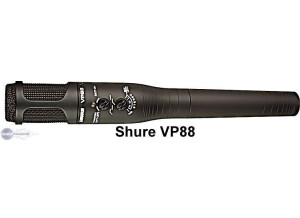
    The VP88 is a slim designed microphone that is used for professional recordings. This is the microphone that I prefer to use for recording sound effects when I am out and about. I was able to capture some really good crowd noise and street noise with it like cars and traffic. It uses 2 condenser cartridges in the capsule to deliver a high quality stereo recording. OVERALL OPINION One of the cartridges forward and it has a cardioids pick up pattern and the other is a bi directional pattern and it is on the side of the microphone. Right on the front of the microphone there are different options to choose from to get the best possible stereo image separation that you may want to use. But I really don’t use that option that is on the microphone, you can always turn them off and just do your stereo imaging in your DAW later one. I generally like to do that part of the process when I get into Pro Tools because I feel like I have more control over the overall sound. The VP88 has a built in pop screen and it works on phantom power. There is a low frequency roll off switch that comes in handy when working with a lot of ambient type of sounds and recordings. The built in shock mount works great with handling noise and vibration from the stand that I use it on. This microphone has a very low noise and sounds amazing when I use it out in streets or where ever I may go to record sounds at. I have not used it for anything else yet, and with the way it sounds I think it will just be my field microphone only and have no other purpose. It captures an amazing live sound and the crowd noise that I captured with it is some of the best crowd noise that I have ever heard captured.

  • « Be Gentle With It »

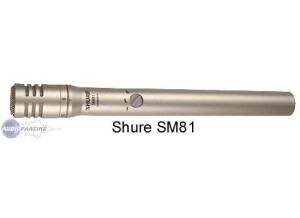
    The Shure SM81 is a small diaphragm cardioid condenser microphone. The price tag is on the high end for a small condenser microphone but it is well worth the 350 dollars spent. The new design of the SM81 is very slim and sleek. This is the perfect microphone for your overhead cymbals. It has an unidirectional design to it which makes it perfect for your over head microphone and it will capture the full dynamic sound of your cymbals. It can also be used to capture a full sound of a choir or a group of singers at the same time because it does a great job of picking up the sound coming from all directions of the microphone. The Shure SM81 comes with a nice hard case to carry your SM81 in so it doesn’t get damaged. These microphones are a lot more fragile than the average Shure small diaphragm microphones are. You will need to take care of this microphone and protect it where ever you are. The Shure SM81 can be used on a number of different instruments in either a live or studio setting. This microphone is a multi purpose microphone that can do it all. OVERALL OPINION I plan on picking up a couple more of the Shure SM81’s to have has over head microphones in the near future. If you use this microphone as an over head microphone you may need to roll of some of the lower frequencies when you go to do your mixing, or put a high shelf filter on it. This will make the recording sound complete and give you a clean mix. Overall , it is a great microphone that can be used in many situations and with many different instruments. Just keep a good eye on it and take care of it. They are pretty fragile and one bad drop could waste your 350 dollars.

  • « well rounded »

    The Shure SM27 is a well rounded mic that is a condenser mic that doesn’t cost a lot of money and will provide you with a pretty good sound. It came out years ago for around 400 or maybe a little more than that. But now can be purchased brand new for less than 300 dollars. I am not sure why its such a difference in price but im all for it. OVERALL OPINION Some of the key features of the SM 27 are that it can react very quick and use its mesh layers to reduce wind and popping noises on your “P” words. This mic is not really made for instruments but I have used it on some before and it seemed to work great. I have actually even seen It in a local rock station being used to interview people such as bands that are local or local business owners for radio ads and it works great. Some bad news about it though is that I have heard that its not very heavy duty and if it gets dropped the wrong way it can really mess the mic up and not make it work properly again. Plus a few people told me there mic chord gets shorted out from time to time and they have to keep replacing it. It could be do to something with the hook up on the mic or just that they kept getting cheap chords. Overall, the mic seems worth it to me, I havent had a bad experience with it. I kept it at home and didn’t take it anywhere with the fear of something happening to it. But for use at home or in a bigger studio it will work for you. Plus it’s a Shure, so you know you are getting good quality. Buy it and try it out.

  • « Shure Beta 87A »

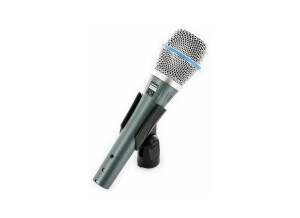
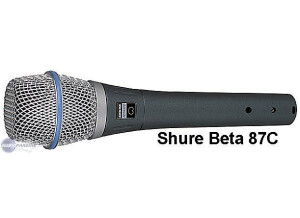
    I bought this mic at Guitar Center for $185. This is significantly less than they were selling it for ($250), but they were willing to match the price that I had found. Which was a really good deal... I decided on the Beta 87A after very extensive research - a lot of internet time sending e-mails, doing searches, reading up; a lot of phone time speaking to pro's, calling for prices, and comparing. And the Beta 87A seemed to stand above all the others. So I went to Guitar Center, tried it out, compared it, and was sold... I like everything about this unit! The sound, in particular. This microphone is a condenser and in being such is supposedly more sensitive and fragile. But Shure dispels that theory with this mic. They have put a studio quality condenser microphone in a rugged, live performance package. Believe it or not, this "sensitive and fragile" microphone has survived the famed Shure Drop Test. This condenser mic is as rugged a mic as the old SM58's. It's crystal clear and so natural. My voice comes across so smoothly ans sounds so...real! Due to its supercardioid design and its significant gain before feedback, this mic has completely eliminated the age-old problem of feedback. It's just an amazing microphone and I love it! Believe it or not, I have tried to be critical about this microphone, but am at a serious loss for complaints! I can't find any faults in this mic! It is just completely satisfactory and I could not be happier. I would definitely buy one of these (since I did...). Rock-solid. Being a Shure, I expected that, but I was still surprised by the heft of this mic. Again, it's withstood the renowned Shure Drop Test and is as rugged as any other Shure product. I recently read in a forum about how a guy took his old SM58, ran it over with his truck, plugged it in, and sang. he said it worked same as before he ran it over. I would expect the same durability from the Beta 87A. Quite honestly and in my opinion, this is the very best live performance microphone that money can buy. It's a condenser, it's studio quality, it's a Shure. What more could you want. I love it. It really brings the best out in my voice and I know that it would not disappoint you either. If you're looking for top-notch quality that will outlast you, this is the mic! Go for it! This review was originally published on http://www.musicgearreview.com

  • « Shure KSM 32 Condenser Microphone »

    When I set out to buy a really good large condenser mic for my home studio, I actually hadn't even considered this mic. I went to Guitar Center looking to purchase a Neumann TLM 103 and was fully prepared to plunk down $900 for it. When I got to talking with the salesperson, however, he told me that I could save $450 and get a mic that, in his opinion, was just as good as the TLM 103. I had used the TLM 103 at a local studio, so I was fully acquainted with it's real-world performance. I frankly didn't believe him, but I figured he couldn't be lying if he was trying to sell me something CHEAPER than what I was prepared to buy unless he really meant what he was saying. At his reccomendation, I reluctantly bought the Shure KSM 32 (for $448) under the stipulation that I be able to return it if I wasn't happy. Boy, was I surprised!!! This is one awesome mic. First of all, the mic comes packaged in a beautiful velveteen pouch and is tucked away in a sturdy metal flight case (along with an elastic shock mount which is also included). I tried it first on vocals (male and female both) and I was stunned with the accuracy and clarity of this microphone. The recorded voices seemed to take on an airy, crisp quality. The mic more than adequately captured the low end of my own voice and, based on some quick tests I did, it would seem to be an excellent mic for voice-over or narration type work as well. On acoustic guitars I was also pleasantly surprised at the trueness with which the KSM 32 captured the subtle nuances of my instrument. I tried several mic placements that I typically use, and it was clear to me that this would be my first choice for recording acoustic guitar. The mic also does a good job on percusssion instruments (tambourine, maracas) and I even tried it on a cello and it sounded great- deep, rich bass tones and an overall clear, well balanced sound. As I mentioned, this mic comes with a shock mount which I found to be easier to use than anything else I have ever tried and does a great job of eliminating unwanted noise when you accidentally bump the mic stand or stomp too loud on the floor. All in all, I don't believe there is a mic on the market at this price that can compare. Even if you are just starting out in home recording, you would be wise to pass up the AKG C3000 and save for this one. Don't get me wrong- I own a C3000 and it is a great mic for the price, but just a little patience to save the extra money is well worth it. This mic is truly world class. Perhaps the only drawback to this unit is the fact that it is strictly cardioid. However, I understand that Shure has recently released the KSM 44 which is essentially the KSM 32 with the addition of figure 8 and omnidirectional patterns. If it's as good as this mic, I may have to buy one of those as well! Appears to be very sturdy, although I wouldn't try dropping this (or any other) condenser mic on the floor to check it out. In terms of asthetics, this is a beautifully designed microphone, and really looks and feels like a "high end" piece of gear. As noted above, the flight case/storage pouch are nice additions as well. Obviously, if you have $2,000 or more to spend you can find a better large condenser mic. But if, like most of us, you have a limited budget and really want to take your recordings to the next level, this is a mic you should strongly consider adding to your setup. This review was originally published on http://www.musicgearreview.com

  • « Basic Mic, gets the job done »

    The Shure SM81 LC is more than its worth. I had bought all equipment needed to start recording previously and so when I got home and hit the record button, what I got was a very clear and concise sound. I have a basic in-home studio set up in my room so I don't exactly have a "dead room" to record in but the way this carded mic picks up straight on sound and minimizes background sound is extremely useful and impressive. World-class large-diaphragm sound at a rock-bottom price!. Studio condenser has a 1"-diameter, 6-micron-thick diaphragm for high sensitivity and detailed recordings!. Uses Mogami wire for added clarity!. Balanced, low-noise output; heavy-duty brass enclosure; 30Hz-heavy-duty brass enclosure; cardioid pattern. Includes spider shock mount that also fits Neumann mics. OVERALL OPINION If I had to make a complaint though, I would say that some times in the play back my voice would be distorted and some words would be completely unheard and at other times it would be completely fine. It's kind of unpredictable and its' really just a guessing game when you hit the play button. The mic is very bright, kind of harsh on certain type of vocals. On very soft tones it works fine, but if there's a heavier voice, it gets rougher. Compared it with other 300-600 dollar mics in my studio - good extra overhead etc mic for 100 bucks, but definitely sticking to my old mics for lead vocals. I am very much satisfied with the Shure SM81LC microphone. I had been interested in MXL 2003 although while searching the internet I read that the V63M was designed in close association with the 2003. The stereo field is much more saturated than with Shure BG 4.1 that I had been using etc. There is more resolution on high frequencies. Much of the progress I have made in the past has been parametric with upgrades in recording components. The V63M is a cost effective solution for acoustic guitar.

  • Deleted member's review

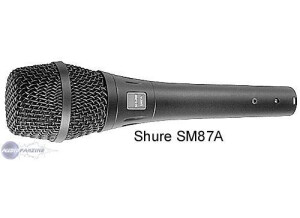
    The Shure SM87 microphone is that next little nudge the Shure gives you before shoving you into Beta condenser territory. And what a nudge it is. In a nutshell, the Shure SM87 does deliver very crisp and clean, but warm sound. I am putting a lot of emphasis on warm here. It is not imbalanced and skewed or exaggerated in the low end, like the venerable SM58 is wont to do when working the microphone up close. This is warm, but still clear and crisp. Imagine throwing a fuzzy blanket over someone instead of an entire comforter, and that is about as nice of a metaphor I can give. This being said, the Shure SM87 is not at all suited for thicker songs where the microphone needs to really cut through the mix. In testing, it had a very unfortunate tendency to get lost in a heavier sound. However, this hyper smoothness also means that it is wonderful on emptier sounds, to take the most obvious example, an acoustic guitar and voice. The Shure SM87 is a condenser microphone intended for live use, and thus unfortunately lacks a few of the refinements that a studio condenser is expected to possess. Self noise is a 24 dB, only workable in live venues. So if you are like me, and work across the live-studio barrier, then this is not the microphone for you. It has a supercardioid pickup pattern for maximum off axis sound isolation, and a respectable frequency response from 50 Hz all the way up to the wonderful standard of 20,000 Hz. It handles a rather impressive 140.5 dB of SPL's. However, with this microphone being ideal for quieter worlds, this spec may be wasted on it. It is certainly nice to have when one is mic'ing in a pinch, however. OVERALL OPINION The SM87 is a great microphone if you know what you are looking for. The microphone itself is extremely warm, and on a quieter stage, sounds fantastic. It does get lost in a heavier mix though. This is probably because unlike the SM58, whose muddiness can be compensated for by the often unpleasant but penetrating midrange honk, the SM87 is incredibly clear, and not designed to overpower any element of a performance. That is why it is a very specific microphone that needs to be tested out, more so than usual, before taking a plunge. It should also be noted that this microphone breaches the $200 mark, and several microphones in the high end line have been opened up under $300.

  • « Affordably-priced condenser microphone »

    This is a large diaphragm condenser microphone that I use quite frequently nowadays. It's a lot cheaper than many other large diaphragm condenser microphones that are of a similar quality. While it's generally used more for studios than live, I do think that it is a better option than most large diaphragm condensers for live because it's built tough and it is on the cheaper side, so it's more easily replaceable on the offchance that it does break (this is unlikely unless you are careless, though). There is only one cardioid pattern, which other reviews have mentioned, which is unfortunate but that's the trade-off that you make for having such a good price. OVERALL OPINION I like the surprisingly versatile use of this microphone. I have used a pair of them as overheads, which is a decidedly unique but often effective use for them. I have also used it in tandem with a dynamic mic on a guitar cabinet, which resulted in a fantastically detailed sound. I don't particularly like them as room mics as they don't have a more encompassing cardioid pattern. But there are certainly good uses for them, if you have no other options for vocals these aren't really a bad option, and they work on acoustic guitars well too. The sound is definitely not on par with a Neumann U87, or any tube-based condenser, but that's to be expected given the price difference between those mics and this one. Also, you don't have to worry about this one breaking on you and costing a fortune to fix. I think that for the home studio, or even some live situations, this is a great bet especially if you are on a budget (which, honestly, most of us are). Highly recommended unless you've already got better mics to work with.

  • songboy's review

    This is definitely a Vocal mic used in live situations. It is a Vocal Condenser mic with a Cardioid Pattern. OVERALL OPINION The best thing about this mic is the both the warmth and the clarity it delivers in a live setting. it is excellent for any kind of vocal style and is a lot of fun to use. Being a Condenser, you can really use the space around the mic to get awesome dynamics (unlike a dynamic mic which you usually have to be pretty close to be heard). I am also a pianist so I find myself unable to keep my mouth right in front of a mic all the time. With the BG 5.1 its a lot less of a problem being heard an playing. The only problem with this mic is the traditional problem using a Condenser live, feedback. In all honesty though, there is little chance you will get any if you set it up correctly (ie not to close to you monitors and not too close to any other sound source besides your voice). If you set it up right, people will really notice. I paid $100 for this mic used. Unfortunately I don't believe they are in production anymore so you have to search around for a used one. $100 for a nice clear/warm mic with a lot of presence is not a bad deal at all. I own a few different vocal mics but the main one that contends with this mic is my Shure Beta 58a. The BG 5.1 is my main vocal mic, but if I am playing with a loud rock band on a medium to small stage, I usually use the Beta 52a. Its a safer bet when you have to worry about feedback. But if that's not an issue, I definitely go with the BG 5.1. Another setup I like is to bring both. The BG for my clean vocal and the Beta 52a for effected vocals. This ensures my clean voice is well heard and my effected vocals don't feedback (especially when using distortion). I would definitely buy this mic again. Someone was selling a pair of these in great condition for $120 and I passed due to lack of funds. I am still very sad about that.

  • moosers's review

    The Shure SM86 is a condenser microphone that is designed for live performances. Most microphone that look like this are dynamic microphones which don't have as much clarity as this one does. Having the mic within this sturdy casing makes it the perfect high quality microphone to bring on the road and for gigs as it will be able to take more of a beating than other mics for live shows, not that you should be beating it up though! The mic also has a cardioid polar pick up pattern. OVERALL OPINION I've used the Shure SM86 condenser microphone a number of times for live shows and it definitely has an impressive sound quality for a microphone like this. Pretty much any condenser mic is going to have a more detailed sound than a dynamic one, but usually you don't see a condenser microphone being used for live shows because they are simply too fragile and delicate to be brought outside of the studio. Shure's SM86 is perfect for anyone looking for a cleaner tone and overall more detail for their vocals during live shows. I would say that I would only recommend this to those who are touring or gigging often where it is important to have a quality microphone on your voice each and every night. This microphone will definitely provide that for you as the sound quality is crisp and quite clean overall. The price of the mic is more expensive than most live performance microphones are, but that is to be expected since this is an entirely different type of microphone than most live performance mics. If you are a singer who is looking for a higher quality microphone than you are getting from your traditional dynamic mics, the Shure SM86 is absolutely worth looking into. Shure is a company you can trust to make good microphones and the SM86 definitely falls right into place.

  • joshsound's review

    This is the middle of the road model in Shure's KSM line of small diaphragm microphones meant for the studio. Overall I will say that this mic sounds very good. Since it's a small diaphragm, it does great with peaks and transients. Anything you record with this mic is at the very least going to sound very crisp and present. Also the higher frequencies come through very well on this mic. Unfortunately so do the upper mids however, which can at times give this mic a little bit of a harsh sound which seems to never happen with this mics more expensive older brother, the KSM 141. It also has a couple of nice features like the switchable attenuation pad. This pad has 3 levels, which can be set to 0, 15 dB of attenuation, or 25dB of attenuation. Between those pads you should really be able to record just about anything without worrying about distorting the signal into your mic. There is also a switchable low pass filter which the less expensive KSM 109 lacks. It actually has 3 positions being neutral, a steep high pass filter that sounds like it starts around 60 Hz, and a much more gradual low roll off that sounds like it starts around 120 Hz. You're going to need a preamp with phantom power to use this mic. OVERALL OPINION I have had a pair of these for a few years. I really only like the sound of these on certain instruments. Sources with a lot of content in the 4k area really end up sounding too harsh through this mic. Sources with a more natural and wide frequency content usually sound a lot better. For that reason, I almost exclusively use a pair of these as room mics. And even then, I only use these when I can't use my KSM 141 pair for that purpose, because the 141's definitely do sound better although they are more expensive. If you can afford it, I would say to just save up for the KSM 141's. They sound better. These are not bad though.