Log in
EN
FR

Virtual Modular Synths

232 products found

Filter
Sort by
Evaluation
  • Reviewed or not
  • Editor’s award
  • Reviewed by Audiofanzine
Availability
  • Available or not
  • Sold new or used
  • Sold new
  • Sold used
Must-have products
  • All products
  • Flagship products
  • Best rated products
  • Hot products
  • Popular products
Price
  • Freeware
  • Low-cost (< $60)
  • Mid-range ($60 - $150)
  • Premium (> $150)
€
Clear
Sort by
  • Popularity
  • User ratings
  • Price - low to high
  • Price - high to low
  • Used price, increasing
  • Used price, decreasing
  • Name (from A to Z)
  • Name (from Z to A)
  • Added on
Sort results
  • Popularity
  • User ratings
  • Price - low to high
  • Price - high to low
  • Used price, increasing
  • Used price, decreasing
  • Name (from A to Z)
  • Name (from Z to A)
  • Added on
Filter results 232 results found
Evaluation
Availability
Must-have products
Price
  • Freeware
  • Low-cost (< $60)
  • Mid-range ($60 - $150)
  • Premium (> $150)
Show results

The best Virtual Modular Synths reviews

The reviews Audiofanzine members found the most helpful.
  • « A synth from another planet »

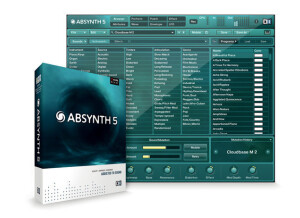
    The Native Instruments Absynth 5 is the newest, latest version of the legendary Absynth line. It is know for its organic, evolving sounds, that can be customized to be very complex. It contains over 2,100 preset sounds, so you don't have to design anything from scratch (but you certain can if you want!). Other features include 68-stage envelopes, tempo sync, semi-modular synthesis, specialized effects (such as Aetherizer, Cloud Filter, and Super Comb), macro controls, usage as a standalone effects unit, and much more. SUITABILITY/PERFORMANCE Native Instrument's Absynth 5 is a complex instrument, and it can be very overwhelming to use at first. Luckily, there are a plethora of factory presets, and they are organized very neatly in the browser section. You can quickly choose and browse sounds based on many categories, such as overall sound type, sound mode, main sound characteristics, and genre applications. There is even a mutation option, built right into the browser, which lets you randomly change and mutate the selected sound, creating new, original sounds immediately. This organic nature of Absynth is displayed throughout the synth, and it makes it a very unique experience. One other unique feature of Absynth 5 is the effects section, which includes 6 various delays and reverbs. But these effects are very unusual and unique, and they work like no other delays. The creative possibilities are endless in this section and in others, and it seems to work in it's own way, with controls and parameters that seem very unusual and specific to Absynth only. Even the graphic layout is an experience, which looks very futuristic, and almost alien-like. It sets the mood and tone of the synth pretty well, and Absynth, with it's complexities, can create some out of this world sounds. OVERALL OPINION Overall, the Native Instruments Absynth 5 is a great synth if you are looking for something with more unusual textures and ambient possibilities. You may have a hard time finding basic, retro sounds here, but if you want to create something that has never been created before, this is the perfect tool.

  • « alot of different sounds »

    The EMS Rehberg is a virtual synth with a wide variety of sections and parameters. Installing it was pretty easy as it didn't take too long and I didn't experience any compatibility issues or other problems like that. The interface of the virtual synth has a lot going on and it did take me a little while to figure out everything that is going, but it is laid out nicely with all the basic functions easily found and labeled. The synth has sections for three different oscillators, a few different types of envelopes, an LFO, an amp and a few different filters. There are also a variety of effects and other features, but it would take too long to go over everything as it has a lot going on. While I haven't seen a manual to this, but for those with little experience with synths it might be helpful. SUITABILITY/PERFORMANCE While EMS Rehberg does take up a good amount of processing power, I usually only have one going up at a time so I never have had any problems running this synth. I am currently running it on a Mac Book Pro that has a 2.2 Ghz Intel Core 2 Duo processor and 4 GB of RAM. I run it routed into Pro Tools LE 7.4 that runs with a Digi 002R audio interface or a Digidesign Micro Box or with Apple Logic. With this recording set up I'm able to run this software well, but it does take up a lot of processing power so make sure that you have an adequate system to run this before buying it. OVERALL OPINION I've been using EMS Rehberg for about a year and it is definitely a good sounding synth by my account. I like how much control you have over your sound and the fact that it is possible to get a wide array of different synth sounds with it. It isn't all that hard to use, but it will take a little bit to get used to everything because there are so many features. The price of is pretty reasonable as this is a nice piece of software with a lot of capabilities. I'd definitely recommend at least trying this software out if you are looking into a virtual synth.

  • « its a beats »

    The Digidesign Hybrid is an in depth software synthesizer, modeling itself after the RSF PolyKobol analog synth. It's got an interface that matches this synth, as it looks just like a real synthesizer on screen, which is something that I love as it makes me feel at ease using something that looks familiar. I wasn't involved with installing this software since I don't own it myself. There is way too much going on here with the make up of the plug-in to mention all of it in a couple of lines, so just take a quick look at a screenshot of the soft synth to get an idea of what I'm talking about. As always, if you understand the features generally associated with analog and software synthesizers, you should be okay here. One thing definitely worth mentioning is the morphing oscillator, which is a unique feature that kind of sets this soft synth apart from the rest. A manual would be a good idea if you're thinking that you might need some assistance or even if you're just looking to learn the software inside and out. SUITABILITY/PERFORMANCE The studio that I work at has the Digidesign Hybrid soft synth running on a number of different systems. All of them are Pro Tools HD based, but this will get used a lot in Logic as well. It definitely takes up a decent amount of processing power, but all of our systems are top notch so we don't ever have performance issues really. If you're going to be running this at home I'd recommend taking a look at the requirements to ensure that you'll be able to run it comfortably. OVERALL OPINION I really can't say enough about the amount of detail involved with the Digidesign Hybrid . I haven't used original RSF PolyKobol analog synth that this is modeled after, but I don't have to do know that this is a great reproduction. It has sounds that could definitely be coming from an analog synth if I didn't know better, and an interface that matches up with the real deal. What more can you really ask for? I don't know what the price of this would be, but if you're in the market for a serious software synthesizer to use on an everyday basis kind of a thing, the Digidesign Hybrid is seriously worth considering. This thing is an absolute beast!

  • moosers's review

    The XILS-lab XILS 3 is virtual synthesizer software that is available for most platforms. I don’t have this at home but have used it quite a bit at the studio where I work that has it. I wasn’t involved with installing this at all since I don’t own it, but I believe you can download it straight from XILS-lab’s website. The synth is a matrix based synthesizer and has quite a bit of different controls to work with, starting with three oscillators. It would be a bit long winded to go through all of the parameters involved here, but in addition to the three oscillators, it’s got a noise generator, a ring modulator, filter oscillator, envelope controls, reverb, and the matrix itself. It has all sorts of effects, a sequencer, a keyboard, and sampling capabilities as well. I’m still learning a lot about XILS 3, as there is a serious amount that can be done with it and in turn there are a ton of controls to be aware of. It’s definitely a good idea to have a manual handy as I’ll probably seek one out next time I use it. SUITABILITY/PERFORMANCE At the studio we have XILS 3 running as stand alone software and is suitable for use in other sequencing software we’ve got, namely Logic which is where I’ve been using it. Our computer is a Mac Pro desktop with 10 GB of RAM and dual 2.66 Ghz Intel Xeon processors, so suffice it so say that I’ve never had a problem running this synth or any other software on this system. It definitely seems like it would take up a good amount of your processing power on a lesser system, so it’s worth it to try the demo to see how well it will run for you. OVERALL OPINION The XILS-lab XILS 3 is one of the most complete virtual synthesizer that I’ve got experience with. Anyone using soft synths at home could benefit from having this, as it’s got everything you’d want in a synthesizer and a great sound to top it off. It’s got a ton of presets to get you started with, which has been working great for me as starting points. Often I’ve been finding that I won’t even need to do too much tweaking with it as they’re pretty awesome to start with. Once I get a bit more comfortable with it I’ll probably start sounds more from scratch, but for now the presets are working great for me. You can get synth sounds on all ends of the spectrum here, as the three oscillators make it possible to get almost any synth sound your can imagine. It’s not the cheapest in the world, but this is a true professional’s virtual synthesizer and is a truly awesome tool to have.

  • moosers's review

    The Arturia ARP2600 V is a software synthesizer that aims to emulate the original ARP 2600 modular synthesizer. There is a second version of this synthesizer that is out now, but this review is for the original as it's the only one that I've used to date. I didn't have any issues related to compatibility or installation, as the process of getting it up and running took only a short amount of time and was problem free. Breaking down the interface of the ARP 2600 would certainly take a long time, but suffice it to say that this has a lot of control and models the original almost to a T. It's even got the patches and all that so you can feel like your using a real modular synth. I wouldn't say that it's hard to use per say, but it definitely will take some time to learn everything about it since there is simply so much happening here. It's got all the bells and whistles you'd expect from a synthesizer, including three VCO's and a four octave virtual keyboard. A manual would be a good idea if you're new to synthesizers (soft or hardware), but I haven't seen it for this one in particular. SUITABILITY/PERFORMANCE I'm running the Arturia ARP2600 V in my rig at home and I can't really say that I've had too many issues with it. Sometimes I get some latency, but for the most part it's been pretty stable. I've been using it as a stand alone piece of software, occasionally rewiring it into Pro Tools or using it in Logic. The computer that I'm running it on is a Mac Book Pro consisting of a 2.2 Ghz Intel Core 2 Duo processor and 4 GB of RAM. This has been enough for me to run the software pretty well as I haven't encountered any problems and don't anticipate running into any in the future. OVERALL OPINION The Arturia ARP2600 V is definitely the most complete software emulator of the ARP 2600, and is a great one at that. I haven't used an original ARP 2600 since they're pretty rare and hard to get a hold of for sure, but this thing sounds good enough that it could stand on it's own for sure. It's got all sorts of classic, 'analog' synthesizer sounds and has the vintage looking interface to match. I love playing around with it because there is so much that you can do. It's got a nice collection of presets as well, making it easy to get started if you're feeling lost at first. Considering the amount of detail involved here, the price of the Arturia ARP2600 V is very reasonable and is absolutely worth getting if you want a great modular synthesizer inside the box.

  • songboy's review

    There were no compatibility issues with this plugin. It installed correctly and functions well in Logic 9, Ableton 7 and as a Standalone unit. The manual is pretty large for this guy. It is clear and sufficient, but, if you are familiar with plugin synths, I would just poke around for awhile and get used to it first. Then, when you have questions, the manual is adequately indexed so you can find you answers quickly. That's what I did and I feel fairly confident using this massive synth to get awesome sounds. Overall, no the configuration is not simple. Its quite a beast with a lot of parameters to tweak. However, the preset setup is pretty nice. If you have used any Native Instrument synths before, this is a familiar face. If not, it won't take but a minute or two to quickly surf through presets. It depends on what functions you deem typical when asking if they are easily accessible. I tend to mess with the basic attack/decay type parameters on synths and I have to say, its not very easy to locate these functions. There are a ton of options (maybe too many for my purposes). SUITABILITY/PERFORMANCE I run a Macbook with the programs mentioned earlier and a Presonus Firebox for my main performance rig. Yes, it works flawlessly in this configuration. So far, it has never crashed on me or lost any of my presets. I would give it a 10 out of 10 for sounds, they really are amazing in this synth, but I would give it a 7 out of 10 for accessibility. There is a little too much going on for my tastes, maybe that will change when I have more time to learn about this huge plugin. So I guess I'll give it an 8 out of 10 overall. I have been using this synth for almost a year. OVERALL OPINION What I like most about this unit is its vast array of quality presets. They are a good way to get your creative juices flowing. Set a good preset up and start messing with familiar parameters and you can get some unique bombshells out of this guy. I also recommend messing with parameters you have no idea about to see what they do, you can get some whacky stuff going on this way too, but be careful, don't mess with everything at once or you might not know how to get back to the sweet sound you just had. What I don't like about this synth is the overall interface. I find that most Native Instruments are harder to use than other plugins I have come across. I wish there was a way to make it larger so the font was easy to read when playing live and simpler to navigate through, but you can't always get what you want. Besides that, it is an amazing unit packed with a ton of quality sounds. I think I paid around $200 for this guy. Thats about average for a nice synth plugin so I am happy about the price. The sounds that come out of this thing are truly awesome. I write a lot of "Radiohead" and "Flaming Lips" style music and this thing fits that glove very well. I have a bunch of different soft synths, but I find myself drifting towards this guy when I want something a little strange and very unique. Yes, I would definitely purchase this synth again. My studio partner might even upgrade to Komplete 5 so I will get to play with the new Absynth.

  • « Korg DS-10: a pocket-sized sonic lab »

    I use Korg DS-10 either on its own or routed through effects pedals. The Nintendo DS comes with obvious limitations, and as far as I know, there’s no MIDI support. But honestly, that doesn’t stop this thing from being seriously fun and inspiring. I’m a longtime Korg fan, so maybe I’m biased, but the sound is there—distinct, digital, and proud of it. I first messed around with Korg DS-10 about ten years ago when I knew nothing about synthesis. It didn’t click at the time, and I quickly moved on. Fast forward to now: I’ve been using it seriously for the past year, and it’s a totally different experience. The sound engine is excellent and has real personality. It may run on a handheld console, but it’s far from being a toy. The semi-modular aspect is a great touch. It lets you experiment, patch, and learn without getting overwhelmed. The built-in effects are surprisingly solid and add depth and character to the sound. On the downside, there’s no tutorial, and the interface isn’t the most intuitive at first. It takes some effort to get used to, especially for beginners. And let’s talk about the current resale prices—it’s ridiculous. Fortunately, there are still alternative ways to get your hands on it. All in all, Korg DS-10 is a highly engaging tool for sound exploration and out-of-the-box music-making. It’s not perfect, but it’s incredibly charming.

  • « A Virtual Analog workhorse! »

    Ultra Analog VA-1's installation and setup process uses a standard challenge and response registration system. Once you start to use it, the user interface is immediately familiar if you've ever used a Virtual Analog synthesizer. Everything is on one panel, there's no complex routing, and everything has very clearly labeled knobs. The manual also explains the functions well, should you need to reference something. The plugin is a little old at this point so the interface is actually a little too small for use on modern high resolution displays and that's definitely a concern for those with impaired vision. SUITABILITY/PERFORMANCE I've used VA-1 regularly in my productions since I purchased it several years ago and I've encountered no instability or performance issues. It has both a 32-bit and 64-bit version and has loaded fine in all of my hosts: Renoise, Reaper, and Maschine. The performance is admirable. On my Intel i5 2500k @ 4.5ghz, 8 instances of VA-1 running an arpeggiated patch with the built-in delay and reverb effects enabled only uses about 12% of CPU combined. OVERALL OPINION It's a standard two-oscillator setup with two filters, two filter envelopes, two LFOs that can manipulate a number of parameters, and two amplitude sections as well as chorus, delay, and reverb effects. The built-in effects don't offer a ton of options, but they're still decent. Both oscillators have your standard virtual analog waveforms as well as a sub-oscillator. As I mentioned before, the interface is immediately familiar and this is one of the best parts about it. There's only one page, all of the oscillator, LFO, envelope, etc. sections are placed from left-to-right as you'd expect. Compared to some more complex plug-ins, Ultra Analog is almost comforting, especially when you're just trying to whip up an analog-ish organ or brass sound and you don't need the insane routing or multi-stage envelope generators from something like Massive or Rapture. The sound quality of Ultra Analog is pretty solid, even for such an old plug-in. It's not trying to emulate any particular hardware synth, but rather just the style of analog in general. It doesn't capture some of the sonic quirks that add so much to real analog, but it is more than capable of delivering decent virtual analog sounds. It can give you your warm, lush pads and also searing hard sync solo leads, but it doesn't really have a standout sonic "character" to set it apart from the many other Virtual Analog synths. The factory preset library is decently diverse and shows a lot of the sounds you can coax from this relatively straightforward synth. One caveat to this review is that Ultra Analog VA-1 has been superseded by VA-2 which adds a few new effects and changes the interface to a more modern, paged setup. So far as I've heard, the synthesis engine hasn't had any noticeable changes, so that should be what you'd consider if you're interested in purchasing this plug-in. The price for VA-1 used to be drastically cheaper than it is now before AAS released VA-2. VA-1 is currently the same price as VA-2 at the few stores that seem to still sell it, so I can't recommend purchasing this over VA-2, which has the same synthesis engine but with some new features and an overhauled interface. So that said, VA-2 should be a consideration if you're in the market for a virtual analog-styled synth, especially if CPU usage is a concern for you. It's also worth noting that this is more-or-less the same as Ableton Live's Analog, so if you have Ableton Live Suite, you don't really need this. Pros: + Low CPU usage + Clean, single page interface + Versatile, capable of a variety of classic analog sounds Cons: - Old and superseded by VA-2 - Though the interface is laid out well, it is not sized appropriately for modern computer displays.

  • « Moog-Tacular »

    This is a Digital version of a Analog piece of gear that has been around for ages. If you are into analog sounds and synths and you love vintage gear then the Arturia Moog Modular V will be perfect for you. I really don’t use it that much and never really have I just like to have sounds like this around in case I get in the mood to make something a little different which happens from time to time. I bought this back in maybe 08 but I remember all of the original hardware vintage moog synths and how popular they use to be and I use to mess around with them a long time ago. Music has changed so much that hardly anyone still uses analog synths or even worse you cant even find them because most people just collect them now. So it was great that Arturia came out with a digital version of it. I will say that its not the same though, if any one reading this is old enough to really remember the original moogs from way back in the day then they will know what I mean. SUITABILITY/PERFORMANCE Very easy to use and run, used it in Cubase for a while and its still configured to run in cubase I just don’t use it at all that much more but its good to keep around, I didn’t need a manual for it, in fact I don’t think I have ever opened the manual for Arturia Moog Modular V. OVERALL OPINION The greatest thing about this software is that it brings those old analog sounds back and in the digital form so you can play them whenever you want right from you laptop. But I can say that its not the same as the real mood. Mainly because even though its made to sound analog like the moog nothing, and I mean nothing in a digital form will sound as good as an original moog will. But if you want the closest thing to it then this is it.

  • « will take some time to learn. »

    Native Instruments Absynth 3 didn’t surprise me at first glance but after really digging in and using it for a while I got the hang of how it works and how to really change the sounds to the way that I want them to sound. Without needing any knowledge of sound creation or sound design I was able to really get in there and change the parameters of the sounds and make them my own (because I hate having to use presets over and over ) The layout of Absynth 3 isn’t confusing if you have some basic understand of vst’s. SUITABILITY/PERFORMANCE Setting it up was really quick, I just inserted the disk and waited a few minutes I actuall think that it updated some online as well just to have the latest tech stuff. I also needed to create an account at NI website when I purchased this. OVERALL OPINION Overall, I was very happy to have a program that didn’t confuse me that I can used often and has some really good synths which is what I was looking for. As far as the synths go, I think they could be a little fuller sounding some of them are really thin and I had to fatten them up with some equine and some effects. But the program has worked for me perfectly and hasn’t froze or crashed at all and it doesn’t seem to look like it will. Also, I run multiple versions of it at the same time and it doesn’t take up to much cpu unless I use some of the presets that are very cpu heavy then you can start to tell. The price for Absynth 3 isn’t cheap at all , if you are looking for a cheap vst look around online and don’t just go buy this one. It will take a little time to understand and you don’t want to invest 300 or more dollars on something that will leave you confused at first.

  • « good virtual synth »

    I use a Macbook with Logic 9 and Ableton 7, so far not a single compatibility issue. Works Great! I have not looked at the manual, actually, I'm not really sure if came with one, but, like many of Arturia's instruments, it is a physical model of the actual instrument and there fore most all of the functions are right in front of you. Most questions can be answered by studying up on the workings of an actual Modular Synth. SUITABILITY/PERFORMANCE Well that depends on how experienced you are on Modular synths. This thing was a little daunting for me, and still is to be honest, due to the massive amount of options and modules. If you really want to use this thing properly, study up. The typical functions are very easy to access, they are all right in front of your face. OVERALL OPINION The software works great in Logic 9 and Ableton 7 as well as it works great as a standalone. This software is very stable, it has never crashed on me nor has it ever failed to save or load a preset. Well, this is obviously a digital representation of a beautiful Analog Monster. If you are trying to compare it to the real deal, you will be disappointed. But, if you weigh that against the fact that the plugin costs thousands less, makes damn good sounds and can go with you anywhere you take your laptop, it gets a 10 out of 10 for me. I have been using this plugin for about 6 months. I am still pretty much a novice at it, but spending an hour on this unit once in awhile will yield some great sounds. The options are virtually endless and it fits right into my laptop. What don't I like? Well, its so large it doesn't fit entirely on screen. Instead of creating a Scroll bar that you could operate via mac's 2 finger scroll option, or even the arrow keys, you have to click on the unit and drag. Its not a huge problem, but when playing live, the former options would have been much better.

  • moosers's review

    The Oli Larkin SE64 is a unique and free virtual synthesizer. It's unique because the sounds heard here are from vintage video games! It's a monophonic synthesizer that runs with two oscillators. The synth is unfortunately only available to those DAW users who have a Windows operating system and can run VST software. It should be a quick and easy download, but I honestly don't remember too much about installing it since it was years ago now and I'm not currently running it due to an incompatible system. As far as the make up of the synth is concerned, it's got the two oscillators, one of which can be set to a few different waveforms and the other which is set to a triangle waveform. The synth also has envelope control for a filter, amplifier, pitch, and pulse width, in addition to have controls for a matrix table, a bit crusher, and a variety of other specific controls. I doubt a manual was made, but you should be able to find all the information you need right from the Oli Larkin website. SUITABILITY/PERFORMANCE While I'm no longer able to run the Oli Larkin SE64 plug-in, when I did it was in Cubase SX 2.0. I had a Hewlett Packard Pavilion dv8000 Notebook computer with a 3.0 Ghz processor and 2 GB of RAM that I was using to run everything on. I was able to run the synth without any issues at all, as I believe will be the case with nearly everyone running it - it doesn't take up very much processing power at all. OVERALL OPINION Oli Larkin's SE64 is definitely one of the coolest virtual synthesizers that I've used as it's totally unique. I don't know of any other synths like this that just focus on sounds from old video games, but it's a pretty awesome idea and it's even cooler that it's free. The aim I think is definitely achieved here, as it's possible to get a nice collection of varying retro game sounds for sure. This is really a must have for anyone who has a compatible system which unfortunately does not include myself at the current time.