Log in
EN
FR

Electric Pianos

111 products found

Filter
Sort by
Evaluation
  • Reviewed or not
  • Editor’s award
  • Reviewed by Audiofanzine
Availability
  • Available or not
  • Sold new or used
  • Sold new
  • Sold used
Must-have products
  • All products
  • Flagship products
  • Best rated products
  • Hot products
  • Popular products
Price
  • Freeware
€
Clear
Sort by
  • Popularity
  • User ratings
  • Price - low to high
  • Price - high to low
  • Used price, increasing
  • Used price, decreasing
  • Name (from A to Z)
  • Name (from Z to A)
  • Added on
Sort results
  • Popularity
  • User ratings
  • Price - low to high
  • Price - high to low
  • Used price, increasing
  • Used price, decreasing
  • Name (from A to Z)
  • Name (from Z to A)
  • Added on
Filter results 111 results found
Evaluation
Availability
Must-have products
Price
  • Freeware
Show results

The best Electric Pianos reviews

The reviews Audiofanzine members found the most helpful.
  • « Stunning! »

    This CP 30 was a present from a friend and it had been sitting for years in a garage. I use it in a progressive metal band that blends Magma, Tool, Messhugah, Neurosis. The Cp30 has a very unique sound: Halfway between a clavinet and a Wurly, in my opinion. Not too Rhodes. It's an electronic piano, it's not warm and does not intend to compete with a piano. It has its own sound. It may be equipped with several sound banks, but the difference between them is not "flagrant." It's more like a variation of the same basic waveform. Do note that it's pretty noisy: A noise suppressor is a must! I plugged it into a JCM900 with lots of effects: wah, fuzz, delay, and I toggle between clean and distortion sound. It's not easy to tame its sound, you need to try lots of combinations, but it has a very interesting personality! It's the centerpiece of my set: Besides it, I have a Korg DW8000 and soon a Nord electro... Broadly speaking, the CP30 is a piano that won't go unnoticed! Its advantages: - The pitch, decay and tremolo, which allow you to sculpt the sound and provide it a strong personality. - Very powerful lows, an edge that allows it to find its place even in a saturated mix. - A rock-solid build - Dual/mono possibility - Its price (about $400) - A unique personality. Its disadvantages: - A stiff keyboard: It's good to exercise the fingers, but you can feel that you are dealing with a real instrument - Its weight, it's like a dead horse. To make yourself an idea of how it sounds, watch this video: https://www.youtube.com/watch?v=ut0TOrraLUg

  • moosers's review

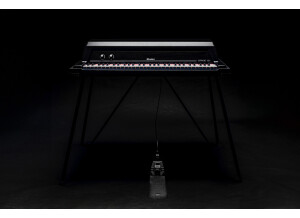
    The Rhodes Piano Bass is a unique keyboard that only has two octaves of bass notes. There are a few different versions of the Piano Bass, but I don't think that all too many of them were made in general. It became a well known instrument because of it's use by The Door's keyboard player/bass player, Ray Manzarek. I don't know if he used this all the time or not, but it's definitely got that fat bass keyboard sound that made him famous. I don't think that there is any difference between this and the lower two octaves of a regular Fender Rhodes, but nonetheless it's cool how compact this keyboard is. Since it only spans two octaves and no real tone controls, there isn't much versatility at all here, but what the Rhodes Piano Bass is good it, it's the best of it's kind. The feel of the keyboard is pretty much the same as a normal Rhodes, as the action is easy to play and light without feeling cheap at all. Pretty much everyone has heard the sound that the Piano Bass has in some capacity or another, which can be described as better really round, fat, and juicy. It's probably the best sounding bass that I've heard come out of a keyboard, as it's so smooth and rich sounding. I think that you could find one of these used somewhat easily if you were willing to spend some money, although I'm not sure exactly what kind of price these do command. My thinking would be that they would be cheaper since they are smaller than a regular Rhodes, but at the same time these are definitely a lot rarer than your typical Rhodes. So if you're interested in the Fender Rhodes sound, I'd recommend going with a full keyboard first, but if you're looking to add to your collection of keyboard, the Rhodes Bass Piano is an awesome instrument to have around.

  • « Classic »

    I've been using the Mark 1 Stage 73 electric piano for about five years. While not every studio or keyboard player has one, when I have access to one I will always try to use it when recording. Those who are familiar with this electric piano know its wonders and know what it can do. The Fender Rhodes is a classic electric piano, sought after by most when choosing an electric piano. The tone is unique and very rich. You can use the tremolo to get more of a wavy sound, or you can also get a bell like tone as well. The general sound is unique, but you can compare it to a Wurlitzer electric piano, but both have distant tones within the the electric piano setting. I have used this both for recording and for playing live, both with great results. It sounds great through an external speaker cabinet, but sounds fine when playing through the built in speaker, if your model has one. The price for a reissue of one of these is quite reasonable, but is comparable to that of a used vintage one, which I would recommend over the newer ones. It is built sturdy and has the Fender seal, which has become synonymous with making high quality instruments. It also looks great, and the keys have an awesome feel to them. It is easy to play, as the keys aren't too heavy and aren't too light. Whenever I play it I feel like I'm getting good results because of how easy it is to play and how great the sound is. If you are a keyboard player and you don't know about the Fender Rhodes by you should definitely try one out as you will fall in love! Great for all types of music including rock, pop, and jazz. The Mark 1 Stage 73 has become classic instrument in modern Western music and is used worldwide for all types of genres and situations.

  • moosers's review

    The Optigan Stereophonic is a unique electronic keyboard instrument that was a precursor to the Orchestron. There are a number of different Optigan models, but the Stereophonic is the one most commonly seen and also goes under the model number Optigan 35002. The Optigans in general are unique instruments because they require the use of outside discs to give it it's different sounds. The keyboard itself spans about three octaves and there is a control panel on the left hand side that also features chord buttons for each note possible and major, minor, and diminished chords. It also has tempo and volume controls. You would probably compare this to the Mellotron, although they are different technologies it's more or less the same idea. The Optigan hasn't held up as well over time however, as the sounds in general are pretty dated to the 1970's. It will depend on what discs you have for this, which is cool because you can get all sorts of different sounds and patterns out there. The downside is that you don't get it all unless you have different discs. I don't know what the availability of these discs is or how expensive or cheap they might be either. The B room at the studio that I work at has this in it, but I'm not really sure which discs they have it in or if they even have extras. While this is definitely a cool instrument to have in the studio since it has it's own sound, it's not something that I would personally be seeking out. It's kind of big and while it must have been cooler at the time to have discs for it, now if you don't have many of them it can be more of a hindrance than anything. If you do come across one, it's going to be a lot of fun to play with and you can certainly get some cool sounds with it, I'm just not sure it's going to be worth the hassle of owning one.

  • moosers's review

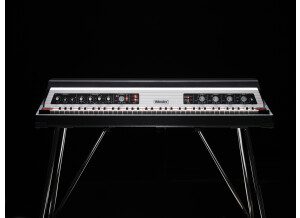
    The Rhodes Mark III EK-10 is a rare electric piano that has a synthesizer built in as well. I believe that this was made in the early 1980's, and I'm pretty sure that only a small handful of them were made. It's probably the most unique Rhodes electric piano that I've used, on account of the synthesizer. The studio that I work at has one of these on hand, although it hasn't seen much use since it's been in hiding. The Mark III EK-10 has a good amount of control over your sound, with more parameters that your standard and more traditional Rhodes pianos. The left side of parameters control your classic Rhodes sound, while the right side has controls for the syntheiszer. I don't believe that you can use the synthesizer on it's own, as it's meant to be used in tandem with the Rhodes sound, giving you the chance to double your parts on the stop. The synthesizer has also got two sets of tuning knobs, so you can set them to different harmony intervals and switch between them if you so choose. There are three different waveforms to choose from for the synth as well. While the Rhodes sound is definitely about where you'd expect it, I'd still probably rather use a Mark I or II to get that sort of sound, although this would certainly do. Having the synthesizer is a really cool feature, although I've yet to find a situation where I wanted to use it. If you're looking to get a Rhodes, I probably wouldn't recommend this one, but it's definitely go it's own thing going on and can do some things that the other Rhodes can't. The Mark III EK-10 Rhodes is a ball to play around with, but if you want a traditional Rhodes I'd recommend going with a Mark I or II...

  • mooseherman's review

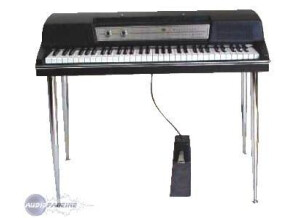
    What can be said about this instrument that hasn't already been said? There's a reason that these are selling at absurdly high rates right now. From Joni Mitchell to Ray Charles to Motown, many great recordings have been made using these great electric pianos. The 200A is a newer model. When I learned that, I was skeptical, as I remember many companies tampering with a classic and turning out a sub-par imitation. However, the 200A is just as good as the original Wurlitzers, at least as far as I could ever tell. It also has a bit more range than those, as there is a knob for controlling tremolo as well as the original volume knob. This is the only benefit that it has over the 112, but it is a tremendous benefit, as it offers far more range on the natural instrument and requires the player to rely less on outside interference. It also has a speaker which allows the player to quietly play it acoustically. It does have the amp output as well. This, in my opinion, is where the interesting possibilities lie. I love the natural distortion that occurs on this instrument. When I listen to Ray Charles' "What'd I Say" or Marvin's "I Heard it Through the Grapevine", I love the distortion that I hear on them. I'm not even sure that it was intentional, but it's almost irrelevant for me as it's the sound I prefer.This similar effect can be achieved, to various intensities and settings, with a good Fender Twin amp, although any good tube amp will do really. Distortion the one advantage that this has over the Fender Rhodes, which doesn't sound as good distorted, although that instrument is great in it's own right. Great for jazz, blues, rock, gospel, even great hip-hop and dance music has featured these instruments. If you can find/afford a good one, it's well worth it, as there aren't many who can. Be prepared to empty out the account though. For serious musicians only, as far as I'm concerned.

  • moosers's review

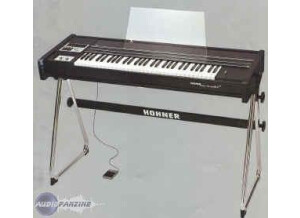
    I've been using the classic Hohner Clavinet D6 electric clavinet for about a year and while I haven't played every clavinet out there, this is by far the best model I have played for a number of different reasons. The first reason is the sound quality as it has the most realistic and rich clavinet sound I've ever heard. It has some filter controls, but the inherent sound is really all you need - it just sounds that good. The filter controls include switches for brilliant, treble, medium, and soft, as well and volume control. It also has a 1/4 inch output to send to an amplifier. The next reason I love the D6 so much is its overall feel and its overall look. The great feel makes it feel like water to play and the wood look is awesome and one that keeps it preserved in the time period it was made, which is the early 1970s. Since the D6 is no longer made, if you would like to buy one you need to get it used. The average used price is pretty reasonable and isn't that expensive for a top quality keyboard like this. I have also used the D6 with phaser and other modulation effects with great success, although it can get some great sounds on its own. Hohner is known for making some awesome products, like their clavinets and their harmonicas, and the D6 is really one of their finest products. This reputation adds to the allure of the Hohner D6. Overall the D6 is a classic keyboard and all keyboard players should try this out. This being said, if you are looking for a single keyboard to use, this isn't it as it is a specified type of sound great for funk. It is a great complementary piece for the keyboard player who has a digital workstation already.

  • moosers's review

    I've been using the Fender Rhodes '73 electric piano for about five years. While not every studio or keyboard player has one, when I have access to one I will always try to use it when recording. Those who are familiar with this electric piano know its wonders and know what it can do. The Fender Rhodes is a classic electric piano, sought after by most when choosing an electric piano. The tone is unique and very rich. You can use the tremolo to get more of a wavy sound, or you can also get a bell like tone as well. The general sound is unique, but you can compare it to a Wurlitzer electric piano, but both have distant tones within the the electric piano setting. I have used this both for recording and for playing live, both with great results. It sounds great through an external speaker cabinet, but sounds fine when playing through the built in speaker, if your model has one. The price for a reissue of one of these is quite reasonable, but is comparable to that of a used vintage one, which I would recommend over the newer ones. It is built sturdy and has the Fender seal, which has become synonymous with making high quality instruments. It also looks great, and the keys have an awesome feel to them. It is easy to play, as the keys aren't too heavy and aren't too light. Whenever I play it I feel like I'm getting good results because of how easy it is to play and how great the sound is. If you are a keyboard player and you don't know about the Fender Rhodes by you should definitley try one out as you will fall in love! Great for all types of music including rock, pop, and jazz. The Fender Rhodes Suitcase '73 has become classic instrument in modern Western music and is used worldwide for all types of genres and situations.

  • songboy's review

    I am writing this review in regards to a Fender Mark 1 series stage piano (1972-79, 88 keys suitcase). I purchased the Rhodes in 2003 used (of course) and at that time, I was just gaining interest in pianos. I would say that I used it pretty regularly starting in 2004. What did I like most about it? THE TONE!! and the ability to alter it to your liking. Wow, its hard to imagine a style of music that wouldn't benefit from this instrument. You actually have a LOT of room for adjustment when it comes to tone. I setup mine to sound slightly plunky (very slight) with a very mellow, warm overall tone. I was going for the Chick Corea "sound," just slightly less bell sounding. Another great thing about this instrument is the basic simplicity of its innards. I am not a trained professional when it comes to working on equipment, but with a Rhodes you don't have to be. At least not for most things. Its like working on an old 350 engine, everything is just laid out for you. I was able to replace broken tines, adjust the tone, adjust the individual pickups for a good volume blend across the board, and fix/replace various small parts all on my own. The only thing I would leave up to the pros is replacing/soldering pickups, but that has never been necessary, they all work great. As for things I do not like? Well, I am having a small problem with my sustain pedal knocking off the damper bar, but I think thats fixed. The sustain pedal will also move on you if you don't secure it well. When that happens, you lose the ability to sustain which really bites when performing live. I have become good at adjusting it mid solo/section quickly but Watch You Head!! haha. Now the real bummer about this instrument..... IT WEIGHS A TON!! Do not try to move it on your own. You will either hurt yourself or the rhodes. I lugged it up the stairs by myself one time an nearly yanked my arm out. If you are a solo musician, get a friend/roadie to join you if you plan on touring. If you are in a band, make sure the band mates understand that it won't show up to a gig without one of there help. As for price and value, if you are good a finding bargains, you might find a sweet deal on one of these. I got mine for $250 in great condition but don't hold your breath for a deal that good, it was really lucky. Good condition ones can range from $750 to $1000+, but, if you know how to work a few basic tools (screwdriver, ratchet set) and you aren't afraid to "tinker," a Rhodes in good/ok condition can be turned into a gem. As far as I know, replacement parts are still made. I also believe Fender might make Tines still. This is one of the greatest instruments ever made in my opinion. The sound coming out of a Fender Twin amp, well, it just doesn't get much better for me.

  • « Not great even in its day »

    My first electric piano when I started gigging in 1981/82. Had I the money I would have bought a CP80. The CP20 and larger twin CP30 were polyphonic, touch sensitive, and had a sustain pedal, but the similarity to either a piano or Rhodes ended there. Very cheesy electronic sounding, was sort of convincing in a band with several loud guitarists and the audience had been drinking heavily. Distinctive sound but not in a good way; any synth VST could easily reproduce, not that you'd want to. Not even a good tine piano, semi-convincing harpsichord. (Think "Right place wrong time" by Dr. John.) Replaced with a Helpinstill Roadmaster 88 Mk. II which, happily, was the acoustic sound I looked for, albeit with its own myriad issues; sold the CP20 in 1984 and though I've regretted selling many instruments over the years, this is not one of them.

  • « Hohner made a solid piece of gear »

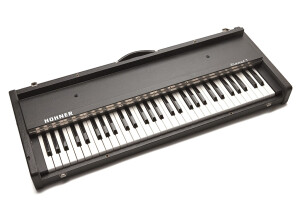
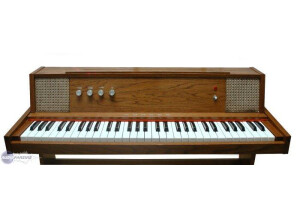
    The Hohner Pianet M is a popular electric piano and it was one of the best one’s that Hohner Made. Hohner is a company from Germany and it was produced between the 60’s and 70’s. The sound of the Pianet M is from a bunch of metal stings that are plucked by pads that are the inside of the unit and then medal rods connected to the keys so that when you press a note the pad moves and makes the string vibrate which creates that sound. There are other versions of the Hohner Pianet as well, the first version of the it by Hohner was just called the Pianet. Then came out when the Pianet C the Pianet L and this version here (not in that order though). The Hohner Pianet M was one of the final models that came out and that’s when they changed the pads on the inside from foam to rubber so they would last longer and be better. This is one of the reason that the Pianet M models was so popular because it basically would last longer, they have worked out all of the kinks with this model of the Pianet by Hohner. The M model was made for home use only and was built in a case that was made of wood and had speakers also built in on it, so no need for external speakers. Also, the M model didn’t come with legs, the previous models had legs so they could stand at a good height on there own. A lot of the technology used on the Pianet M is still being used on a lot of electric pianos in todays world almost 40 years later. Hohner was way ahead of time when making this model. I take my hat of to Hohner they have created a great electric piano and if I could rewind time I would purchase one of these now.

  • « very good sound »

    The Hohner Clavinet C is a electric keyboard. The keyboard itself has a nice weight and feel too it. Not too heavy. The design is very vintage and can come in the version pictured above or they also make a version that looks like the whole thing is wood. There have been several models of this produced over time like the D6 and the E7. When you push down a key there is a mechanism on the inside that hammers down on the string. Basically similar to like an upright piano. Its sort of like a guitar string with a hammer coming down on it, and that’s where you get your sound from. it’s a very nice sound that you can get from it. Its authentic and not like most o the other electric keyboards that have been produced of the last 25 years or so. You will love the sound you will get out of the Hohner Clavinet. The Honer Clavinet C seems like it was designed for used at home and not to be moved too many times. Even though its really not that heavy because I have picked it up several times and was surprised by the weight of it. Overtime, you will probably need to have the hammer tips replaced. You can actually still purchase these online even though this keyboard is pretty old. Many people also restore the Clavinets now adays so that people can have them “brand new” again. Because it would be very hard to find one of these in great shape. Unless someone already worked on it and restored it and if you do find one that is in good shape already it will cost you a lot of money because you will probably have to get it from a collector. But overall, if you do get your hands on the Hohner Clavinet C you will love it. It is one of the best Clavinets produced and Hohner has been doing it for a long time.

Categories that may interest you