Log in
EN
FR

Amps & Monitors

2378 products found

Categories
Filter
Sort by
Brand
Evaluation
  • Reviewed or not
  • Editor’s award
  • Reviewed by Audiofanzine
Availability
  • Available or not
  • Sold new or used
  • Sold new
  • Sold used
Must-have products
  • All products
  • Flagship products
  • Best rated products
  • Hot products
  • Popular products
Price
  • Freeware
  • Low-cost (< $500)
  • Mid-range ($500 - $1,500)
  • Premium (> $1,500)
€
Clear
Sort by
  • Popularity
  • User ratings
  • Price - low to high
  • Price - high to low
  • Used price, increasing
  • Used price, decreasing
  • Name (from A to Z)
  • Name (from Z to A)
  • Added on
Choose a category
Selected category: Amps & Monitors
Sort results
  • Popularity
  • User ratings
  • Price - low to high
  • Price - high to low
  • Used price, increasing
  • Used price, decreasing
  • Name (from A to Z)
  • Name (from Z to A)
  • Added on
Filter results 2,378 results found
Brands
Evaluation
Availability
Must-have products
Price
  • Freeware
  • Low-cost (< $500)
  • Mid-range ($500 - $1,500)
  • Premium (> $1,500)
Show results

The best Amps & Monitors reviews

The reviews Audiofanzine members found the most helpful.
  • « Does "impartiality" really mean a thing for speakers... ? »

    Here’s the first review on these gems : I work as a producer and mixer. Some months ago I had a budget to upgrade my main speakers (Focal solo6 Be)... My choice was aimed at ATC25 or 45, Barefoot MM27 GEN2, Focal SM9 or trio, and PSI A21 or A25 if there was an opportunity... After testing the ATC 45 and Barefoot MM27 GEN2. I’ll say (in short) for these models : -ATC 45 : really warm sound hence presence in the low-mids = pleasant to the ear, but with a tendency to squash the sound at (very) high levels… For the rest, it’s all high-end: all I listened on them sounded bettered (organic, all the opposite compared with the Barefoot) -Barefoot MM27 GEN2 : an astounding clarity, well-decomposed stereo image (which can be a bit disturbing) and a very controlled low-end, but… a sub that seems like disconnected from the rest of the instruments. This can be a problem for a musical feeling (as a whole the song’s unity is somehow mistreated). Feeling of a digital listening – all the opposite compared with the ATC. Just a mention for Focal which Trio 6 really astounded me considering the price difference… The new class G amps are certainly no strangers to this. Coming from solo 6be (but I also know other models from this manufacturer), I could recognize Focal’s trademark (beryllium tweeter, stereo width, depth…) but with the addition of a clearly audible 3rd voice. You end up with a very detailed monitoring, above the Twin, with an impressive overall power, with a well-controlled low (really low at 35Hz)-end. All in all: a must have in its price range! I was about to opt for the latter (and their excellent value-for-money) when I found an opportunity for PSI A25Ms. I quickly remembered listening to A17s from the same brand, long ago, and being really impressed by them. After listening to them at the shop, I end up choosing these A25M... After a month working with them: I can say they’re just incredible with accuracy. I had to listen many tracks I already knew by heart to understand how far these speakers would take me. These are very high end devices that don’t aim at embellishing or polishing the sound, which would just hurt their aim… if a record was badly mixed/mastered, it jumps to the ears… I read a review recently that said they could turn you into someone snobbish and picky as they are particularly merciless. I wouldn’t say it so… Actually, they’re helping me perfect my musical culture when listening for a long period of time… I’ve never heard monitors that counl enter this way into the very character of a record’s production… What I mean is, I can perceive all the choices and little (or bigger) misses at recording or mixing – all this with a perfect transparency. Adopting a more distanced position for musical listening, they also deliver especially brilliantly… No need for an outrageous decomposition ala Barefoot, you end up with a musical unit as wished by the producer (and in wide band too: 32Hz to 23 kHz)… Of course, the better the record is mixed, the greater the result… while the more the record will have been driven down by an incompetent producer or the requirements of our consumer society (loudness war and so on), the worst the listening experience. In working conditions, you can imagine how easy it is to project oneself into a real producing session (with the right choices made from the start) or a mixing session… As an example, I’ve rarely ever managed such a portability to other systems without even making a 2-bus mix (which by the way are nowadays essentially used in mastering), all this with a quickness of decision-making I’d never experienced until then. So, I could go on developing the technologies used by Mr A.Roux and all the patents linked to these "AOI, ALG, CPR, PSC" speakers (by the way, the AVAA 20 is quite a revolution compared with what it can replace...), the excellent (and very reactive) customer service… among other things. I’ll complete this review with a little more experience with it. In the meantime, here are 3 pics of them in my studio...

  • « Very clean and dynamic, perfect »

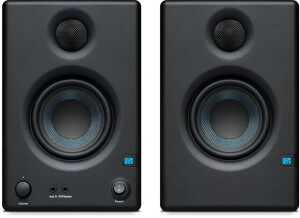
    Active monitoring speakers with 5.25" kevlar woofer + 1" tweeter Class-AB amp: 70 Watt Front-port bass reflex system EQ: mids +/- 6 dB - highs: +/-6 dB Low-cut filter: 80 Hz - 100 Hz "Acoustic space" parameters: 0, -2, -4 dB Frequency response: 53 Hz - 22 kHz Balanced XLR and 1/4" jack inputs plus unbalanced RCA Dimensions (WxDxH): 7" x 7.68" x 10.24" (178 x 198 x 260 mm) Weight: 10.2 lbs (4.63 kg) I use them in my 120 sq ft home studio, both for mixing demos and standard listening. Size, power, front-port were the pre-selection criteria, with plenty of controls to adjust the sound to the room. And then came the sound (see below). SOUNDS I hesitated buying the KRK RP6 G3 (6" against 5.25"), which are more expensive and bigger. I compared them both at my local store, where the owner took the time to give me detailed information and let me test them. The ERIS 5 were much clearer than the RP6, which sound "heavy." However, the ERIS 5 remain well-balanced, with average but precise lows. I tested the Yamaha HS 5 (or 7?) and couldn't help but cry... no lows and not clear at all... Once at home: I installed them one to each side of my 19" screen, much closer to me than in the store. The sound is still clear, but I have discovered the low end. The front port was indispensable in my case, with the "acoustic space" setting at -2db (halfway). The lows aren't "huge" (you can even gain some at 0dB), but they are very present and precise, with nice dynamics. Given the quality of the highs/mids, they are very good for mixing (my priority), while remaining pleasant for listening. So, for me, they are perfect. They are more than enough for my setup in terms of power. I can play with my guitar amp and backing tracks at decent volumes. OVERALL OPINION I don't have much experience with studio monitors, but you can realize a lot of things if you test them at the store and the seller gives you enough time. I bought them a month ago for about $350. For me, they were better than the KRK RP6 G3 and less expensive. I didn't like the Yamaha HS. The Focal alpha 50 were better (bigger, with more lows and a comparable clarity) but more expensive. I didn't listen to everything... Perfect size, weight, power and adjustment controls for a small home studio. Comprehensive connections. Nice (and sober) look, too. The manufacturing quality seems fine, but this type of product doesn't suffer much in general. A small detail, it doesn't have rubber feet (?). Presonus has accomplished a product with very good highs/mids and an excellent value for money. They are certainly not "top end," but they are the best choice for me right now.

  • « Look no further »

    Since April 2015 they're in my homestudio set, I've been discovering them progressively since then and I guess they certainly need an extra breaking time, still they're already really good. Great for mixing, I finally can distinctly hear my reverbs' depth and the musical stage is incredibly precise. Spaced by 1.3m (a little over 50 in) in a zone with Auralex phonic isolation foam. Now, let's not get mistaken: the sound of a speaker depends a lot on the room's acoustical properties and to take full advantage of it nothing compares with a precise metering and compensation system such as Ik multimedia's Arc 2, and suddenly everything starts making sense. Magical! The Alpha 80 goes very low in the bass, and I personally will do without a subwoofer. (see the graph on the accompanying pic) They rest horizontally on Isoacoustics stands. The lows are punchy and don't drowl (if you hear otherwise then have your room treated for your listening spot is exactly at the worst place). Its power allows to listen at a small volume with a high level of details, while pushing it produces a huge sound (my house resounds at 50 Hz...). A test using daft punk's latest release, a Bob Marley or Rage Against the Machine will achieve convincing you, if need be. Caution: they're heavy and take a lot of space on a 1.8m (6ft) wide desk, I have just enough space left fot two 27" screens and the speakers. Overall, it comes with a huge value for money ratio that allows doing without a sub (hence less to spend), and accessing the Focal range with a precise, almost surgical sound full of air that makes mixing easier. On a side note, no listening fatigue to be noticed on long sessions. Still, the plastic structure seems fragile and sensible to scratches. No protection grill on it. note regarding metering and compensation (which I consider a necessity) : Use Arc 2 within your favorite DAW (remember to bypass it for rendering) and use Foobar 2000 + the asio George young's Vst wrapper addon. You won't believe your ears, which in return will thank you. As a bonus, the included measuring mic is great when used to record a guitar or voice. Other solutions are the freeware mathaudio room EQ (http://mathaudio.com/download.htm) and Sonarworks (21 day trial version, https://sonarworks.com/speakers/ov, but it requires buying a separate measuring mic - that approximates €/$70).

  • « Stunningly accurate. Not expensive. »

    • Which technical specifications motivated your choice? Irreproachable German construction. The fact that Neumann uses such strict technical specs that they consider all KH120 to be matched. And you can see and hear that right out of the box. The frequency response (even if it's only one factor, the other and no-less important ones are the listening space and position). The three frequency correction controls (which are stepped, so stable) have a well-chosen response, in relation to other speakers at the same (and even higher) price point. • Use: Professional. Album mixing and premastering, as well as audio post-production. Protools HD SOUNDS Is the frequency response neutral enough? The frequency response curve seems incredibly neutral to me. If you focus on each frequency range, on each instrument, everything is in the right place. • Is the stereo image good? Very good. With a very clean phantom image. You can even move one feet from the center without the image being distorted. The phase coherence and flat frequency response certainly have something to do with that. • Is the sound clear and accurate across the entire frequency spectrum? YES...Within the physical and acoustical limits of speakers this size. Nevertheless, it has an extremely extended response in the high end, while remaining unaggressive up to frequencies that largely exceed our hearing range. I was also surprised by the presence and accuracy of the lows. No issues to mix the bass nor the kick, always you know where you are. However, to mix special effects or the 30Hz of large organs, you'll need bigger speakers. Personally, I think the subwoofer option isn't necessarily the best. It is very hard to place and set a subwoofer if you want to do it by the book. If you don't have enough experience, you might end up setting it in a way that harms rather than improves the natural balance of the kh120 down to around… 45 Hz, I'd say (if my ears don't deceive me!). This is only my personal opinion, obviously. These speakers either reproduce sound very well or they simply not reproduce it at all (in the low end). • Is the dynamic response faithful? ... Very large headroom. I don't hear any compression. I have already cranked them quite a bit. They have more than enough power for me. I stop before the security signal activates. It's even scary. (I'm about 5ft away from the speakers). OVERALL OPINION • How long have you been using them? 2 months. • Which feature do you like the most / the least? The most: It seems as if I'm pitching these speakers, but I really love everything about them. A good sound for a more than reasonable price. The least: It would be easier to have the power switch on the front panel, rather than on the rear. • Did you try any other models before buying it? I have known the NS10 for 20 years. I still mix with them sometimes. You need to know them to work with them ;-) Mackie HR 824: Good, but a bit soft and sound changes depending on the listening level (even if you consider the Fletcher and Munson curves) Dynaudio BM5a: Very good. Not as neutral. Genelec 8030: Very good, too. Genelec 1030a: Way too flattering. Yamaha HS8: Flattering in the low and high end. Yamaha HS7: OK, for the price. Too "mids-heavy" for me. ADAM and KRK: Very far from what I expect to be able to mix. • How would you rate its value for money? Unbeatable. • Based on your experience, would you buy this product again? ... YES, sir! They are perfect for me.

  • « Really excellent! »

    I was extremely happy with my CMS50 + CMS sub kit after my room underwent an acoustic treatment, then I had an opportunity to invest into these Trio 6. No regret! They're unbelievable, very precise even at minimal volume, with an incredible dynamic reserve, if you wanted you could use them to blow your head off - litteraly. Everything is optimized: power, bandwith, stereo image, filter frequency, I've heard things I'd never heard before from records that rank among my favorites which I'd previously listened to thousands of times. One of the things that most astounds me is the way you can walk in front of them without the sound changing entirely, as on other models. The sound is extremely good, not too directive - incredible! Plus, they look classy, you can put them as you like and the focus mode is a great idea. Great job, Focal. I also had to try their customer support for an unexpected problem: they're very reactive and friendly.

  • « A real sound bubble »

    After trying them out in a store, I went directly back home to try them in their future environment. Getting through the highway. Once home, I unpacked them and put them on on a home-made shelve. Put the laptop on my desk, the audio interface, plugged the cables, started the audio player. I sat comfortably in my armchair, turned the volume knob on my digital audio interface and… no sound! Well, no sound from the speakers, but there is from the laptop itself. What the...? :?!: Everything was plugged correctly (checked). Speakers turned on ? Checked. :noidea: Traktor must have failed to detect the interface, which it usually does. I leant over my computer to sort this out, and that’s the moment I start to hear sound from my speakers; I go back into my armchair and… the sound comes from the PC again. :???: :idee: I put the laptop away from the desk, the sound starts floating in front of me just above the desk. A clear, neat sound bubble. Got it ! I launch Riders on the Storm. Sound starts on the left speaker, the singer starts on both speakers and the drums in the right one. Jim Morrison is so close, in front of me, singing. Just great! The speakers are 4 ft from each other, and I am located 4 ft away from each of them. The sound is at the barycentre, above the desk, moving left and right with the stereo signal. To hear one of the speakers, I have to move my head 4 in on one side. An explanation for this phenomenon can be found in Presonus’s description: The R65 and R80 feature a custom 6.8-inch² Air Motion Transformer (AMT) tweeter that responds to the subtlest waveforms and the highest frequencies. (…)Unlike a traditional 1-inch dome tweeter, which provides a mere 506 mm² projection area, an unfolded AMT tweeter diaphragm provides 8 to 13 times the projection area so its sound coverage is much larger. For example, the 4,400 mm² PreSonus R65 and R80 tweeter provides coverage equivalent to that of a 3-inch dome tweeter. This enables the R-series monitors to provide a much wide stereo soundstage than traditional designs. (…) The broad, even horizontal dispersion creates a wide sweet spot. Because they are less subject to room-anomaly interference, the R65 and R80 react more predictably and sound more consistent from room to room. The following scheme is supposed to explain how it works : To make it short, the tweeter is surrounded by a rectangle-shaped horn that gathers the sound in a space that is wider than high, which is said to avoid unwanted sound reflections in the workspace and ceiling. I think it would take some testing with people used to monitoring speakers to reach conclusions. What is sure is, with these speakers 6 in over my desk in my 36sq m room with a ceiling 9 ½ ft above, all this without any official and worthy acoustic treatment, I have a very good listening quality from my armchair with no unwanted side reflection. I say “no official acoustic treatment”, for the floor is largely covered with carpets behind my listening position while in front of it are 7ft high of shelves covered with books. There are also thick curtains and a carpet on the wall opposite the window, and the ceiling is joisted. Clapping my hands reveals a short reverberation time. Basses are not exaggerated, except for a small, uncovered wall angle that provides a short echo. I still diminished the setting by 1.5 dB behind the speakers. For close monitoring, I put the volume knob around 1 to 1.5 for a max level of 10. Beware in a very small room, they may be too powerful if there are reflections. These active monitors have the following specs : • 2-way active studio monitor with AMT (Air Motion Transformer) ribbon tweeter • Class D biamping: 100/50 Watts • 8" woven kevlar low-frequency driver • Custom-designed AMT tweeter with ultra-thin kapton membrane (&lt;0.01mm) • Tweeter surface: 4.4cm² (equivalent diaphragm diameter: 3") • Frequency response: 40 - 22000 Hz • Crossover frequency: 2.6khz • Variable volume range (a-type taper) • Switchable HF correction: linear / +1 / +3 / +6 dB • Switchable HPF (linear/60hz/80hz/100hz) • Switchable "acoustic space" LF correction (linear/-1.5db/-3db/-6db) • SPL: 107 dB • Inputs: balanced xlr, balanced 6,3mm trs, unbalanced rca • Input impedance: 20kohms (balanced), 10kohms (unbalanced) • protection: rf interference, output-current limiting, over-temperature, turn-on/off transient, subsonic filter • Energy conservation mode (auto standby) that can be switched off • Cabinet: vinyl-laminated, medium-density fiberboard • Blue or black front panel • Weight : 9 kg • Dimensions: 241 x 309 x 379 mm These speakers are very well built. They are delivered with 4 felt pads to be glued underneath. The hex key (necessary to change the front plate) is also included. The user manual features several languages. These speakers perfectly suit my aim for spectral balance so as to properly select music for balls. :aime2: I wish they’d have crackles on old recordings stand out more, but now I know about this weakness I’ll be particularly careful.

  • « Completely satisfying near-field monitors »

    Features 9/10 This pair of monitoring speakers found their place seamlessly in my home studio's very simple setup: My Imac equipped with an Apogee Duet soundcard and Logic X and Garageband. I use them as near fields in a small room to listen to different music styles: Pop, rock, funk, blues, reggae, lots of jazz, and some classical music. I use them regularly every day, but not intensively. Despite the constraints of placing them back-to-back with the wall, which wouldn't be approved by a purist, I was looking for gear that wasn't too influenced by such constraints, I think this speakers are very well adapted to my context because they do their job perfectly, even at high listening volumes. Sound 9/10 I think the reproduction is neutral and the sound excellent at low levels, but they can also handle high levels without a sweat, although, personally, I prefer "decent" levels for my daily use. I really love the sound of these "Alpha 65" speakers, I thinks it's reliable and pleasant enough to my ears, the stereo image is respected. I'm a music lover but consider myself an amateur, that's why I said I use them regularly, not intensively. I think the sound of these speakers is very good, even excellent considering their price and performance. Overall opinion 9/10 I was seduced by the Focal CMS with their more silky side, a very nice smoothness... But my wallet preferred the "Alpha" range, which is more affordable. The investment isn't justified for my use. I also compared them to the Yamaha HS-8, which are rather convincing, but the sound of the Focals pleased me more... That may have prompted me to consider choosing the Alpha 65 model rather than the 50. The latter are compact and precise but seem a bit weaker, the lows seem to be handled better by the 65s, they seem to "breathe" more. As for the 80s, which I tested next, you really need to crank them up and pump up the lows to notice any difference. In short, I think the Focal Alpha 65s are more homogeneous and better suited for my personal use.. I strongly recommend you to listen to these Alpha 65 before making a choice, nothing will replace your own ears to make up your own opinion... After several weeks of use, I am currently really satisfied and happy with them!

  • Audiofanzine FR's review

    (Originally written by PanoraMics/translated from Audiofanzine FR) Quality of big systems like the 100, which I have tested and worked with. I tested them before buying them. For professional audio, post-production and as main monitors. Active speakers. SOUNDS - Very linear frequency response, one of the best in this price range. - Very good and detailed stereo imaging if the room acoustics are also good. Which actually applies to every monitoring system. - Very clear sound along the whole frequency spectrum. Low frequencies are VERY accurate and not overemphasized. Sometimes I work with them 11 or 12 hours straight and I don't get tired (wchich isn't the case with Genelecs, Dynaudios or NHTs). OVERALL OPINION - 14 months ago. - Closed enclosures. Superb finish. The main disadvantage is the after sale service. Before you buy them check how your local distributor works! Because I had to send a 66 lb. speaker to England for repair. And considering the price of the speaker it was impossible to get a replacement speaker while it was being repaired. - I have tested and worked with lots of other brands: Genelec, NHT, Dynaudio. - Good value for money. - I wouldn't hesitate to buy them again. - Last comment: lousy packaging: A simple cardboard box with polystyrene chips and some foam on the top and the bottom. The cardboard box was torn to pieces when I got them and I had to check if the membranes were not damaged before signing off the delivery. It was almost a miracle that they arrived in one piece! Unfortunately I didn't notice that one of the speakers was damaged. You can surely imagine how pissed I was considering how much they cost! And of course, this damage wasn't covered by any insurance... Take all this into account before you choose this product.

  • redox75's review

    THE TRUE LEGENDARY JBL SOUND! It's among the most respected/emblematic models of the brand and it is still in their catalog after 20 years. Hundreds of sound engineers have worked their masters using the 4312, the most famous album mixed with them is Michael Jackson's Thriller. When it comes to sound reproduction, they are clear, clean, precise, with a very punchy and groovy low end, while the mids/highs lack, at the most, a bit of finesse compared to other speakers. SOUNDS A very proper and transparent sound, you can hear a fly passing by several feet away... Superb stereo image, airy and well-balanced. Two controls to adjust the mids and highs to the acoustics of the room. However, they lack some power to really move the 12" (white) woofer (ref 2213H), despite the 80W RMS, they need to be driven to the limits to sound best. The mid driver is a 5-incher, model LE-5. ref 2213H: WOOFER ref LE-5: MIDS ref LE 25: tweeter OVERALL OPINION I've had them since 2005 after dreaming about them for 30 years, I then bought the 4312A version, with titanium tweeter (ref 052TI) and the white JBL logo on a black background. I also bought 2 pairs of new woofers, as well as the tweeters, to have them as spare parts. Because these speakers are pretty sought-after by people in the know and their price is only going up, besides them being not easy to find. They are sold currently for about $1000/$1300, the first model. I love their musicality and attack. The lows are very round and warm, the mids are well-proportioned and the highs have that chiseled touch that I love! They are awesome for studio! And they are great as a HiFi system or for home cinema, too. However, they are not the best to listen to classical music. As for good amps to go with them, there are some Yamaha and Technics, but the best way to go is a tube MacIntosh! IT'S FOR THE JOY OF YOUR EARS AND YOUR WELL-BEING!! I would love to get the recently launched 4312E, but the pair sells for about $3300.

  • « Dynaudio BM15A »

    Powerful speakers that go very deep, as long as you have a large enough room. You can do without a subwoofer. They are not aggressive, you can listen to them for hours without getting tired. SOUNDS These speakers reproduce 45hz at 0db. Playing with the filters you can get 30hz at -3db but the frequency response curve is not so flat (peak of +6db at 45hz - see the manufacturer's diagram). You need to run them in following the instructions of the manufacturer, which means you shouldn't drive them too hard the first 24 hours of use. Personally, I only used them at low-mid volumes for 8-hour sessions every day during a week. Afterwards you can drive them progressively harder to let the transducers work correctly. It's hard to describe with words what you feel listening to the BM15A... The sound is very clean, very detailed, the dynamic response is incredible. No frequency intrudes upon any other. The stereo image is very good, you don't have to be right in the sweet spot to hear it clearly. OVERALL OPINION I've had them for a little over a month and they only get better with time. Each speaker is on a stand and isolated with 4 pads. For their part, the stands are isolated from the ground by spikes and feet. I don't regret my purchase in the slightest. The sound is the same at low and high volumes. Brief update after 1 year of use: The tweeter is making some noise due to a faulty electric installation, but I moved and everything is great now. As for the lack of mids, I have nothing to say, after running them in, the frequency spectrum is full now. And it's a delight to have them in my 226 sq ft room!

  • « Very good! »

    I was looking for small monitor speakers that were faithful enough and a good value for money. Pretty standard features: 2-way (5" + 1") near-field active speakers Power: 41W + 41W Class D amplifiers Max. SPL: 108 dB (C-weighted) Frequency response: 43 Hz - 24 kHz Thomann volume control EQ: LF (+2 dB / -2 dB), HF (+2 dB / -2 dB) Input: XLR and 1/4" jack Magnetically shielded Auto-bypass function Dimensions: 11.7" x 7.3" x 9.9". (298 x 185 x 251 mm) Weight: 10.1 lbs. (4.6 kg) SOUNDS I didn't test anything in particular, I only followed the reviews and read about them on the net. However, from a more subjective point of view, I have the right sound I need for mixing. The lows are reproduced well enough, despite the woofers being only 5" big, and the dynamics are well preserved. OVERALL OPINION I don't have enough experience with them yet, but they asked to write a review and here it is! I also have the HS50M, but it makes no sense to compare them, the JBL blow them away!! Much more transparent and you can tell they are better quality. I also have the ADAM A5 + SUB7, and I think the quality of the LSR305 is pretty close to the A5, without SUB. Will I push the boundaries so far as to find something better than the ADAM? Or something equivalent (to avoid making any enemies around here :) A small detail: There's some latency when you turn them on, they need some time to be really on, but it's not that annoying. It allows you to turn other gear on without any crackling if you forgot to do it before powering the speakers.

  • « Very good for the price »

    Features available at the Presonus website and also in the review by Audiofanzine. I was looking for some not-too-expensive monitors with an 8 incher to avoid having to use a subwoofer. I use them to listen to music at home. SOUNDS Very good sound. The speakers seem well-balanced to me. Clear and precise highs. Mids not too upfront. The speakers have a good dynamic response and perform very well with all types of music. The stereo image is okay. No annoying coloration. But it's still 2-ways only... OVERALL OPINION I've been using it for two and a half months. I also listened to other models by Yamaha (HS8), Prodipe (TDC8), Focal (CMS)... The Eris 8 seem to be the best value for money by far. What I like best is the numerous controls, the plentiful connections, the excellent sound for speakers this price. I still haven't found something I don't like about them... I would definitely buy them again because, even if spending a bit more, I'm not sure I would find something better.