Log in
EN
FR

Mixing Consoles

2795 products found

Categories
Filter
Sort by
Brand
Evaluation
  • Reviewed or not
  • Editor’s award
  • Reviewed by Audiofanzine
Availability
  • Available or not
  • Sold new or used
  • Sold new
  • Sold used
Must-have products
  • All products
  • Flagship products
  • Best rated products
  • Hot products
  • Popular products
Price
  • Freeware
  • Low-cost (< $1,500)
  • Mid-range ($1,500 - $4,500)
  • Premium (> $4,500)
€
Clear
Sort by
  • Popularity
  • User ratings
  • Price - low to high
  • Price - high to low
  • Used price, increasing
  • Used price, decreasing
  • Name (from A to Z)
  • Name (from Z to A)
  • Added on
Sort results
  • Popularity
  • User ratings
  • Price - low to high
  • Price - high to low
  • Used price, increasing
  • Used price, decreasing
  • Name (from A to Z)
  • Name (from Z to A)
  • Added on
Filter results 2,795 results found
Brands
Evaluation
Availability
Must-have products
Price
  • Freeware
  • Low-cost (< $1,500)
  • Mid-range ($1,500 - $4,500)
  • Premium (> $4,500)
Show results

The best Mixing Consoles reviews

The reviews Audiofanzine members found the most helpful.
  • « Flexible, with a great sound ;) »

    I bought this mixer after a long quest: I wanted a digital mixer which behaved and provided the ergonomics of an analog model :) PLUS, with a USB connection to a PC or Mac... I spend 5 years mixing with digital mixers by Roland, Behringer (mostly the X32 in different versions), Midas (M32), ... Each of them had its own pros and cons. Later on, I had the opportunity to mix using a Soundcraft Expression 32 and really loves its preamps and summing (which was not the case with the X32), and I also enjoyed the Soundcraft's ergonomics (alike the Roland models by the way). The only cons were the absence of a small screen for each channel, the lack of a USB connection... After a quick research on the web, I came across the Soundcraft Impact, which featured all that the Expression was missing -in my eyes at least- :) I was also lucky to be asked to mix at a music festival, with 13 bands in a row to be mixed within 13 hours using this console while multitrack-recording the entire festival... So I immediately embraced the challenge, worked the manual and got my hands on the table on the evening before the festival was to start. I quickly downloaded Reaper (which I didn't know at all...), tried and tested everything and on the following day I was ready for the mixing marathon :) And 13 hours later, my decision to buy this mixer was made. The preamps let you get them into the red, and in a pleasant-sounding manner. The high-pass filter available in the preamp section works with no issue whatsoever. The Gate section is VERY thorough: it features a "high-pass" and a "low-pass" knob with Side Chain mode, allowing turning it into a de-esser which I found quite impressive... Otherwise, it also works well as a "standard" gate ;) There are also LEDs to show the Gate's state... The (DBX) Comp section is also very thorough, but remains "classic". Still, the GR features LEDs. All settings have their own dedicated knob... The EQ section is also VERY thorough with a full-configurable 4-band and all knobs on the front - great job! When you push the low or high band's Q, the band commutes to Shelf mode :) The "Output" section features pan setting and a delay that can be applied compared with the input signal (apparently designed to sort some front-of-house issues...). Each of the small screens indicates the input level, compression level, channel name and Gate's state. Please note that the mixer's touchscreen doesn't offer a lot of features (EQ display is rather basic, and there is no Gate or Comp display :) ). I like this, as it forces you to work with your ears - not your eyes :) Hence, the analog-feeling I was talking about :) :) :) However, it lacks a page which would display the levels for all of the mixer's inputs and outputs. Please also note that the mixer can of course be remote-controlled using an iPad and dedicated router. Using this option, you get that very modern and complete display ala X32... So, getting a tablet besides the table is definitely a possibility (and one I intend to try out very soon...). So, the mixer comes with the MADI and USB card. So, you can play AND record in the same time towards a PC or Mac (which I did in a live situation): benefiting from a two-way flow from and to a DAW is something very appreciable!! So, it's perfect for live. In my studio, I have a PCIe SSL MX4 card with an available MADI connector, so it's perfect!!! I will be able to add this mixer to my studio setup, as I'll use it for all my headphone monitoring duties. The monitor outs 9 to 14 can be switched to stereo, and with a total 16 XLR outs on the mixer it allows to send 8 different and independent mixes to the headphones (and of course the same in live situations... ). Other than that, the mixer originally features 14 mono aux and 4 send aux to the mixer's internal FX. The effects are Lexicon-made effects from the MX400 series, with mono sends and stereo returns to the dedicated 4 stereo tracks... After thoroughly exploring them, I can say that I really like the effects which are offered here. beautiful reverbs and delays, as well as more special stuff such as a voice doubler (pitch on one side and reversed detuner on the other), choruses, flangers and so on :) Regarding the number of channels, the master manages a total 40 channel (32 XLR, MADI or USB ins + the four stereo FX returns), plus 14 aux, 4 sends and matrixes... Each of these channels features the aforementioned gate, comp and EQ sections. Plus, each of the mixer's outputs (aux, master and matrixes) features an additional 32-band EQ... The mixer also includes a good monitoring section, a headphone out located under the mixer... Please note that (compared with the Roland models) it features 32 XLR ins in front (including 8 XLR/jack combos), 16 XLR outs, USB and MADI inputs and outputs as well as HQNet connectors (compatible with Soundcraft STUDER boxes), a free slot for a second (optional) card (plenty of card models are compatible with this mixer!! ), the (integrated) power supply. No MIDI. So, this mixer can't be used as a control surface in a studio. The integrated software is rather ugly, but very easy to use. However, I advise those who like the M32 or X32's beautiful screens to get a Wi-Fi router and an iPad. Each fader features an underneath band-shaped light. This lit ban changes color with the function attributed to the fades (mono mic in, stereo in, matrix, aux, 32EQ...), and this is anything but a gadget when you have to take quick decision... Let alone that sexy look it provides to the mixer as a whole :) The upper front features two USB sockets: one for the USB lamp, the other one to update the mixer's firmware or save a "Show" - as they call it... Otherwise, this Soundcraft sounds very very good, the different - Gate Comp EQ- sections are very useful, the preamps take in very well, the summing is flawless and there are extreme freqs in both the highs and lows (something the X32 has more problems to deliver). I'm going to add a SansAmp pedal and a 1176 to go towards a more rocking sound, and perhaps a PCM 90 for big and thick reverb sounds (as the mixer's internal delays and short reverbs are already perfect!!! ). I'm about to start a series of shows with an electro-pop band during which I'll have their Mac with me in the control room, and I'll split their mix all across the console mixing it with stage mics. I can't wait to be there, future 'in residence' studio sessions look promising, this feature is really great!!! So, what do I like least in it?? Perhaps the lack of possibility to use an Android tablet to monitor some necessary data. Their partnership with Apple is somewhat burdensome... Except for this, that' a perfect score! :)

  • « A logical evolution for huge results ! Analog mixers are going to suffer while bands will love it. »

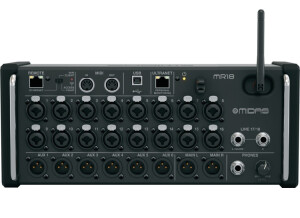
    I bought this compact gear as part of a sound system for my small, 5 to 7 band with several acoustic instruments, drums and sax. I own the RACK XR 18 version. Really small, but a huge result. The 6 aux sends to send whatever signal you want to monitors (I personally opt for the Ear Monitor, with added stereo ;) ) although the headphone out to get the master signal could be enough in many cases. The wifi sound management from the stage using a Samsung tablet or PC is great… I precise the PC software has a visual signal routing quicker and more logical compared with on a tablet, although the latter’s graphical resolution is better. Otherwise, a PC with a 50 meters cable can do… No more hums emanating from low-quality multi-pair cables sensible to light dimmers… Our rehearsal setup can easily be transported for small performances. The presence of effects, EQs and other useful features such as BBE or PULTEC emulations is great… Per-channel compression, FX sends… there’s plenty in it. As a result, our entry-level monitors sound fine because we can “draw” a worthy equalization without losing one’s earing… Yet I still favor the Ear Monitor, as less monitors means more room available, less feedback issues and a better overall sound, plus the bright musician ceases to call for the sound engineer every 2 seconds or so to express his needs regarding his monitor (here, just DIY). Recording our rehearsals or shows has become so easy… My sole regret is the lack of any opening to something bigger. I wish there were AES50-style connectors to patch the ins so a sound engineers gets what he wants for his front signal, which makes all the difference with the 32 model… “Caution, the XR18 tends to heat a bit even with its integrated fan”, so allow some room for the heat to evacuate properly. At such a price… GO AHEAD AND GET IT!!! I’m not disappointed to have a USB interface mixer with “by MIDAS” that I can put in my glove compartment. And frankly, it’ll soon be a real standard… 06/03/2015 update: The latest software update is great, clearer and a more coherent routing with the PC version… Better GUI and it works better with my old Samsung S3 too. It’s enormous! It’s so good that I’d do that choice again, or maybe I’d get a X32. Now that I’m used to some of its subtleties it’s great to be able to equalize each monitor with additional RTA to avoid feedback. Don’t look further: if it sounds bad, it’s either because of the band or your ears, not the gear. 09/28/2015 re-update ! Network use with a dual band ethernet & wifi router, which means : - A virtual front engineer PC-linked with a 50m cat.5 ethernet cable, the whole for under the €100 mark – so no more heavier, bigger multi-pairs - 5 additional connections from tablets with X Air Edit so everyone manages his own stage monitoring volume (but it’s more difficult for some, it takes a certain know-how, it’s an eternal debate between generations) – so no need for a €300 PM16 interface. I found the setting on the address below. - and of course, you keep the possibility to get a 16-track recording of the whole http://www.face.be/content/files/manuals/Behringer/FACE_User%20guide_XR18%20usage%20with%20external%20router.pdf So, it’s just huge !!! To be even better would mean an additional ethernet/AES 50 interface to please the sound engineers equipped with a X32 so as to leave them something to do, or an ADAT in to add more tracks for I use all of its inputs.

  • « SSL Matrix »

    Hi, I owned this mixing console for 3 years. It was interesting to have and learn to use such a hardware. I personally consider it to be for knowledgeable and experienced users only, as it's not that easy to use at first and it took me a long while to learn the basis. Granted, I'm not a veteran sound engineer but rather the self-taught kind. Yet... even experienced sound engineers who came at home made me the same remark. With this review, I just want to warn everyone who would consider buying this mixer. I consider this mixing desk as a beautiful, very efficient and advanced control surface, with high-quality analog summing, yet quite pricey... Do not forget that this device's channels include no preamp, equalizer or compressor, so keep in mind the additional cost this lack involves... And, don't forget the price of cables... So keep it all in mind before building your system around it, so as to determine if it suits your needs, workflow and what you can afford. As far as I'm concerned, if I were to do it again, I would choose an analog console with preamps, EQs... Plus, I'd get additional preamps, compressors and other gears.

  • « Well-designed, practical and innovative!!! »

    Well-designed, compact and sturdy, this is really a well-thought device! The box is very classy, reminds of Apple products and gives a positive impression of the whole which is only confirmed when using it! You can instantly feel the care that was given to designing this product. I’m still a bit more reserved as to the cover which I can only hope won’t degrade with time. It looks soft as peach with a very classy matte aspect. The faders and 4 white wheels look like rubber and are pleasant to touch, hopefully the white won’t fade but only time will tell. The Master fader could have been bigger to allow for a better output volume control precision. There’s a “Fine” setting, still I consider the fader could have been bigger. For live, I believe I will adjust its position with the K-Mix Editor app instead of using it directly – we’ll see… The device is class compliant so no need for a driver, this is one of the reasons why y chose it. It works right Out of the box (MIDI and 10out/8in audio) with MacOSX Maverick, El Capitan, GNU/Linux, iPad Pro/Mini4/iPhone5S. It’s very compact but not too small, it can take place on the left or right of a Pa4X 76 or Korg Kronos 73 without risking to fall. The osund seems to be nice, but I’ll tell more after a more thorough testing and listening. I’ll complete this review after a few days using it So here we go, after a few hours using it, Soundwise: no problem, it’s great. As I’ve worked with an RME UCX, i’d say it stands the test. Compared with my tiny Echo Audio2 USB interface, I’d say that the Audio2 sounds rounder and nicer. I’ve never compared them thoroughly in that regard, but that’s how I feel so far (I felt the same with the RME UCX). The EQ: it’s a nice surprise, very useable and rather efficient, unlike what Mackie does these days (I have a Reack powered speaker which EQ section is really crap). The Compressor/ Gate: it’s also a nice surprise, it’s very good considering it’s an included DSP Use: I was afraid it would turn out complex to use, but in the end all appears quite logic and the small LEDs indicating the parameters here and there help to find your way, the whole is easy to understand. We’ll see what it gives for live use… The faders and four wheels are not very finely precise, but that was to be expected – this is exactly why there’s the “Fine” mode for adjusting more precisely. It’s a bit disturbing at first, time will tell how fast (and if) I get used to it. However, using it with a computer and the K-Mix Editor software which controls the K-Mix allows for more precision using the mouse. As a whole, it does the job and i consider this small mixer to be really efficient!

  • « I'm very happy with it ! »

    In what context do you currently use this product? I've been a live sound engineer since 1978 and I use it for that purpose on a regular basis. How long have you used it? For a few months now, after trying the X32 Standard several times. Have you tested other comparable or competing products before purchasing this one? Yes, I've tried almost all analog and digital mixers on the market! What are the pros and cons of this product? Pros: Value-for-money-for-space ratio Very complete features Internal effects Remote controllable from an Androd tablet Ergonomics and capacities (it's the first time a mixer allows me to do whatever I want or so) 22 ins/14 outs (considering AUXes) + the ability to add more through the S16 rack (16 ins/8 outs) Cons: Well, there's nothing I can think of... A 24/96 version would be better? Oh, I got one: the "Combinator" (multiband compressor) and reverbs can only be used on the first 4 effect slots, the following 4 are reserved for EQs, dynamic processors, enhancers and so on... I've only used it for a few months but I'm really having a great time and can record my shows on 24 tracks. I also use in in my home studio as a USB sound interface (22 ins/14 outs) with very low latency. Here's my opinion on it... Marc

  • « Small but mighty »

    Just received it and gave it a quick try. It weighs under 6 lbs, I got it to replace a xenius2222fx mixer, 2x15 and 2x31 equalizers, a stereo compressor, all in a flightcase + current supply. I use it for our rehearsals and shows. Here's our setup: drums backing track, singer, two back vocalists, acoustic guitar, electric acoustic guitar and mandolin on the pedalboard out, keyboard and digital piano. Buss send to return through a parametric EQ for feedback-taming purpose. The XR12 has a professional look, it resembles a patch bay. It's very small but I put it in a a short-depth 19" rack for its safety on stage. We got extra effects that we can also use as inserts. USB-only playback (wave files, 48kHz), recording on 2 tracks, really nice. Soundwise, nothing wrong as a replacement for a mixer of the same brand. Pros: it allows to gain space, weighs less, features wireless, and if you're switching from a small-sized rack you're gaining extra effects. Cons: none so far, but we'll see if future updates through the x-air app and the xr firmware cause no issue in the future. Also to be seen whether controlling from a tablet isn't a problem for outdoor daily shows. Have a nice time playing, Elwood

  • « Compact and effective »

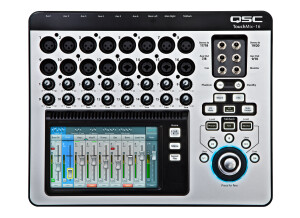
    ° What do you use the product for and within which context? We just bought this console for our trio and occasional sound reinforcement of an 11-man troupe of singers/musicians. We are amateur, I must add. We use it in the studio for rehearsals and for live gigs (2 vocals, 1 acoustic-electric guitar and 2 keyboards, including an arranger for the rhythmic foundation) * How long have you been using it? Since Wednesday December 3, when it came out in France. * Did you try out any other competing products before buying it? No. We made a decision based on the tech specs and our confidence in the QSC brand. We have a Soundcraft GB Rack + all peripherals * What are the things that you like the most and the least about it? The size and weight!!!!! No more breaking your back with racks. It's well designed and the interface is very simple (it's like a Mac: You think, you press and it works!). The display is easily readable. You select what you want to modify and set it with the finger. The rotary push-knob is very precise because when you turn it while pressing you can make finer settings. Everything is well thought-out! I have the impression that the output gain is high. We are no experts when it comes to compression, etc., so the presets are very helpful. At first I thought it only had 4 effects, but each of them provides lots of options, and you can customize them. It has lots of controls for the aux returns! Low-cut, high-cut, etc. anything you wish! Jack for headphone monitoring, which is nice. For the time being, this console has won me over. I set it up for my keyboards, put it in the transport case and the vocalist/guitarist was able to do the same at his place. Awesome! I'll update my review after a couple of live gigs. I don't know for pros, but it's great for experienced amateurs.

  • « Very good! »

    Nothing to add here!! UTILIZATION I think this is its main strength: In concert, everything can be accessed quickly and intuitively, there's no need for a manual (which is only available as PDF). You can access the dynamics section quickly, the EQ benefits from a very practical analyzer, an "assign" block lets you freely configure 12 pots and 24 buttons (distributed in 3 banks) to the parameters of your choice, intuitive "bus sends" and "DCA" sections, comfortable scene management and fast FX management. The list is long, just to say that it's a pleasure to mix with the X 32. SOUNDS Regarding sound, it's hard to say, it may have some issues in the high end, but I'm really satisfied with the overall sound (post-EQ). OVERALL OPINION I've used it for 2 months (in concert and studio) and have no complaints. Yes, I have used lots of other models in the same price range as the X 32 and also at much higher price points. If I had to choose between he LS9 and the x 32, I'd take the x 32 (despite preferring the yamaha preamps). The hardest thing for me was to trust its reliability, I hope it was a good choice. It's also not easy to convince bands to use this mixer, but every single one of them has been satisfied and even seduced by it. I have to explain many new bands that I do FOH for that Behringer has released a good product, etc., etc., which is a negative point (to talk to someone and say: "My mixer? A Behringer!" is not easy) In my opinion, this mixer is for concerts, but it is also quite useful as a soundcard. You can do multitrack concert recordings without a sweat, the send-return connections with the DAW are relatively comfortable, recording on a USB is practical for rehearsals, I'm thrilled with the possibility to mix on a tablet (it's awesome;) ), both to control the monitors and to mix when the console is hidden in a dark and dirty corner of the venue (it spares me having to go back and forth from the center of the venue to the console and then again to the center of the venue and back to the console. It features a practical built-in talkback mic on 2 assignable channels, the delay and reverb effects are good (but be careful not to change certain parameters live because it's not very smooth), the 31-band EQs are a bit weak, in my opinion, but the EQs on the channels are very good, plus, it also features an oscilloscope and noise gate. Unbeatable value for money IMHO, I never would've thought I'd get such a console at this price.

  • Audiofanzine FR's review

    (Originally written by pilip/translated from Audiofanzine FR) See manufacturer's website. UTILIZATION Versatility. SOUNDS Very transparent (preamps, EQ). OVERALL OPINION I used it for two months. High-quality mixing desk. I've tested lots of mixers (Mackie, Allen, Yamaha, Soundcraft, Behringer...) I wanted to write this review to say that this high-quality, but not extraordinary mixing desk, is EXCESSIVELY EXPENSIVE! For example, 4 of the 6 aux's are not pre/post switchable, subgroups don't have VU-meters, channels only have one signal LED (3 or 4 LEDs wouldn't really increase the costs that much and they would add a lot to the mixer), no EQ ON LED, short and not very pleasant faders...!

  • « A good choice for small to mid-sized studios »

    An analog mixer with an in line setup, which allows a direct out to the recorder from each in/out module. However, the mixer features 8 busses, which are repeated in block (1-8, 9-16, 17-24 and so on) all along the mixer and can be used with just any multitrack provided you don’t need more than eight subgroups. Each channel goes into the multitrack’s corresponding track, or to another through the eight subgroups – as for the monitoring it’s done through the track’s corresponding channel, obviously. This mixer includes – among other things – an input/output module featuring a noise gate, plus a double stereo module, or a double line in module, and all this can be combined in chassis featuring 20 to 52 ins. The mixer that I’ve used features 44 inputs. Other features will be developed in the next part. USE High quality commutators offer a nice course, but the LEDs are too sparse to my taste and makes getting a global vision difficult: the only LEDs on the in/out module are the Gate On, PFL, mute, solo, peak and active channel indicators. The faders feel soft and the knobs relatively soft too, they’re larger for more frequent tweaking such as pan setting or monitor level, and nicely color-coded. The color code is also features on the Bounce, Extra Effect and Reverse Fader switches, which are yellow while their send, buss and sub counterparts are in a pale shade of purple. Using the mixer remains quite simple, now let’s see in details its most important functions. 1 inputs: Input gain is controlled using a double concentric knob for the line/mic in and multitrack in. The mic in will only work if the line switch is up. Switches are here for phase inversion, and a 100Hz high-pass filter. There’s also a purple knob labelled “sub” (bus to channel) which sends the subgroup affected to the channel to the recorder’s corresponding track, with the channel then working as a subgroup “master” control (ala SSL). 2 the Noise Gate: Like on every nameworthy studio mixing desks, each in/out module features a noise gate which can easily be assigned to any signal path (or input). Three knobs allow to control a bandpass filter (ranging from 70 Hz to 4kHz), a threshold and a release controls. The release control can be held through a control named… HOLD, so as to work like a sustain control for up to 2se with a release time fixed at 0.1s. A 15dB or 60dB attenuation can also be selected using the Range switch. There is also a Flip switch which allows to start the noise gate from the other signal path in the modult to that where the gate is, like on the Neve VR 60! Hallelujah! 3 the equalizer: The EQ section is divided into two parts, with a HF+LF part and a HMF+LMF part, each being separately switchable to the whole audio path. The rather subtle HF and LF controls deal with the 12kHz and 60Hz frequency areas, with +/- 15dB. The LF’s asymmetrical curve allows cuts with a radical, steepest slope, while the gain setting’s slope is way softer. The 600Hz-to-12kHz HMF and 100Hz-to-2kHz bands allow for +/-15dB, unfortunately without a bandwith setting, resulting in a gain on a larger band and a cut on a narrower band. There’s a practical reason though, as you’ll often go after suppressing a very specific, localized fault in the sound, while making the sound better generally requires a wider band approach – so as to confere more brightness, for instance. 4 Auxs: 6 aux sends can be found, with the first being a stereo aux. Auxs 1 and 2 can be switched pre- or post-fader, as well as to any audio path. The others are fixed in the monitor path and are of course post-fader only, their main aim being to feed the monitors and studio monitoring effects. This lack of routing can be bore with, even if mutes are still missed to send a vocal (or other) detail to a delay line. Using a Tape Send out through a XFX (Extra Effect) control is possible if need be, like an extra aux send, as this feature attaches the channel’s volume to the monitoring level, which IMHO makes it a source for problems. 5 assignations: The channel faders come with routing controls, which won’t surprise anyone – not at least thoses used to use a mixer. So, these routing controls go towards the main mixing buss and the eight subgroups that are paired on four switches, through the channel’s pan control. There’s also a bounce switch which bring the recorder’s monitor out back to the mixing busses. There are also XFV and REV Buttons which allow reversing the linear knobs. Each of the eight busses is placed repeatedly on each 8-channel group, with a “bus” button controlling it. Group 7 goes towards track 7 – or 15 if “buss 7” is set on channel 15 – no trap here. Another button located just under it then allows to listen to the group’s mix on this channel, sending the “Tape Send” signal to the studio monitor buss – nothing unusual here. 6 The master section: Of course, this section is very simplified compared with big studio consoles. No automation here – not on the model I’ve tested at least. Two big VU-meters can be switched on control either the main mix or the currently selected tracks, which are signalled permanently by two 20-point LEDs above the master section. The six aux general levels have their own “AFL” each, and the aux 1 features a mono switch. A 6-frequency oscillator can be can be routed to the mix or busses. Two keys allow to set the AFL or PFL mode for one, and the SOLO status for the other one – that is interrupting or not the signal’s path in the mixing busses of the whole mixer, with small yet very bright LED indicators! Of course, there are AFL/PFL and overall volume controls, with a “dim” control. Monitoring can be done in mono or through two sets of monitor speakers. Selecting two 2-track recorder controls with the main mix is also possible. These three monitoring sources can be introduced into a “foldback” headphone monitoring buss, which I personally find both clever and practical. The “foldback” section takes its sound from the main monitor section, and features its own output level, AFL and cut controls. SOUND Here we come. First of all and to be totally honest, I must mention that the mixing desk has been entirely refurbished by highly competent people, that I don’t own it andthat it was chosen by a studio wanting to offer a third desk. Let’s start with the beginning: the preamps are rather good, they only bring little hiss and allow for a great sound dynamics. The EQ is pleasing and works well, but the combination of both sections don’t make what I’d call a first-class equalizer. Once again, I must mention that I am comparing this Sapphyre with the studio’s other console, an Amek 9098i, and.of course there is little if any ground for comparing – the budget is not the same either. As for the equalizer, it is adequate and efficient but it is not awesome and lacks a bit of subtlety, which is quite surprising at first from a Soundcraft. OVERALL This mixer is mostly aimed at a musical use, and i believe this “small” analog console to be a good choice for small to mid-sized studios looking for a worthy analog mixer. This console is quick to get used to and quickly adapts to tracking sessions. For a refurbished 44-input mixing desk, the 11,000 € investment that was made seems to me both reasonable and adequate. It’s a good analog console with great performances, but stripped-down features. Please keep in mind that it’s not an SSL, Neve or Amek, so don’t expect it to be – there’ll be differences and lacks compared with such other models, obviously.

  • Audiofanzine FR's review

    (Originally written by plastok2/translated from Audiofanzine FR) 24-channel inline mixer with 6 aux, 8 groups, 8 FX returns, 3 stereo inputs, 2U rack PSU, blah blah blah!!!! Plenty of input channels: 24 + 24 + 8 stereo + 8 stereo ........... UTILIZATION Can be used for recording and mixing. Easy to use. It has talkback, switchable solo-in-place / PFL (24 holes at the bottom give you access to the Solo/PFL switches for each channel). SOUNDS Best of all is the EQ, I didn't expect such an incredible quality. Listen to the sound of the EQ between 4 kHz and 6.3 kHz where it normally sounds awful!!! The EQ sounds very smooth with a nice bottom end. The preamp is also great. If you crank it the sound becomes fuller without adding noise, you only get a nice distortion, the mixing console breathes... The signal summing is good even though the main output is via balanced phone jacks, which don't seem to be as reliable as a pair of XLR's! Real analog sound. OVERALL OPINION Very good manufacturing. The knobs have a very nice feel, much better than the faders. The EQ is fabulous. This console would be perfect, even if the price went up a bit, if it had: - a complete balanced architecture - real good faders

  • « A huge analog sound! »

    This “old French lady” (according to Réditec) has graced the best days of disco and the best productions of the 70s and 80s. If well taken care of and as is, it will stand tall against any middle-market or even high-end digital mixer (think 02R Yam, Tascam and so on). If you’re after pure technical prowess, the 1604 is obsolete, however if you want an organic sound and the most important basic features, then the 1604 will undoubtedly make your ears happy beyond all your hopes. And, most important, it will perfectly do the job! Considering that instead of a (now too expensive) tape multitrack, a desktop tower with a correct sound interface (Marian Seraph 8, Rme fireface, etc.) in each track’s send and return will live up to its expectations. If I could afford it, I would have another built to the exact same specs but in a 32-tracks version and with stereo effect sends. The manufacturer also produced an 8-track block which corresponded to half the mixer and could be plugged on the 4 busses to turn the mixer into a 24-track model. It’s now very hard to find (I’m willing to buy one, just in case!). I’ve just finished refurbishing it, and it’s a certain thing that what I’ve heard coming from it in the last few days will be enough to keep me away from digital mixers for a long, long while. Enjoy!