Log in
EN
FR

Waves Software EQs

26 products found

Categories
Series
Filter
Sort by
Waves
Evaluation
  • Reviewed or not
  • Editor’s award
  • Reviewed by Audiofanzine
Availability
  • Available or not
  • Sold new or used
  • Sold new
  • Sold used
Must-have products
  • All products
  • Flagship products
  • Best rated products
  • Hot products
  • Popular products
Price
  • Freeware
  • Low-cost (< $50)
  • Mid-range ($50 - $90)
  • Premium (> $90)
€
Clear
Sort by
  • Popularity
  • User ratings
  • Price - low to high
  • Price - high to low
  • Used price, increasing
  • Used price, decreasing
  • Name (from A to Z)
  • Name (from Z to A)
  • Added on
Choose a category
Selected category: Software EQs
Sort results
  • Popularity
  • User ratings
  • Price - low to high
  • Price - high to low
  • Used price, increasing
  • Used price, decreasing
  • Name (from A to Z)
  • Name (from Z to A)
  • Added on
Filter results 26 results found
Brands
Evaluation
Availability
Must-have products
Price
  • Freeware
  • Low-cost (< $50)
  • Mid-range ($50 - $90)
  • Premium (> $90)
Show results

The best Waves Software EQs reviews

The reviews Audiofanzine members found the most helpful.
  • « A Good plug-in with all the needed features »

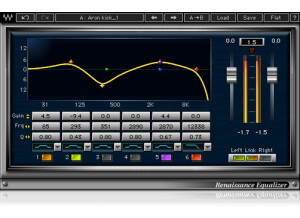
    As always, please, please do yourself a favor and make sure that the software that you purchase is compatable with your system and recording software when necessary. Otherwise, this software in no more difficult than any other to install or to begin using. Manual? Well, if you really need a guide book to enlighten you to the mysteries of using EQ, such as Q and high-shelf, low-shelf, etc., then you really need to put yourself back into school. Overall, the Renaissance EQ is fairly easy to use and all of your typical options and adjustments are easily accesible. SUITABILITY/PERFORMANCE Yet again. It is your responsibility to ensure that the software products that you purchase are all compatable with your hardware and yourself. End of Story. The Waves REQ series are widely compatable with alot, and I mean it, ALOT, of existing programs. You shouldn't have much trouble. Performance wise, the Renaissance series of EQ's are not huge CPU hogs. You, again, shouldn't have many problems, if at all. The Renaissance EQ has been a LONG TIME staple of Waves'. I personally have been using their slightly less pretty version of the REQ since about 1999. OVERALL OPINION The Renaissance EQ series was essentially created to be able to model a wide variety of vintage EQ's. Some being much sought after units and some being rare units that only a few engineers were partial to. That being said, the REQ series are extremely versatile, once you get a hands on chance with the options and possibilties of the REQ's you will see just how handy these guys can be. The Renaissance EQ's and the brethern compressor have been offered as a bundle and they have also been included in many Waves bundles. I encourage you to go ahead and buy them bundled, with whatever other plug-ins you desire, and at whatever cost you can afford. Waves' software really is the best, so bundling is always a good idea. For the most part the REQ series doesn't seem to color the sound in any depreciable or negative way. Really, it seems as though your own adjustments play the most significant role in how the plug-in responds to incomming sounds. This is not entirely uncommon, there are many different EQ's that seem to react differently according to source information and user settings. Chalk it up to the nature of how many older "vintage EQ's" were constructed and the technology available/used and the concept has a certain logic. Keep in mind that the REQ series, among others, were designed to mimic the performance of many sought after vintage EQ's. The Renaissance Eq's are a guaranteed solid choice. You should have these in your arsenal.

  • « quick and easy to install »

    Installing Waves q10 was quick and easy. I had no compatibility errors and it has been running smoothly since I installed it. The interface is extremely easy to follow and there is really nothing complicated about this plug-in. I don't have a manual so I can't speak to how useful it is or not. SUITABILITY/PERFORMANCE I run the Waves q10 on my Mac Book Pro with a 2.2 Ghz Intel Core 2 Duo processor and 4 GB of RAM. I use it in Pro Tools LE 7.4 with a Digi 002R audio interface. It has always run flawlessly on this set up and I am able to run a few of these at once. It is a simple plug-in which doesn't take up too much of your processing power and is a great sounding EQ as well. OVERALL OPINION I've had this plug-in for two years and it has become a great tool in my arsenal as far as equalization goes. The ease of the interface makes it easy to do what I want it to do. The sound quality is good and it is definitely a good option when looking to use an EQ plug-in. I have used it on everything from vocals to drums. It also sounds good on electric guitars. In terms of drums, I like it on all types - kick drum, snare drum and tom toms, as it is easy to manipulate and get the sound I am looking for. While I use it mostly for these applications, this is a good overall EQ and can be used on just about anything you'd like. It is comparable to the Digidesign EQ III plug-in that comes free with Pro Tools, but it a little better sounding to my ears. While it isn't free, it is sold at a cheap price and is worth it to me to have another option like this in my DAW - this is definitely worth a look.

  • « Vintage style EQ »

    The mixture of vintage sound with the precision, reliability and response of digital stuff is always something that software engineers in the music industry are working to achieve. This is another vintage style EQ that Waves has made to help people get that vintage sound without having to buy the unreliable equipment. This is actually a clone of the 1066 and 1073 console EQs. It has a knob for different settings of the high pass filter, a knob for the LF shelf filter, MF bell filter knob, HF shelf filter, output knob, analog on/off switch and eq/phase switch. To enable this, simple call it up in your DAW on whatever buss you want to EQ. I tend to EQ first before doing anything. I never read the manual, but this is so simple that it's not needed. SUITABILITY/PERFORMANCE Waves is really one of the best companies out there when it comes to implementing solid plugins with no real fuss. These plugins are always rock solid and super stable; this plugin is really no different. I've never experienced a single crash or hiccup while using this plugin. The plugin is also cross platform compatible, so Windows and OS X users alike can use these without any problems. There is one issue that I always gripe about, however. These plugins are 32 bit for OS X. Right now, I'm using a 64 bit DAW, and for me to utilize these plugins, it needs to launch a special bridge application. I'm not a huge fan of the way my DAW utilizes these, so I'm hoping they update these in the future. I've been using the Waves Mercury bundle for the past six or so months, and it's been a very enlightening experience to say the least. OVERALL OPINION This isn't exactly the most versatile EQ out there. It's more geared towards getting that vintage console EQ sound for those finishing touches more than anything else. It works fairly nicely, but I find myself just reaching for the default EQ whenever I want to EQ stuff. It's just easier for me to work with a paragraphic style EQ than working with these old school turn knob EQs as I was brought up in the digital age of recording. Good quality but not exactly something I'd use on a daily basis.

  • « Interesting master buss finalizer »

    Tony Maserati is one of the top music engineers and producers. He's done stuff from the Simpsons to Tupac and nearly everything in between, but his major focus tends to be on the more R&B/rap/rock side of things. Finalizing mixes can be a huge pain, and for a plugin to have everything packed inside of it is quite a task. The plugin has knobs for sensitivity, output, lows, mids, highs and compress. There are also buttons for drums room, drums live, guitars, strings, keys, background vocals and master. To use this, simply enable it on your master buss, and you're good to go. I've never read the manual, so I can't comment on that. However, this plugin is fairly straight forward and shouldn't cause to much of an issue for first timers. SUITABILITY/PERFORMANCE Waves is the king when it comes to things such as stability and overall performance. For one, this plugin doesn't take up too much RAM or processing power, and that's a big plus considering a DAW can have tons of different plugins and virtual synths running at any time. The plugins are all cross platform compatible, so anybody with an OS X or Windows machine can run these without any problems. I've never experienced a single issue while running this plugin when it came to things like stability and overall performance. There is one issue, however, that I did come across. These plugins are 32 bit inside of OS X. For me to utilize these in Logic Pro, it needs to run a special bridge application as my DAW is a 64 bit DAW. I'm not a huge fan as to how Logic Pro implements this, and I'm hoping that Waves updates these later on. I've been using the Mercury bundle for the past half a year or so, and it's been awesome. OVERALL OPINION Trying to make a special master buss finalizer plugin can be quite a big task. While my favorite is still iZotope's Ozone, this plugin doesn't do too bad of a job. I've used this with my power metal band without an issue. It doesn't really work out too nicely for my death metal bands, but that has to do with the way it processes everything; it's just a different approach to mixing that doesn't seem to really work for that genre.

  • « 10 band EQ »

    This is yet another EQ that Waves has made. This time, it's modeled after the famous graphic equalizer of the time. There are ten different EQ bands on this ranging from 31 Hz to 16KHz. On top of that, there is a Q control that can either widen or narrow the overall filter band. The moment people see this, they're going to mention its versatility. Yes, it's more versatile than the other ones. However, the other ones were more parametric EQs where as this is a graphic EQ. I find that this can work awesome for boosting a guitar signal into overdrive by applying it before the amp modeler, but it doesn't have that vintage EQ character that I enjoyed from the other ones. SUITABILITY/PERFORMANCE Waves plugins are some of the best out there, bar none. For one, they're cross platform. For a Mac user, that means the world. I'm always trying to support companies that support Mac, and Waves has been pretty good about that since the whole Intel switch. I've used these in Logic without any problems. Although they're 32 bit plugins, Logic will add a bridge to allow you to use them in a 64 bit environment as to not limit you to the amount of ram you can utilize. On top of that, these things are rock solid. I've never had a crash with Waves plugins at all. OVERALL OPINION In one way, this EQ is a bit more versatile simply because it's a 10 band graphic EQ. On the other hand, I find myself using the API 550 series more because they're closer to parametric EQs, and they tend to be better suited for guitars and the such. However, this is still a great EQ, and I recommend you check it out if you ever get the chance. Just be sure not to pirate these as Waves loses enough money as it is thanks to the pirates out there.

  • « 3 band EQ »

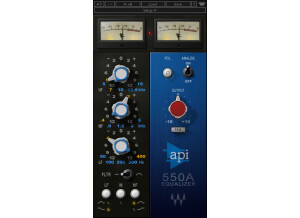
    This is a pretty versatile EQ that Waves offers. It's a three band EQ modeled after the API 550A. There are 15 points of boost that are divided into three different ranges, and they are selectable in five different steps. The high and low frequencies can be selected individually, and you can choose between either peaking or shelving, depending on what you're looking for. You can also have a band-pass filter that can be inserted independently from all the other settings in there. This EQ is pretty nice compared to the other vintage EQs because it's very versatile. Because of that, I found more usages with this plugin than I have with their other vintage EQ plugins. You can choose a wide variety of sounds thanks to its versatility, and despite it being a three band EQ that is limited to notched frequencies, it can work nicely on vocals, guitar, bass and even drums. SUITABILITY/PERFORMANCE Waves plugins are some of the best out there, bar none. For one, they're cross platform. For a Mac user, that means the world. I'm always trying to support companies that support Mac, and Waves has been pretty good about that since the whole Intel switch. I've used these in Logic without any problems. Although they're 32 bit plugins, Logic will add a bridge to allow you to use them in a 64 bit environment as to not limit you to the amount of ram you can utilize. On top of that, these things are rock solid. I've never had a crash with Waves plugins at all. OVERALL OPINION This is one of the more useful EQs that Waves has created, in terms of vintage EQs, at least. I found quite a few usages for this, where as some of the other ones were a bit geared more towards classic rock. Applying these to some slightly overdriven guitars give it a real vintage-esque EQ sound that can make the mix really pop out. Using it on vocals can give it all kinds of neat effects, too. Try it out.

  • « Vintage midrange EQ »

    This is another part of the set of plugins that Waves offers. This time, it's a midrange EQ based off of a vintage model. The MEQ-5 is a real cool plugin that can be used on vocals, guitars and even drums. The EQ itself gives you a few frequencies you can boost or cut, and it also has some other tricks up its sleeve. For one, you can control the mains. This introduces different hum for that ultra vintage sound. There are two peak switches and one dip switch. This means you can really taylor that midrange frequency to whatever you want. However, it's still limited to whatever the notches are. Because of that, it's not the most versatile EQ out there, especially considering its narrow overall band. SUITABILITY/PERFORMANCE Waves plugins are some of my favorite out there. First of all, they're cross platform, and as a Mac user, that's a huge plus for me. The plugins are always rock solid, too. They perform amazingly well, take up very little memory and play nicely in Logic. While they're 32 bit, Logic applies a bridge that allows you to use them in 64 bit environments. This way, you get the best of both worlds -- you can use these 32 bit plugins, but you can still access all the precious memory that the 64 bit environment needs. I never read any of the manuals, so I can't comment on that. OVERALL OPINION This is a pretty cool plugin to use on vocals, guitars and drums. You can get a real unique, vintage sounding EQ going on, complete with all the artifacts that they come with. However, it's not nearly as versatile as today's EQs. Because of that, there's a limited application to this. Some might not find it that usable, and because of the price, it's kinda hard to warrant it. That said, it sounds great.

  • « Puig EQ »

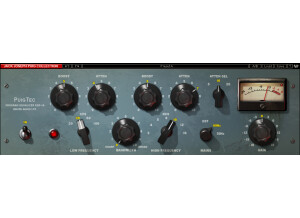
    This Waves plugin is pretty famous as it's modeled after the Pultec EQP-1A. That's been a very famous EQ that was used on records from Black Crowes, Weezer, Panic at the Disco and more. It's unique in that it can boost and cut the same frequency at the same time, so you can get all kinds of cool EQ curves going on. This plugin models that very EQ that was made so famous throughout the years. There are quite a few knobs on this, but they're all fairly straight forward as to what they do. You select a low or high frequency, and then you turn the dials to boost/cut it. There's also a bandwidth knob which adjusts the "Q" control of the EQ curve. This makes it sharper or broader across the EQ spectrum. Finally, there's a gain and attenuation knob you can adjust to fine tune everything. SUITABILITY/PERFORMANCE Waves plugins are some of my favorite out there. First of all, they're cross platform, and as a Mac user, that's a huge plus for me. The plugins are always rock solid, too. They perform amazingly well, take up very little memory and play nicely in Logic. While they're 32 bit, Logic applies a bridge that allows you to use them in 64 bit environments. This way, you get the best of both worlds -- you can use these 32 bit plugins, but you can still access all the precious memory that the 64 bit environment needs. I never read any of the manuals, so I can't comment on that. OVERALL OPINION This is a pretty unique EQ thanks to it being able to cut and boost the same frequency. You can get all kinds of killer tones out of it because of that. However, it's not that versatile in terms of what you can actually cut or boost. You're limited as to what frequency the program allows, and that can be a bit of a pain. I tend to find myself using Logic's built-in EQ more than anything, to be honest.

  • « Useful EQ plug-in that mimics the SSL eq »

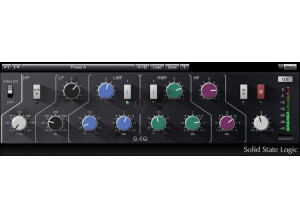
    This is a plug-in version of an SSL EQ. It attempts to be a replica of a real SSL EQ and I must say it works extremely well. There weren't any compatibility issues with this one for me, I received it as part of a Waves bundle, and like all the other plug-ins in that bundle it worked fantastically well. I haven't read the manual for this plug-in but it's simple and straightforward enough that it doesn't really require one at all. It's got a pretty basic setup, and installation is a breeze. The functions are really easy to use. SUITABILITY/PERFORMANCE This plug-in has a pretty great interface. It's simple to use and is preferable sometimes to using the entire SSL channel, as you only really need the EQ. It acts a little bit brighter than the normal SSL channel as it's the G series, which was known in its time as a brighter channel strip. It works perfectly for me. The EQ is four-band (low, low mid, high mid, and high frequencies. There is a knob for gain, a knob for frequency, and a width knob for each band (although the low and high frequencies lack this last knob). This gives you control over how much to amplify each frequency, how wide or narrow the frequency that you are affecting is, as well as which frequencies to affect. It's versatile enough to work really well. Other features include a high pass filter, phase switch, and EQ bypass, which is useful if you just want to flip phase. There's also an analog switch, which gives the sound a more classic feel, and is sometimes useful. OVERALL OPINION I think this is a great sounding plug-in EQ. I like working it as it feels a lot more natural than some of the visual EQ plug-ins I have used, and has a tendency to narrow down the sweet spots more easily. Having used some SSL outboard gear, I know it doesn't work exactly the same way, as that's impossible, but I am surprised at how well it mimics the outboard gear it's based on. It's not that expensive as part of the bundle, and as their bundles are worth getting for almost all the plug-ins that come with them, I'd have to recommend it.

  • moosers's review

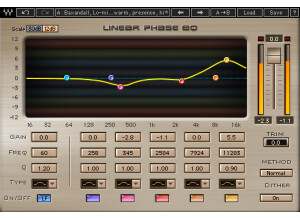
    The Waves Linear Phase EQ is a mastering and mixing equalizer plug-in that comes with just about all of the major Waves bundles. We've got this at the studio where I work and I've also got it on my home's system. It's one of Waves' kind of standard plug-ins, as you've got it if you have any of the big bundles. Installing it happens when you install the full bundle, although I'm not sure if it's also available individually. The interface of the plug-in is easy enough to follow, as it's a simple parametric EQ with five bands. Each band has parameters for gain, frequency, and Q, which is otherwise known as bandwidth. You can also set the type of slope you'd like to use, which is helpful for low and high pass filtering as well as for getting more precise in what you want to do in general. You can turn each band on or off as wanted as well. Lastly, it has built in dither and an overall output leveler. I haven't seen a manual for this plug-in, nor do I ever anticipate needing to see one. SUITABILITY/PERFORMANCE My home system has the Waves Linear Phase EQ plug-in currently running in on a native Pro Tools 9 rig. I'm running it on a Mac Book Pro laptop that has 4 GB of RAM and a 2.2 Ghz Intel Core 2 Duo processor to work with, while I've got Pro Tools running with a Digi 002R audio interface. It's enough for me to run this plug-in comfortably, although I don't use it on every track and really only when I'm looking for super precise control... OVERALL OPINION The Waves Linear Phase EQ plug-in is an awesome tool to have in any audio suite. It couldn't be easier to use and provides about as much control as you can ask for in a parametric EQ. It has a super clean sound quality that would be hard to top in another plug-in. Waves really is just about the best in the business when it comes to making plug-ins, and the Linear Phase EQ is a perfect example of their virtual craftsmanship. I'd highly recommend checking out this plug-in and the bundles that include it as any DAW is going to benefit mightily from having it.