Log in
EN
FR

Condenser Microphones

1515 products found

Categories
Filter
Sort by
Brand
Evaluation
  • Reviewed or not
  • Editor’s award
  • Reviewed by Audiofanzine
Availability
  • Available or not
  • Sold new or used
  • Sold new
  • Sold used
Must-have products
  • All products
  • Flagship products
  • Best rated products
  • Hot products
  • Popular products
Price
  • Freeware
  • Low-cost (< $450)
  • Mid-range ($450 - $1,000)
  • Premium (> $1,000)
€
Clear
Sort by
  • Popularity
  • User ratings
  • Price - low to high
  • Price - high to low
  • Used price, increasing
  • Used price, decreasing
  • Name (from A to Z)
  • Name (from Z to A)
  • Added on
Choose a category
Selected category: Condenser Microphones
Sort results
  • Popularity
  • User ratings
  • Price - low to high
  • Price - high to low
  • Used price, increasing
  • Used price, decreasing
  • Name (from A to Z)
  • Name (from Z to A)
  • Added on
Filter results 1,515 results found
Brands
Evaluation
Availability
Must-have products
Price
  • Freeware
  • Low-cost (< $450)
  • Mid-range ($450 - $1,000)
  • Premium (> $1,000)
Show results

The best Condenser Microphones reviews

The reviews Audiofanzine members found the most helpful.
  • « Excellent for the price »

    Condenser mic. A mic for all occasions, as long as you have a good preamp behind it. Very (or even too) clean sound, so pay attention to sibilants and HF, which can be hard to get rid of during mixdown. But let's be clear, for $120 you really get your money's worth. It's very simple: To have something really better you have to spend three times as much. It lacks a low-cut and a pad, but if you have a good preamp or mixer, you already have everything you need, so such features are useless for someone who has outboard gear. It has to do with the price, I think, because the manufacturer launched the same mic with filter and pad with a higher price tag. OVERALL OPINION I've used it for about a year in my home studio and I'm satisfied with it. Yes, I compared ii to many others, but it was the flattest and most versatile in its price range. You really have to go to the next price range to notice a difference that justifies the investment. Granted, it's certainly not a Neumann! Continuation: I used it this week in post-production to record a Japanese female voice. It was perfect. The production thought it was a high-end mic. Almost no background noise and a nice precision in the high frequencies to give presence to the voice off. I can confirm this mic can even be used for broadcast without the slightest problem.

  • « All-purpose, good performing mic »

    Very versatile, due to the polar patterns available (omni, cardioid, figure 8) and low-pass, as well as pad: You can record percussion vocals, piano and everything else you want, with the only condition that you need to have some time to test the settings: 3 polar patterns x 3 filters x 3 pads = 27 possibilities. Large-diaphragm, condenser mic, which means it needs 42V phantom power. To make yourself an idea, you can make simulations at Rode's website: You need to send a recording made with another indexed mic and then listen what it would sound like with the NT-2A and these or those settings. Nice and interesting, but you should always take the results with a pinch of salt — it's their site. They also have pedagogical videos regarding the capturing of sound. I have no shock mount, only a standard screw-on clip but the low-pass filters out lots of annoying rumble from the ground. It's practical and improves the recording, while also reducing the need for digital processing afterwards, like using a digital filter after digitization. OVERALL OPINION I have it since 2006 and I didn't test anything before: There was simply nothing comparable at this price point back then, I think. And I still think the same today. I use it with an MC200 Behringer preamp, and it sounds pretty good (even if I think the tube must be changed), or with a Toneport UX2 when it is in the mood for working, or even with my small Alesis USB mixer. It comes out clean and clear out of all of them, without any shrill, but you obviously need high-end hardware to get the best out of it. The pros: It is not only versatile, it is good and not expensive. It's even a bit too good: You can clearly hear the noises from the computer and even the fridge in the room next door. I'll have to isolate better my studio. The cons: I got mad when I saw that it is now sold with a shock mount for the same price. And you must also be careful with mic stands that are too light, since the mic has a considerable weight. I don't know if it's fragile, I have always taken good care of it. In hindsight, I'd buy it with the whole kit rather than having to settle for the mic clip.

  • « Excellent! An excellent value for money! »

    I find them excellent for: flamenco guitar, violin, viola, cello, overheads, snare (pads) condenser technology. OVERALL OPINION I use the sc 140 for 2 years already and I love it! You can really put them on almost everything! (Few static with a-10dB PAD AND to - 20dB!) I tried the sc 100, but soon one of two crashed. The sc140 kit bag is full. Bonnets, suspension, coupling bar, and even 2 "elastic" parts for suspensions. On my advice, 8 people have already been purchased it and have no regrets. I would repeat this choice without hesitation.

  • « Excellent for Recording Vocals Until... »

    I used this mic to record vocals and it initially gave a nice quality sound that was warm and clear. After a few months of using the mic, it started making a crackling and static sound that would come and go intermittently. I thought it might have been the cable so I purchased a high quality cable but the problem continued. I have had to do recordings with hopes that the static sound would not return while singing was occurring. I have had to redo vocal tracks due to the static sound manifesting during a recording and now the mic does not work at all. It's unfortunate that a mic with such an excellent build quality that initially generated a top notch sound no longer works. Lastly, this mic was in a stable environment (home studio) and handled with care. Here are some successful recordings that I did with the mic before it stopped working (all vocals were done using this mic). https://youtu.be/sXZAlQADiOk

  • « Good Mic but for the $$ Look around »

    I use this microphone daily at my studio www.chrislieckstudios.com. Here is my assessment of this mic. Clean, but not a U87 or even close. There are some major differences with this mic as opposed to other Neumann microphones. I like it for certain vocalists that have a great deal of dynamic control. If a singer is trained around a microphone and in a recording booth and has worked for many years with studios and recorded a great deal, I will pull this mic out of my collection. I don't use it if the singer is new, or a rapper, or a up and down vocalist that does not have experience or a great deal of knowledge about how to hit a mic the right way on high notes or louder notes. It has a real sensitive spot when it has a hot signal and it distorts way to easily. If you have a hot signal to the mic that is in any way cracking up, it does not take a beating on the input stage like a U87 or a U67. Great for Vocals and Acoustic Guitar. It is what we call a medium sensitive mic. Meaning if your vocalist is loud, it is rather sensitive. So if you are using this without a compressor on the front end, you will have to ride the input gain. I like this microphone a great deal but I am not sure for the money you could not pick up a few other mics that do the trick and have some money left over for a few other pieces of gear or plug ins that you would need. The sound overall is very warm with low level input. OVERALL OPINION I use this mic daily but it is not our go to microphone. I do like it for vocals but only if the singer that you are using is trained and knows how to work a microphone correctly. There are better dummy proof mics out there and to be honest if I were on a limited budget try finding the hand made Superlux on Ebay which is a copy of the U87. I do like it for Acoustic Guitar. I don't use it for much else. As for bumps in the EQ, it has one in the high mid. There are several uses for the mic but I only found it useful for vocals and acoustic guitars. I did not use it for anything else.

  • « Good Video Mic »

    These microphones are great for Video work, but not for videos that you need clarity on the vocal without any room noise. Remember you can use shoot gun kinds of microphones for kick drum and snare drums. We have done this for years at my online recording school www.comia.us., however I don't think you would use this for close or clear micing for a video. I would use a lavalier mic. I like lav mics for the real clear video audio. I used this mic for a recent movie and it was a bit low endy and harsh on inside scenes and a bit more noisy on outside scenes in this movie. If you are looking for a great video mic I would go with a more recognized professional mic. If you are looking for decent mic that would suffice for some inside scenes and some basic background sounds, then this mic would work just fine. I used it daily for a while but not for voice during a scene. There is a bump at about 50hz that is noticeable. I also hear a bit of noise. OVERALL OPINION Of the video mics I will review I think this would be in the top 50 percent. I like the clear sound for background video sound. If you are using it for voice in video look into some real expensive microphones that are specifically used for voice work. I would not think this would work great for any voice over or tracking voice in a scene for video. Other uses for a mic like this is for kick drum or a secondary snare mic. It has a narrow diaphragm and does not pick up any noise on the sides of the mic. That would be helpful in a hi-hat bleed drum set up. I use to use these on kick drums but now I find it to be too thin. I would rather use a better shotgun for kick or snare that is not so muddy on the low end.

  • « AMAZING Overheads! »

    Microphone Type: Condenser Polar Pattern: Cardioid Frequency Response: 40Hz-20kHz Max SPL: 125 dB (140 dB w/Pad) Output Impedance: 180 ohms Signal to Noise Ratio: 71 dB Self Noise: 16 dB Low Cut Filter: 250 Hz Pad: 15 dB Includes case, shockmount and windscreen OVERALL OPINION This is the first Beyerdynamic microphone I've ever used. Having used their headphones before, and being impressed by the comfort, but not necessarily the sound (for mixing), I didn't have too high of hopes for these mics coming in. Boy, was I wrong! These mics sound absolutely GORGEOUS! Through a Universal Audio 2-610, these were, by far, the best sounding drum overheads I've heard in this price range (and significantly higher). The shimmering highs really bring out the character and glassiness of high end cymbals. Even in a completely untreated room, these mics made my Oktava MK012s sound like a Behringer mic into a $50 interface. The difference was THAT big. An utterly stunning amount of clarity out of these mics. The detail it truly insane for the price. I had previously made up my mind on buying a pair of Neumann KM184s, but on recommendation from a friend, I tried these first. Glad I did, these things sound BETTER than the Neumanns, for significantly cheaper. Truly a dark-horse in mics. I'm surprised these haven't gotten more attention, because they're simply fantastic! People have asked me before what I use for overheads and simply written them off, because they've never heard the name; then I show them the results, and they quickly become converts!

  • « Very Inconsistent »

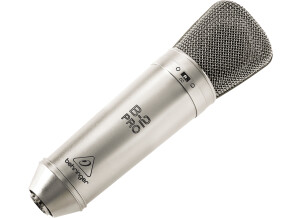
    The Behringer B2 is a budget (low budget) dual diaphragm condenser mic it comes equipped with a carrying case,universal shock mount and a cheap windscreen. I think they should have packaged it with a pop filter as well but that's just my opinion. Here are some of the key features Satin nickle plated body finish 3 pin XLR connection (gold plate) Low freq roll off -10dB input attenuation (switchable) flat frequency response multi pickup patterns: cardioid,omni and figure 8 INEXPENSIVE I've owned this mic for a little over 10 years and it's one of kind. No seriously the one I have really is one of kind. I purchased mic for 200.00 took It to a studio and recorded with it and it was very very similar to the engineers Nueman U87. The b2 wasn't as smooth on the highs but for 200.00 it was close enough. We spent the entire night (free of charge thank god) running test on the Behringer B2 and his Nueman. After that the engineer and I went online and purchased 10 of them each. We figured if they sound this good we could record video footage and toss them up on eBay and make at least $500.00. The reason we could make that is because Nuemans were expensive (up in the thousands) and behringer is known as a company that produces so so music gear (depending on the price range) So what you'd have to do is buy a piece of gear and keep returning it until you got one that quality. It' was a lot of work but once you got one it was worth it. Long story short the condenser mics arrived and out of all 20 mics only 5 were really quality (all different ) but nowhere near as quality as the one I brought in. I think I must have gotten lucky or something. OVERALL OPINION So is the mic worth the time and effort? I say it's worth having as an extra mic in your arsenal but if you are just starting out and you're on a budget stay away from it because for an extra $40.00 (including tax) you can get something like a Rode NT1. The Behringer is just too inconsistent with this model for me to recommend without feeling guilty. Not to mention most stores now a days won't do returns on mics for health reasons so it's best to go with a company or model that is more consistent. Just a little update it seems as if the Behringer B2 was discontinued and replaced by with the Behringer B2-PRO which are consistent and a lot of people are noticing the similarity in clarity it shares with more expensive mics that sit in the $1000-$4,000 Price range.

  • « Good, but try it before you buy it »

    It works fine with instruments and vocals (although it depends on the timbre of the voice, obviously). This was my first condenser mic and I still use it. It has a particular color, but it's impossible for me to tell you exactly what it is, because I have two and they don't sound the same. One is warm and has a nice color, while the other one is very timid or dull I should say. I even bought another one that is outright lifeless. OVERALL OPINION I've used it for four years. I prefer it over some other more prestigious ones. Pros: Value for money Cons: It's a bit like playing the lottery (one sounds good, the other one not so...) But I still recommend it: A mic with this quality and price tag is definitely worth a chance.

  • moosers's review

    The AKG C 430 is a small diaphragm condenser microphone that can be used for both recording and on the stage. I had only used this in the recording studio. Its small design makes it good for drum overheads and for capturing the high end in just about any setting. These are some of the smallest microphones I have seen, which can come in really handy when placing them as you can get it exactly where you want to put it. OVERALL OPINION These microphones were the first set of small diaphragm condensers that I bought for my project home studio. I got them about six or seven years ago and have seen upgraded to another pair of small diaphragm mics. I bought them to use when recording drums, to use as overheads mostly. I have also used them for acoustic guitars and hi hats. The main reason I bought these mics was because I was looking for a cheap set to get started with, and they did more than a good job for me. They are well built are have a really nice sound for such a cheap set of microphones. Since I bought these I have upgraded to a pair of Rode NT5s, which are a bit more expensive and more crisp sounding than these in my opinion. That being said, they are about double the price. You can also compare these to Neumann KM184 because they are similar mics in theory. Obviously the KM184s can't be touched by the C 430s, but they are priced exponentially higher and are made for a different audience. I would definitley recommend looking into these mics for those who are on a budget and want a cheap pair of small diaphragm condensers that will give you more bang for your buck than you think.

  • « Very good first choice »

    Cardioid vocal mic that works with 48V phantom power. It comes with a nice-looking case, inside which is the mic itself and the suspension, as well as spare rubber bands. OVERALL OPINION I've used it for 5 years in my home studio for vocals and some guitar takes. It is my first real mic, so I don't have any reference to compare it to. Before the SC450, I had a Sennheiser MD 43 and I must say it's like night and day... Vocals are picked up fine and the reproduction is dynamic, with no or almost no coloration. I think it's pretty versatile for use with different types of vocals and musical styles. This product is a real bombshell, given its price and, especially, the contents of the box. Not only would I buy it again, I also recommend it to anyone who wants a good mic to start his or her home studio with the right foot.

  • zebzik's review

    This mic is the first preamp version of the 451, which was revolutionary in its time! But despite its technical characteristics (transformerless solid-state preamp, exceptional transients) Well... Despite all that it has a well-known defect, the famous dropouts after some time (you need to cut the phantom power, turn it on again and then everything's fine). The next versions (451 EB, 451B) don't have this defect. OVERALL OPINION Exceptional transients. It's a reference in terms of sound.

Categories that may interest you